- Author: Raymond
- Category: WIBA, GPA and GLA Insurance
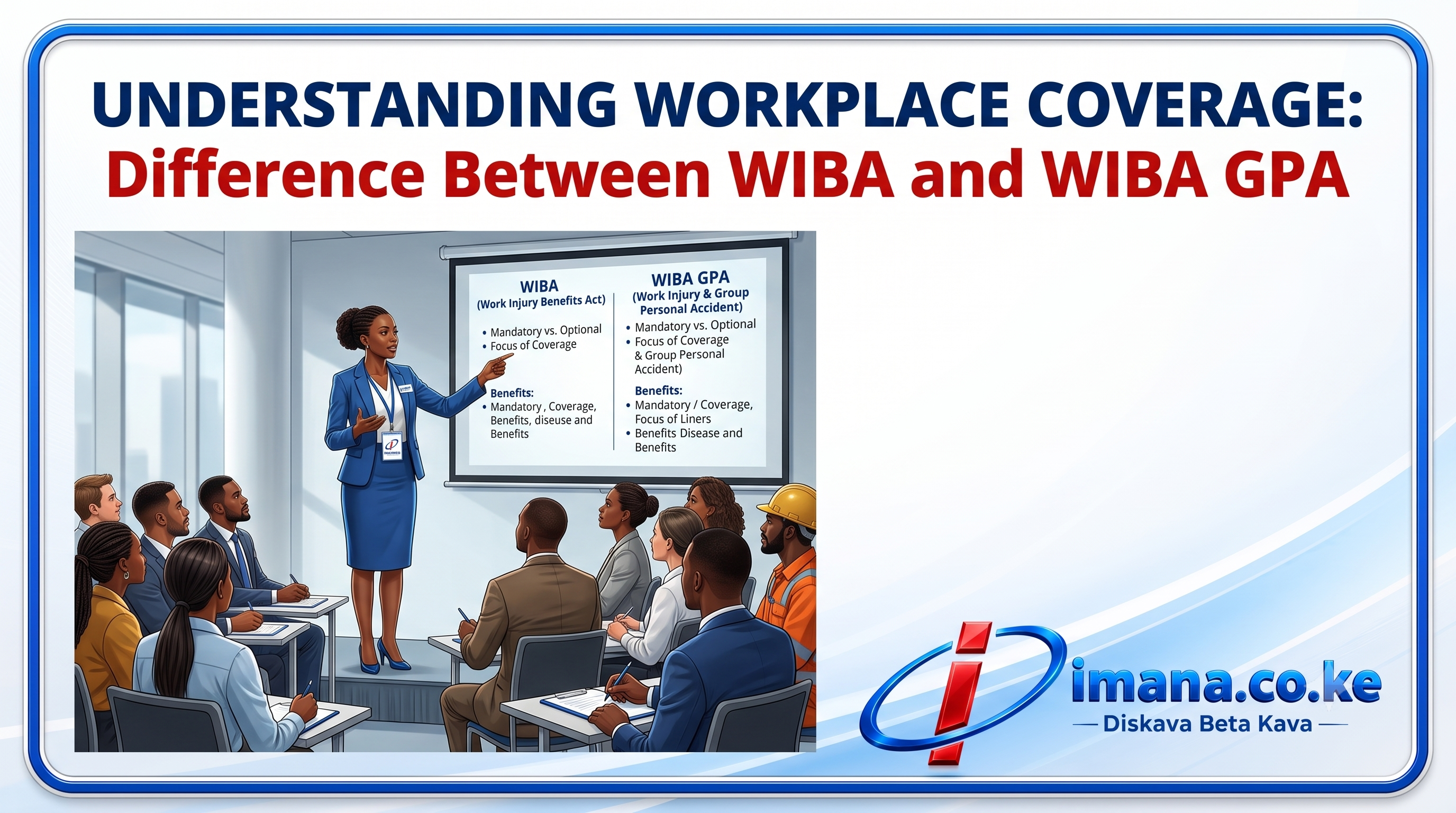
WIBA vs Group Personal Accident Insurance in Kenya
Understand the difference between WIBA and Group Personal Accident Insurance in Kenya. Compare legal requirements, coverage periods, benefits, claims, costs and why employers may need both.
Is WIBA the Same as Group Personal Accident Insurance?
No.
Work Injury Benefits Act Insurance, commonly called WIBA Insurance, and Group Personal Accident Insurance, commonly abbreviated as GPA, both provide protection following injury or death. However, they serve different purposes.
WIBA protects an employer against statutory liabilities arising when an employee suffers a qualifying work-related accident or occupational disease. Kenya’s Work Injury Benefits Act defines a compensable accident as one arising out of and in the course and scope of employment. It also requires employers to maintain appropriate insurance against liabilities incurred under the Act. (Kenya Law)
Group Personal Accident Insurance provides agreed benefits when an insured employee or group member suffers accidental bodily injury, disability or death within the period and territorial scope stated in the policy. Depending on the arrangement, GPA can protect employees for accidents occurring both at work and away from work. Current Kenyan insurer descriptions identify accidental death, permanent disability and certain hospital-related expenses among common GPA benefits. (Britam)
The simplest distinction is:
WIBA addresses the employer’s legal liability for work-related injuries and occupational diseases. GPA provides defined accident benefits under the selected group policy, often on a 24-hour basis.
For many businesses, the correct decision is therefore not necessarily choosing one instead of the other. It may be arranging WIBA for statutory compliance and adding GPA for broader employee protection.
What Is WIBA Insurance?
WIBA Insurance covers an employer’s liability under Kenya’s Work Injury Benefits Act when an employee suffers a qualifying injury, occupational disease, disability or death arising from employment.
Section 7 of the Act requires every employer to obtain and maintain insurance for liabilities that may arise under WIBA. Kenyan courts have repeatedly affirmed this obligation. (Kenya Law)
The cover is connected to:
- The employer
- The employee’s occupation
- The work being performed
- Annual earnings or payroll
- Workplace exposure
- Statutory compensation rules
- Occupational illness and injury
WIBA should therefore be treated as part of an employer’s legal and risk-management responsibilities—not merely an optional employee benefit.
Who is considered an employer?
The legal definition is broad and can include a person, business, company, public body or organisation employing another person under a contract of service.
This means WIBA can be relevant to:
- Companies
- Partnerships
- Sole proprietors
- Schools
- Hospitals
- Shops
- Hotels
- NGOs
- Construction firms
- Professional offices
- Property managers
- Transport companies
- Religious institutions
- Households employing workers
- SMEs with permanent or casual employees
The nature and scale of the business may affect the premium, but having only a small number of employees does not automatically remove the employer’s responsibility.
What Does WIBA Insurance Cover?
Subject to the Act and policy terms, WIBA may address compensation relating to:
Work-related accidental injury
Examples may include:
- An employee falling at the workplace
- A machine operator being injured by equipment
- A delivery employee being injured while carrying out assigned duties
- A cleaner slipping while performing work
- A construction worker being injured at a project site
- An employee being injured during authorised work travel
The incident must have a sufficient connection to the employee’s work.
Occupational disease
WIBA can address diseases that arise out of and in the course of employment, including scheduled occupational diseases and other qualifying work-related illnesses. (Kenya Law)
Examples may include conditions connected to:
- Workplace chemicals
- Repetitive exposure
- Dust
- Excessive noise
- Hazardous materials
- Occupational respiratory exposure
- Other documented workplace causes
The employee or claimant must demonstrate the connection between the condition and the employment.
Temporary disablement
An injury may temporarily prevent an employee from carrying out their work.
WIBA defines temporary disablement as a temporary condition caused by an accident that reduces or removes the employee’s wage-earning capacity in the work performed at the time of the accident. (Kenya Law)
Permanent disablement
Where the injury causes lasting disability, compensation may be assessed according to:
- Degree of disablement
- Employee earnings
- Statutory compensation provisions
- Medical assessment
- Applicable legal procedures
Work-related death
Where a qualifying workplace accident or occupational disease results in death, compensation may become payable to eligible dependants according to the Act.
Medical expenses
Eligible medical treatment connected to the workplace injury may be considered under the statutory framework and policy terms.
Funeral expenses
Specified funeral-related benefits may be payable following a qualifying work-related death, subject to statutory limits and procedures.
What Does WIBA Normally Not Cover?
WIBA is not ordinary 24-hour accident cover.
It generally does not address an accident with no connection to employment.
Examples may include:
- An employee injured while engaging in a personal weekend activity
- An accident during unauthorised private travel
- An injury that occurred before employment
- Ordinary illness unrelated to the workplace
- A personal accident occurring during annual leave
- An accident arising from activities outside the course and scope of employment
The exact decision depends on the facts, employment circumstances and applicable law.
An injury occurring outside the physical workplace can still be work-related. For example, a driver, salesperson, technician or employee attending an authorised meeting may be working away from the main premises.
The key question is not only where the accident happened. It is whether it arose out of and in the course and scope of employment.
What Is Group Personal Accident Insurance?
Group Personal Accident Insurance is a policy arranged for a defined group of people, commonly employees, members or students.
It pays agreed benefits where an insured person suffers accidental bodily injury resulting in outcomes such as:
- Accidental death
- Permanent total disability
- Permanent partial disability
- Temporary total disability
- Medical expenses
- Hospitalisation expenses
- Funeral expenses
- Artificial appliances
- Emergency transportation
The benefits vary considerably between insurers and plans.
Britam describes GPA as a tailor-made group accident scheme covering accidental death, total permanent disability and limited hospital-related expenses. CIC describes personal accident protection as potentially providing benefits for accidental death, permanent disability and temporary disability. (Britam)
Who can be insured under GPA?
A GPA policy may cover groups such as:
- Company employees
- Directors
- Members of an association
- SACCO members
- Church members
- Students
- Sports-club members
- Volunteers
- Contractors
- Casual workers
- Welfare-group members
The insurer will normally require a defined and identifiable group rather than unrelated individuals assembled only for insurance purposes.
Does GPA Cover Employees for 24 Hours?
It can.
Many employers arrange GPA on a 24-hour basis, meaning eligible accidental injuries may be covered whether they occur:
- At work
- At home
- During travel
- On weekends
- During leave
- Outside ordinary working hours
However, 24-hour cover should never be assumed.
The quotation and schedule should confirm:
- Coverage hours
- Territorial limits
- Included employees
- Accident definition
- Covered activities
- Benefits
- Exclusions
Some GPA arrangements may be restricted to occupational or business-hour accidents. Others may provide full 24-hour protection within Kenya or worldwide.
Key Differences Between WIBA and GPA
1. Legal status
WIBA
WIBA Insurance is a statutory employer requirement. Section 7 of the Work Injury Benefits Act obliges employers to maintain insurance for liabilities incurred under the Act. (Kenya Law)
GPA
Group Personal Accident Insurance is generally an optional employee benefit unless required by:
- An employment contract
- Collective bargaining agreement
- Tender
- Client contract
- Membership arrangement
- Organisational policy
GPA does not ordinarily replace mandatory WIBA protection.
2. Main purpose
WIBA
Protects the employer against statutory liability for work-related injury and occupational disease.
GPA
Provides predefined accident benefits to insured employees or members.
3. When cover applies
WIBA
Applies when the accident or disease arises out of and in the course and scope of employment.
GPA
Can apply to accidents occurring at work and outside work, depending on whether the policy provides occupational or 24-hour protection.
4. Occupational disease
WIBA
Can address qualifying occupational diseases connected to employment. (Kenya Law)
GPA
Usually focuses on accidental bodily injury rather than disease. Illness and occupational disease are not automatically included unless the policy expressly provides such benefits.
5. Compensation basis
WIBA
Compensation is determined under the statutory framework and may take account of:
- Employee earnings
- Nature of the injury
- Degree of disability
- Medical assessment
- Dependants
- Statutory limits
GPA
Benefits are normally based on the agreed capital sum insured or fixed limits shown in the policy schedule.
For example, a policy may provide:
- Accidental death: 100% of the capital sum insured
- Permanent total disability: up to 100%
- Permanent partial disability: a percentage based on the benefit scale
- Temporary disability: a weekly benefit
- Medical expenses: a stated limit
The exact percentages and limits depend on the selected policy.
6. Who purchases the cover?
WIBA
The employer purchases it to insure statutory liabilities involving employees.
GPA
An employer, association, school, SACCO or organisation may purchase it to provide benefits to members of the insured group.
7. Who benefits?
WIBA
The employee or eligible dependants receive compensation under the statutory process, while the policy protects the employer’s WIBA liability.
GPA
The insured person or nominated beneficiary receives the agreed policy benefit, subject to the claim terms.
8. Premium basis
WIBA
Premiums are commonly calculated using:
- Annual gross payroll
- Occupations
- Number of employees
- Industry
- Work environment
- Claims history
- Risk controls
GPA
Premiums may be based on:
- Number of members
- Capital sum insured
- Salary multiples
- Occupations
- Age distribution
- Scope of cover
- Claims experience
- Optional benefits
Practical Examples
Example 1: Employee injured by machinery
A factory employee is injured while operating authorised machinery during working hours.
The incident is connected to employment and may fall under WIBA.
Where the employer also has GPA, the employee may potentially receive a separate GPA benefit if the accident falls within that policy’s terms.
The existence of one policy does not automatically prevent the other from responding, although benefits and coordination must be assessed according to both policies.
Example 2: Employee injured during the weekend
An employee suffers an accidental injury on a personal weekend trip.
WIBA would ordinarily not apply because the incident was not connected to employment.
A 24-hour GPA policy may respond, subject to exclusions and the selected benefits.
Example 3: Occupational hearing condition
An employee develops a medically supported hearing condition after prolonged workplace exposure to excessive noise.
WIBA may respond where the condition is established as an occupational disease.
Ordinary GPA may not respond because the condition did not result from a sudden accidental event.
Example 4: Work-related fatal road accident
An employee dies in a road accident while making an authorised business delivery.
Depending on the circumstances, WIBA may apply because the employee was acting within the course of employment.
A GPA policy may also pay an accidental-death benefit if the person was included in the insured group.
Separate Motor Insurance considerations may arise for vehicle damage and third-party liability.
Example 5: Employee falls at home
An employee falls at home during personal time and suffers a permanent disability.
WIBA would ordinarily not apply.
A 24-hour GPA plan may provide permanent-disability compensation based on the selected capital sum insured and benefit schedule.
Can an Employee Claim Under Both WIBA and GPA?
Potentially, yes.
WIBA and GPA respond on different legal and contractual bases.
A workplace accident may trigger:
- The employer’s statutory WIBA liability
- A separate GPA benefit
- Medical Insurance
- Motor Personal Accident benefits
- Group Life benefits where death occurs
- Other relevant employee-benefit policies
Whether multiple benefits are payable depends on:
- The circumstances of the accident
- Policy wording
- Benefit type
- Coordination clauses
- Statutory rules
- Whether a benefit is indemnity-based or fixed
Fixed accidental-death or disability benefits may operate differently from reimbursement of actual medical expenses.
Employers should notify every potentially relevant insurer rather than assuming only one policy can respond.
What Is WIBA Plus?
WIBA Plus is a combined or enhanced product that generally joins statutory WIBA protection with additional Group Personal Accident benefits.
The exact structure varies between insurers.
A WIBA Plus policy may provide:
- Statutory WIBA protection
- 24-hour accidental-death benefits
- Permanent-disability benefits
- Temporary-disability benefits
- Additional medical expenses
- Funeral expenses
- Other selected employee benefits
Current Kenyan insurer product pages present WIBA Plus and GPA as enhanced accident solutions alongside ordinary WIBA. Britam also describes combined employee protection that maintains mandatory WIBA while adding GPA or Group Life benefits for events unrelated to occupation. (CIC Kenya)
Why employers consider WIBA Plus
It can simplify the insurance arrangement by combining:
- Legal compliance for workplace injury.
- Broader protection for non-work accidents.
- Additional employee-benefit limits.
- One coordinated policy or renewal process.
However, employers should inspect the schedule carefully because the additional GPA benefits may be lower than those available under a dedicated standalone GPA policy.
WIBA, GPA and Group Life: What Is the Difference?
These three products are often confused.
WIBA
Addresses qualifying work-related injury, occupational disease, disability and death under the statutory framework.
GPA
Pays agreed benefits following accidental injury, disability or death.
Group Life
Pays a death benefit under the policy, whether death results from illness or accident, subject to the terms and exclusions.
An employee who dies from an ordinary illness may not have a WIBA or GPA claim, but the Group Life policy may respond.
A broad employee-benefits programme can therefore combine:
- WIBA
- GPA
- Group Life
- Group Medical
- Last Expense
- Pension or retirement benefits
Each product addresses a different financial risk.
WIBA vs Employer’s Liability
WIBA should also not be confused with Employer’s Liability Insurance.
WIBA
Addresses the employer’s statutory liabilities under the Work Injury Benefits Act.
Employer’s Liability
May protect the employer against eligible common-law claims alleging negligence or failure to provide a safe working environment, subject to the selected wording.
Kenya’s Occupational Safety and Health Act imposes responsibilities on employers and employees concerning workplace safety, protective equipment, procedures and accident reporting. Insurance does not remove these safety obligations. (Kenya Law)
Some businesses arrange:
- WIBA
- Employer’s Liability
- GPA
This can provide broader protection than relying on one section alone.
Benefits Commonly Available Under GPA
Accidental death
The policy may pay the agreed death benefit to the nominated beneficiary or estate following an eligible accidental death.
Permanent total disability
This benefit may become payable where an accident results in a disability that permanently prevents the insured person from performing gainful work, based on the policy definition.
Permanent partial disability
A proportion of the capital sum insured may be paid for specified permanent injuries.
The percentage normally follows a benefit table.
Temporary total disability
The policy may pay a weekly amount where an accident temporarily prevents the insured person from working.
The benefit may be subject to:
- A waiting period
- Weekly maximum
- Maximum number of weeks
- Medical certification
- Salary-related limits
Medical expenses
The policy may reimburse eligible accidental-injury treatment up to a specified limit.
Medical expenses are often lower than the accidental-death or disability benefit and should not be confused with full medical insurance.
Funeral expenses
A fixed funeral benefit may be included following accidental death.
Artificial appliances
Some policies may contribute towards artificial limbs, wheelchairs or similar appliances after an insured accident.
Emergency evacuation
Emergency transport may be available where expressly included.
Common GPA Exclusions
Depending on the insurer, GPA may exclude or restrict:
- Illness or disease
- Pre-existing disability
- Deliberate injury
- Criminal activity
- Intoxication
- War
- Certain political risks
- Hazardous sports
- Aviation other than as a fare-paying passenger
- Unauthorised occupations
- Accidents occurring outside the territorial limits
- Failure to seek timely medical treatment
- Activities not disclosed to the insurer
Employees involved in high-risk activities should be declared accurately.
Examples include:
- Construction at height
- Mining
- Quarrying
- Security work
- Aviation
- Offshore work
- Heavy machinery operation
- Hazardous chemicals
- Professional sports
How WIBA Premiums Are Calculated
WIBA premiums are normally calculated using the employer’s estimated annual gross payroll and occupational categories.
The insurer may request:
- Employee numbers
- Job titles
- Annual earnings
- Work locations
- Nature of business
- Casual labour
- Subcontracted workers
- Claims history
- Safety controls
Different occupations attract different rates.
An office administrator generally presents lower workplace-injury exposure than:
- A construction worker
- Welder
- Driver
- Security guard
- Machine operator
- Quarry worker
- Roofer
The employer should separate employees into accurate occupational classes instead of applying one description to the entire workforce.
How GPA Premiums Are Calculated
The premium may depend on:
- Number of employees
- Occupations
- Capital sum insured
- Salary multiples
- Scope of cover
- Medical-expense limit
- Temporary-disability benefit
- Territorial area
- Claims history
- Age profile
- Hazardous activities
The employer can structure benefits as:
- Fixed amount for every employee
- Multiple of annual salary
- Different limits for employee categories
- Graded benefits for management and other staff
Care must be taken to avoid unfair or unexplained benefit differences.
Information Required for WIBA and GPA Quotations
Employers should prepare an accurate employee schedule containing:
- Employee name or identification number
- Occupation
- Department
- Work location
- Gross monthly or annual earnings
- Date of birth where required
- Employment category
- Required capital sum insured
- Previous claims
- Temporary or casual worker details
The business may also need to provide:
- Registered company name
- KRA PIN
- Business registration documents
- Nature of operations
- Physical locations
- Existing policy
- Claims experience
- Workplace safety information
- Required policy period
Incomplete payroll information can produce a misleading premium and create difficulties during a claim.
Should Casual Workers Be Included?
Employers should disclose casual, temporary, seasonal and contract workers who fall within the applicable employment and insurance framework.
Construction, agriculture, hospitality, events and manufacturing businesses frequently use temporary labour. Excluding these workers from the declared payroll can create a serious insurance gap.
The insurer should be told:
- Estimated number of casual workers
- Nature of duties
- Estimated earnings
- Periods of engagement
- Work sites
Do not assume a worker is outside WIBA simply because they are paid daily.
What Employers Should Do After a Workplace Accident
1. Provide immediate assistance
Arrange appropriate first aid, emergency transport and medical care.
2. Make the workplace safe
Prevent further injury without destroying important evidence.
3. Record the incident
Document:
- Date and time
- Location
- Employee’s duties
- Witnesses
- Machinery involved
- Photographs
- Safety equipment
- Supervisor’s report
4. Notify the insurer
Inform the insurer or insurance intermediary immediately.
5. Report to the relevant labour authority
WIBA requires employers to report work-related injuries through the applicable statutory procedure. Kenyan courts have noted that sections 21 and 22 impose reporting obligations in relation to work injuries. (Kenya Law)
6. Preserve evidence
Keep:
- CCTV footage
- Equipment
- Maintenance records
- Training records
- Employment records
- Medical documents
- Witness information
7. Avoid suppressing the incident
Failure to report or attempts to conceal an injury can worsen the legal and financial position.
Documents Commonly Required for a WIBA Claim
The insurer or relevant authority may request:
- WIBA claim forms
- Employer’s accident report
- Employee identification
- Employment contract
- Payroll records
- Medical report
- Treatment invoices
- Sick-off records
- Witness statements
- Police abstract where applicable
- Death certificate
- Post-mortem report where applicable
- Dependants’ documents
- Occupational-safety records
- Disability assessment
Requirements depend on the nature and severity of the claim.
Documents Commonly Required for a GPA Claim
These may include:
- Completed claim form
- Policy schedule
- Insured-member schedule
- Medical report
- Treatment receipts
- Police abstract
- Proof of earnings
- Disability assessment
- Death certificate
- Post-mortem report
- Beneficiary identification
- Employer’s incident report
- Proof of relationship
- Bank details
CIC maintains separate claim documentation for personal and group accident claims, illustrating that GPA follows its contractual claims procedure rather than the statutory WIBA process alone. (CIC Kenya)
Common Employer Mistakes
Buying GPA and assuming WIBA is unnecessary
GPA does not ordinarily satisfy the employer’s statutory WIBA requirement.
Buying WIBA and assuming employees are covered for every accident
Ordinary WIBA is connected to employment. Personal accidents away from work may require GPA.
Under-declaring payroll
This can produce underinsurance, additional premium or claim disputes.
Using incorrect occupations
Describing construction workers as office staff will misrepresent the risk.
Excluding casual employees
Temporary workers may still create employer liability.
Failing to update the insurer
Notify the insurer when:
- Payroll increases
- New occupations are introduced
- The business opens another site
- Employees begin higher-risk duties
- New machinery is installed
- Operations expand
Reporting claims late
Prompt notification helps preserve evidence and meet statutory requirements.
Treating insurance as a substitute for safety
Insurance does not excuse unsafe equipment, inadequate training or failure to provide protective gear.
Which Policy Should an Employer Choose?
Choose WIBA where:
- The organisation employs workers.
- Statutory work-injury compliance is required.
- The business wants protection against WIBA liabilities.
- Employees face workplace or occupational-disease exposure.
In practice, employers should treat WIBA as foundational protection.
Add GPA where:
- The employer wants 24-hour accident protection.
- Employees travel frequently.
- The organisation wants fixed death and disability benefits.
- The business wants stronger employee benefits.
- Non-work accidents could financially affect employees and their families.
Consider WIBA Plus where:
- The employer wants statutory WIBA and basic GPA benefits combined.
- Administrative simplicity is important.
- The included GPA limits are adequate.
- The insurer provides suitable 24-hour protection.
Consider separate WIBA and GPA where:
- Higher GPA limits are required.
- Different employee categories need different benefits.
- The employer wants more flexible coverage.
- The combined policy’s GPA limits are too restrictive.
How to Compare WIBA and GPA Quotations
Ensure each insurer receives the same:
- Employee numbers
- Occupations
- Annual payroll
- Work locations
- Claims history
- GPA capital sums
- Required extensions
Then compare:
WIBA section
- Statutory scope
- Occupational-disease protection
- Medical-expense provisions
- Funeral benefit
- Payroll basis
- Occupation rates
- Claims procedure
- Territorial scope
- Excesses
- Employer’s Liability extension
GPA section
- Accidental-death benefit
- Permanent-disability benefit
- Temporary-disability benefit
- Medical-expense limit
- Funeral benefit
- Coverage hours
- Territorial scope
- Hazardous-occupation restrictions
- Age limits
- Exclusions
A cheaper quotation may have:
- Lower GPA limits
- No temporary-disability benefit
- Restricted occupations
- Occupational-only cover
- Smaller medical limits
- Narrow territorial protection
How Imana Helps Employers Compare WIBA and GPA Insurance
Imana Insurance Agency Kenya Ltd helps employers, SMEs, schools, NGOs, contractors and corporate organisations compare WIBA, GPA and combined WIBA Plus quotations from suitable licensed insurers.
The process may include:
- Reviewing the organisation’s workforce.
- Classifying employee occupations.
- Confirming annual payroll.
- Identifying workplace risks.
- Selecting suitable GPA limits.
- Comparing WIBA, GPA and WIBA Plus structures.
- Reviewing premiums, benefits and exclusions.
- Coordinating policy issuance.
- Supporting endorsements and renewals.
- Guiding the employer during claim notification.
Imana can also help coordinate related employee protection, including:
- Group Medical Insurance
- Group Life Insurance
- Employer’s Liability
- Last Expense
- Key-Person Insurance
- Corporate Travel Insurance
- Commercial Motor Insurance
- Public Liability
Insurance should be placed with properly licensed insurers and intermediaries. The Insurance Regulatory Authority regulates and supervises Kenya’s insurance industry and provides an online registry of licensed entities. (ira.go.ke)
WIBA and GPA Insurance in Westlands and Across Kenya
Imana Insurance Agency Kenya Ltd
4th Floor, Krishna Centre
Woodvale Grove, Westlands
Nairobi, Kenya
Imana supports employers in:
- Westlands
- Parklands
- Riverside
- Nairobi CBD
- Industrial Area
- Kiambu
- Machakos
- Kajiado
- Mombasa
- Nakuru
- Kisumu
- Eldoret
- Other counties across Kenya
Website: www.imana.co.ke
Call or WhatsApp: +254 796 209 402
Compare quotations. Understand the differences. Protect your employees. Let Imana handle the rest.
Frequently Asked Questions
Is WIBA Insurance compulsory in Kenya?
Yes. Section 7 of the Work Injury Benefits Act requires every employer to maintain insurance against liabilities incurred under the Act. (Kenya Law)
Is GPA Insurance compulsory?
GPA is generally optional unless required by a contract, employment arrangement, tender or organisational policy.
Does GPA replace WIBA?
No. GPA provides contractual accident benefits but does not ordinarily replace mandatory WIBA protection.
Does WIBA cover employees outside work?
Ordinary WIBA applies to injuries or diseases arising out of and in the course and scope of employment. A personal accident unrelated to work may require GPA.
Does GPA cover employees for 24 hours?
It may. Confirm that the quotation expressly provides 24-hour cover.
Does WIBA cover occupational diseases?
Yes, qualifying occupational diseases arising from employment may be compensable under the Act. (Kenya Law)
Does GPA cover illness?
Ordinary GPA primarily covers accidental bodily injury. Illness is generally not covered unless the policy expressly includes it.
Can an employee receive both WIBA and GPA benefits?
Potentially, where the same accident satisfies the requirements of both policies. Each claim is assessed independently under the applicable law and wording.
What is WIBA Plus?
It is an enhanced or combined arrangement that usually includes statutory WIBA protection together with selected GPA benefits.
Are casual workers covered?
They should be declared where they fall within the employer’s workforce and legal obligations. Employers should not omit casual labour from the quotation without professional guidance.
How is the WIBA premium calculated?
It is generally based on annual payroll, occupations, industry, work locations, claims history and workplace exposure.
How is the GPA benefit calculated?
GPA benefits are generally based on the agreed capital sum insured, salary multiple or fixed benefits shown in the schedule.
Can Imana compare WIBA and GPA quotations?
Yes. Imana can compare standalone WIBA, standalone GPA and combined WIBA Plus options from suitable insurers.
The Bottom Line
WIBA and Group Personal Accident Insurance protect employees in different ways.
WIBA:
- Is a statutory employer requirement
- Focuses on work-related injury and occupational disease
- Uses the legal compensation framework
- Protects the employer’s liability
GPA:
- Is generally an optional employee benefit
- Can provide 24-hour accident protection
- Pays agreed death, disability and medical benefits
- Can cover accidents unrelated to work
A responsible employer should begin with WIBA compliance and then assess whether GPA is needed to close the protection gap outside working hours.
WIBA protects employees where work creates the risk. GPA can protect them wherever an insured accident happens. Together, they can provide broader financial security.
Imana Insurance Agency Kenya Ltd
4th Floor, Krishna Centre, Woodvale Grove, Westlands, Nairobi
Call or WhatsApp: +254 796 209 402
Website: www.imana.co.ke
Understand the legal requirement. Compare the employee benefits. Choose suitable protection. Let Imana handle the rest.
WIBA and Group Personal Accident premiums, compensation limits, benefits, territorial scope, age limits, exclusions and claims requirements vary. WIBA obligations are governed by applicable law, while GPA benefits are governed by the selected insurance policy. Obtain current written quotations, schedules and full policy wordings before purchasing cover.