- Author: Raymond
- Category: Insurance in Kenya
Most Common Insurance Questions and Answers in Kenya
Get clear answers to common insurance questions in Kenya, including motor, medical, WIBA, claims, premiums, excesses, exclusions and choosing an insurer.
Understanding Insurance in Simple Terms
Insurance can appear complicated because policies contain technical terms, conditions, exclusions, limits and claims procedures.
Many customers buy insurance because it is legally required, demanded by a bank or requested by an employer. Others purchase cover because they want protection against risks that could cause serious financial loss.
The most important step is understanding what you are buying before paying the premium.
This guide answers some of the questions that individuals, families, motorists, employers and businesses commonly ask about insurance in Kenya.
Insurance works best when you understand the risk, compare suitable options and follow the policy conditions.
General Insurance Questions
1. What is insurance?
Insurance is a contract through which an insurer agrees to provide specified financial protection against particular risks in exchange for a premium.
The contract is documented through:
- A proposal or application
- A quotation
- A policy schedule
- A certificate, where applicable
- The full policy wording
- Endorsements or amendments
The insurer does not promise that nothing bad will happen. It agrees to respond when an event covered by the policy occurs, subject to the limits, excesses, conditions and exclusions.
2. Why do I need insurance?
Insurance helps protect you against losses that may be difficult to pay from your savings.
It can protect:
- Your vehicle
- Home and belongings
- Medical expenses
- Business property
- Employees
- Goods in transit
- Professional liabilities
- Construction projects
- Travel expenses
- Legal liability to other people
The right question is not simply whether you can afford the premium.
Ask:
Can I comfortably carry the full financial loss if the insured asset is damaged, stolen or involved in a liability claim?
3. Is every type of insurance compulsory in Kenya?
No.
Some covers are legally compulsory, while others are optional or required by contracts.
Examples of compulsory insurance include:
- Motor third-party insurance for vehicles used on public roads
- WIBA insurance for employers
Kenya’s motor-insurance legislation requires vehicles used on roads to have insurance against specified third-party risks. The Work Injury Benefits Act requires every employer to maintain insurance against liabilities arising under the Act. (Kenya Law)
Other covers may be required by:
- Banks
- Asset financiers
- Landlords
- Project owners
- Tender documents
- Professional regulators
- Client contracts
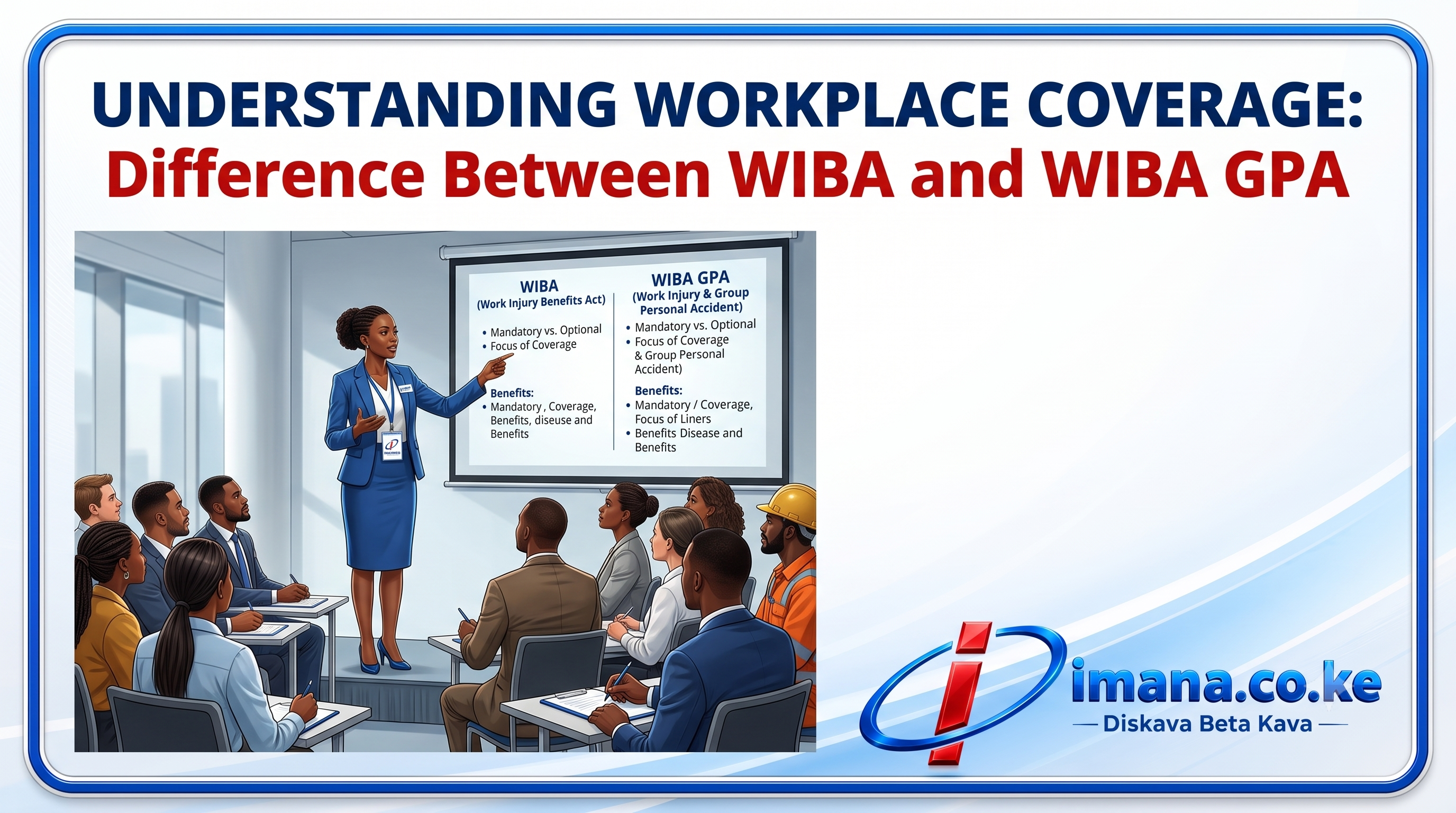
4. What is an insurance premium?
A premium is the amount paid to obtain insurance protection.
It may be calculated using factors such as:
- Value of the property
- Type of risk
- Age of the insured person
- Claims history
- Business turnover
- Employee payroll
- Vehicle class
- Policy period
- Selected benefits
- Applicable excess
A higher premium does not automatically mean better insurance, and a cheaper premium does not necessarily mean poor cover.
The full benefits, limits, exclusions and excesses must be compared.
5. What is a sum insured?
The sum insured is the financial value declared under the policy.
It may represent:
- Vehicle value
- Building replacement cost
- Value of contents
- Value of goods
- Machinery replacement cost
- Medical benefit limit
- Liability limit
The sum insured is not always the amount automatically payable after a claim.
Settlement depends on:
- Actual loss
- Market or replacement value
- Policy limits
- Underinsurance
- Excess
- Depreciation or betterment where applicable
- Salvage
- Other policy conditions
6. What is an insurance excess?
An excess is the part of an approved claim that the policyholder must contribute.
For example:
- Approved repair cost: KSh 250,000
- Policy excess: KSh 25,000
- Policyholder contribution: KSh 25,000
- Eligible insurer contribution: KSh 225,000
A policy can contain different excesses for:
- Accidental damage
- Theft
- Flood
- Young drivers
- Property damage
- Particular types of equipment
Compare excesses as carefully as premiums.
7. What is an exclusion?
An exclusion is a loss, event, activity or circumstance that the policy does not cover.
Common exclusions may include:
- Wear and tear
- Deliberate damage
- Fraud
- Illegal activity
- Mechanical breakdown
- Undisclosed commercial use
- Existing damage
- War
- Unauthorised drivers
- Treatment during a waiting period
- Poor maintenance
Exclusions differ between policies.
Do not rely only on an advert or summary. Request the full wording.
8. What is an insurance limit?
A limit is the maximum amount payable for a particular benefit or claim.
A policy may have:
- Overall annual limit
- Per-person limit
- Per-incident limit
- Per-vehicle limit
- Per-item limit
- Medical sublimit
- Liability aggregate
For example, a medical policy with a KSh 1 million inpatient limit may have a smaller limit for dental, optical, chronic illness or maternity treatment.
9. What is underinsurance?
Underinsurance occurs when property is insured for less than its correct value.
Suppose business equipment worth KSh 10 million is insured for KSh 5 million.
If the policy contains an average condition, the insurer may reduce even a partial claim because only half of the true value was insured.
Underinsurance can affect:
- Buildings
- Vehicles
- Stock
- Machinery
- Business interruption
- Goods in transit
Review insured values regularly, especially after inflation, renovations or business growth.
10. What is overinsurance?
Overinsurance occurs when property is insured for more than its reasonable value.
Paying a premium based on an inflated value does not normally allow the policyholder to make a profit after a claim.
Insurance is generally intended to restore the insured to approximately the financial position held before the loss, subject to the policy.
Use realistic values when requesting quotations.
Buying and Comparing Insurance
11. How do I choose a good insurance policy?
Start by identifying:
- What you want to protect
- The risks you face
- How much loss you can afford
- The benefits you require
- Your preferred budget
- Contractual or legal requirements
Then compare:
- Premium
- Sum insured
- Excesses
- Limits
- Exclusions
- Waiting periods
- Claims procedure
- Provider or garage network
- Optional extensions
- Payment terms
Do not automatically select the lowest premium.
12. Should I compare quotations from different insurers?
Yes.
Insurers may assess the same risk differently because they have different:
- Premium rates
- Minimum premiums
- Excesses
- Benefits
- Underwriting appetite
- Claims requirements
- Provider networks
- Optional extensions
Every insurer should receive the same information so that the comparison is fair.
13. Why are insurance quotations different?
Quotations may differ because of:
- Risk assessment
- Claims experience
- Vehicle or property value
- Customer profile
- Business activity
- Security controls
- Insurer appetite
- Selected benefits
- Policy excess
- Minimum premium
A lower quotation may contain fewer benefits or a higher excess.
14. What information should I disclose?
Disclose all material information that could influence the insurer’s decision.
Examples include:
- Previous claims
- Existing damage
- Medical conditions
- Commercial use of a vehicle
- Employee occupations
- Business activities
- Property security
- Construction type
- Goods being transported
- Changes in vehicle use
Incorrect or incomplete information can affect a claim.
15. Can I buy insurance through an agent?
Yes.
A licensed insurance agent helps customers obtain insurance through an underwriting insurer.
An intermediary may assist with:
- Understanding the risk
- Obtaining quotations
- Comparing options
- Submitting documents
- Policy issuance
- Amendments
- Renewals
- Claims guidance
The insurer remains responsible for underwriting the policy and assessing eligible claims.
The Insurance Regulatory Authority supervises insurance business in Kenya and provides licensing and consumer-protection resources. (Insurance Regulatory Authority)
16. How do I know whether an insurance company or intermediary is licensed?
Check the current licensing information published by the Insurance Regulatory Authority.
Before paying, confirm:
- Underwriting insurer’s name
- Intermediary’s registered name
- Official payment details
- Policy number
- Receipt
- Certificate
- Cover period
Avoid paying insurance premiums through unverified individuals or personal accounts.
17. When does insurance cover begin?
Cover begins on the effective date and time confirmed by the insurer.
Payment alone does not always mean that every benefit is immediately active.
Confirm:
- Insurer’s acceptance
- Policy start date
- Certificate
- Waiting periods
- Inspection requirements
- Outstanding documents
- Premium-payment conditions
Medical and life policies may contain waiting periods even after the policy starts.
18. Can insurance start before I pay?
This depends on the policy and insurer.
Some insurance contracts require full payment before cover begins. Others may allow an approved instalment or credit arrangement.
Never assume that a verbal promise creates cover.
Obtain written confirmation.
19. Can I pay insurance in instalments?
Some insurers permit instalments for selected policies, particularly comprehensive motor, medical, property and corporate insurance.
The arrangement may require:
- Initial deposit
- Agreed payment dates
- Additional charges
- Standing order
- Premium-financing agreement
- Cancellation after default
Compare the total instalment cost with the single-payment premium.
20. Can I cancel my insurance?
Cancellation may be possible, subject to the policy terms.
The insurer may consider:
- Time already covered
- Whether a claim has occurred
- Administrative charges
- Minimum retained premium
- Financier’s interest
- Legal or contractual requirements
Compulsory or financed insurance may require approval before cancellation.
Motor Insurance Questions
21. Is motor insurance compulsory in Kenya?
Yes. A vehicle used on a public road must have insurance satisfying Kenya’s third-party-risk requirements, subject to limited statutory exceptions. (Kenya Law)
The minimum legal requirement does not ordinarily protect your own vehicle from accidental damage, theft or fire.
22. What is third-party motor insurance?
Third-Party Only insurance protects against specified legal liabilities involving other people.
It may respond to eligible claims for:
- Third-party bodily injury
- Third-party death
- Third-party property damage
- Approved legal expenses
It does not normally pay to repair your own vehicle after an accident.
23. What is comprehensive motor insurance?
Comprehensive insurance normally combines third-party liability with protection for your own vehicle against insured risks such as:
- Accidental damage
- Theft
- Fire
- Malicious damage
- Other listed risks
The policy still contains exclusions, excesses and conditions.
“Comprehensive” does not mean every loss is covered.
24. Does comprehensive insurance cover mechanical breakdown?
Ordinarily, no.
Mechanical and electrical breakdown, wear and tear and gradual deterioration are commonly excluded.
If an insured accident causes mechanical damage, the resulting loss may be considered differently from an internal breakdown occurring without an external accident.
25. Can I insure an old vehicle comprehensively?
Possibly.
Acceptance may depend on:
- Vehicle age
- Condition
- Current value
- Availability of spare parts
- Inspection
- Valuation
- Insurer’s underwriting criteria
An insurer may offer comprehensive, third party fire and theft, or third-party cover depending on the vehicle.
26. Why does my car need a valuation?
A valuation helps establish:
- Current market value
- Vehicle condition
- Existing damage
- Accessories
- Correct identification details
- Recommended sum insured
It reduces the risk of overinsurance, underinsurance and disputes during claims.
27. Does motor insurance cover any driver?
Not necessarily.
The policy may restrict drivers by:
- Age
- Licence status
- Driving experience
- Named-driver condition
- Authorised use
- Vehicle class
Always ensure the driver has a valid licence and permission to use the vehicle.
28. Can private-car insurance cover Uber or Bolt use?
Ordinarily, no.
A vehicle carrying passengers for hire or reward should be insured under the appropriate PSV or taxi classification.
Using a private policy for commercial passenger transport may affect a claim.
29. Does third-party insurance cover my passengers?
Passenger protection depends on:
- Vehicle class
- Policy wording
- Legal requirements
- Passenger-liability section
PSV, taxi, matatu and bus policies require appropriate passenger-related protection.
30. What should I do immediately after a road accident?
Take these steps:
- Confirm that everyone is safe.
- Obtain medical help where required.
- Secure the scene without putting yourself in danger.
- Take photographs and videos.
- Record the vehicles and drivers involved.
- Obtain witness contacts.
- Report to the police where required.
- Notify the insurer or intermediary promptly.
- Do not admit liability or negotiate a settlement without approval.
- Preserve all documents and communication.
Insurance Claims Questions
31. What is an insurance claim?
A claim is a formal request asking an insurer to respond to a loss covered by the policy.
The insurer assesses:
- Whether the policy was active
- How the incident occurred
- Whether the risk was covered
- Whether exclusions apply
- Whether conditions were followed
- Value of the loss
- Applicable excess
- Supporting evidence
Submitting a claim does not automatically guarantee payment.
32. What documents are normally required for a claim?
Requirements depend on the type of insurance.
Common documents may include:
- Claim form
- Policy schedule
- Identification documents
- Police abstract
- Photographs
- Medical reports
- Repair quotations
- Purchase receipts
- Valuation report
- Proof of ownership
- Witness statements
- Invoices
- Incident report
- Demand letter
Ask for the claim-document checklist immediately after notification.
33. How long does an insurance claim take?
There is no single period applicable to every claim.
Timing depends on:
- Type and size of claim
- Completeness of documents
- Investigation
- Liability disputes
- Medical assessment
- Repairs or quotations
- Police records
- Third-party involvement
- Fraud concerns
- Policy interpretation
Submitting complete documents quickly can reduce avoidable delays.
34. Why do insurance claims get delayed?
Common causes include:
- Missing documents
- Late notification
- Inconsistent information
- Unclear cause of loss
- Delayed police records
- Repair quotations not received
- Investigation
- Liability dispute
- Lack of ownership evidence
- Policy or premium issues
Ask the insurer or intermediary to identify outstanding requirements in writing.
35. Why can an insurance claim be declined?
A claim may be declined because:
- The event is excluded.
- The policy was inactive.
- Premium conditions were not met.
- The loss occurred before cover began.
- The policyholder failed to disclose material facts.
- The property was used differently from what was declared.
- The claim involved deliberate damage or fraud.
- The claimant failed to prove the loss.
- A waiting period had not ended.
- The insured failed to follow a policy warranty.
A decline should be explained with reference to the policy wording.
36. Can I repair damaged property before the insurer inspects it?
Avoid major repairs before receiving the insurer’s approval.
You may take reasonable emergency action to:
- Protect people
- Prevent further damage
- Secure the property
- Move goods away from danger
Take photographs and preserve evidence.
The insurer may appoint a loss adjuster, assessor, engineer or investigator.
37. What is a loss adjuster?
A loss adjuster is a professional appointed to investigate and assess a claim.
The adjuster may:
- Visit the scene
- Interview parties
- Review documents
- Confirm the cause
- Assess damage
- Estimate repair or replacement cost
- Review policy terms
- Recommend a settlement
The final claim decision is generally made by the insurer.
38. What is salvage?
Salvage is damaged property that still has some value after a claim.
Examples include:
- A written-off vehicle
- Damaged machinery
- Partly damaged stock
- Recoverable building materials
The insurer may retain, sell or deduct the salvage value depending on the settlement arrangement.
39. What can I do if I disagree with the insurer?
Begin by requesting:
- Written claim decision
- Reason for the decision
- Relevant policy clauses
- Claim calculation
- Outstanding requirements
Use the insurer’s internal complaints process first.
Where the matter remains unresolved, the policyholder may lodge a complaint with the Insurance Regulatory Authority. The IRA handles complaints involving issues such as liability disputes, settlement amounts and delays in paying claims. (Insurance Regulatory Authority)
40. Can I complain directly to the IRA?
Yes.
The IRA provides a consumer complaint procedure and online complaint form. It advises complainants to provide relevant details and supporting documentation. (Insurance Regulatory Authority)
You should retain:
- Policy documents
- Claim correspondence
- Insurer’s decision
- Receipts
- Medical or repair records
- Complaint reference
- Other supporting evidence
Medical Insurance Questions
41. What does medical insurance cover?
Depending on the plan, medical insurance may include:
- Inpatient treatment
- Outpatient treatment
- Maternity
- Dental care
- Optical care
- Chronic illnesses
- Pre-existing conditions
- Emergency evacuation
- Last expense
- Overseas treatment
Every benefit is subject to its limit, network, waiting period and exclusions.
42. What is a medical insurance waiting period?
A waiting period is the time after a policy begins during which a particular benefit is not yet available.
Waiting periods may apply to:
- General illness
- Maternity
- Surgery
- Chronic conditions
- Pre-existing conditions
- Cancer treatment
- Dental procedures
Accidental injury may begin immediately under some plans, but this must be confirmed.
43. Does medical insurance cover pre-existing conditions?
Some policies do, while others exclude them or cover them after a waiting period.
Protection may be subject to:
- Medical underwriting
- Separate sublimit
- Co-payment
- Waiting period
- Restricted providers
- Additional premium
Always disclose existing medical conditions.
44. Can I buy maternity cover when already pregnant?
You may be accepted for a medical policy, but the existing pregnancy will ordinarily not qualify if the maternity waiting period cannot be completed before delivery.
Maternity cover should be arranged before pregnancy.
45. What is a hospital network?
A hospital network is the list of healthcare providers approved under a particular medical plan.
A hospital appearing on an insurer’s general panel does not necessarily mean it is available under every benefit option.
Confirm access to your preferred:
- Hospital
- Clinic
- Pharmacy
- Specialist
- Diagnostic centre
46. What is a medical co-payment?
A co-payment is the amount the insured person pays when receiving treatment.
It may be:
- Fixed amount per visit
- Percentage of the bill
- Applicable at selected hospitals
- Applicable to specific services
Frequent co-payments can materially increase annual out-of-pocket costs.
47. What is medical pre-authorisation?
Pre-authorisation is approval obtained before certain treatments or admissions.
It may be required for:
- Planned hospital admission
- Surgery
- MRI or CT scan
- Specialist treatment
- Overseas care
- Expensive medicine
Emergency treatment may follow a different notification procedure.
48. Can I have SHA and private medical insurance?
Yes.
SHA operates under Kenya’s statutory health-financing framework, while private medical insurance is a separate commercial contract.
A private plan may supplement SHA through:
- Additional limits
- Wider provider options
- Outpatient benefits
- Maternity
- Dental and optical
- Other stated benefits
The current SHA regulations address the funds, healthcare benefits, provider empanelment, tariffs and claims procedures within the statutory system. (Kenya Law)
49. Can I insure my child without insuring myself?
Some insurers and microhealth providers offer child-only medical plans.
Eligibility may depend on:
- Child’s age
- Principal payer
- Required identification
- Benefit limits
- Waiting periods
- Provider network
Compare child-only cover with adding the child to a family policy.
50. Can parents above 60 get medical insurance?
Yes.
Several insurers offer senior medical options, subject to:
- Entry age
- Renewal age
- Medical examination
- Pre-existing conditions
- Waiting periods
- Co-payments
- Benefit limits
Apply before the parent exceeds the maximum entry age.
Employment and Business Insurance Questions
51. Is WIBA Insurance compulsory?
Yes.
Every employer is required to obtain and maintain insurance covering liabilities arising under the Work Injury Benefits Act, unless a lawful exemption and approved security apply. (Kenya Law)
52. Does WIBA cover accidents outside work?
Ordinary WIBA applies to qualifying injuries and diseases arising out of and in the course and scope of employment.
A separate Group Personal Accident policy can provide broader 24-hour accident benefits, depending on its terms.
53. Are casual workers covered under WIBA?
Employers should disclose casual, temporary and seasonal workers who fall within the employment relationship and applicable legal framework.
Paying someone daily does not automatically eliminate the employer’s potential responsibility.
54. What is Public Liability Insurance?
Public Liability Insurance protects a business against eligible legal claims where a third party suffers accidental injury, death or property damage connected to the business.
It may be relevant to:
- Shops
- Restaurants
- Hotels
- Offices
- Contractors
- Schools
- Property owners
- Event organisers
55. What is Professional Indemnity Insurance?
Professional Indemnity Insurance protects professionals against eligible claims alleging negligent advice, errors, omissions or professional services.
It may be relevant to:
- Consultants
- Accountants
- Architects
- Engineers
- Lawyers
- Doctors
- Valuers
- IT professionals
- Insurance intermediaries
56. What is Business Interruption Insurance?
Business Interruption Insurance helps protect eligible income and continuing expenses after operations are interrupted by an insured event.
Property Insurance may replace damaged equipment, while Business Interruption can help address:
- Lost gross profit
- Continuing rent
- Salaries
- Temporary premises
- Additional operating expenses
57. What is Goods in Transit Insurance?
Goods in Transit Insurance protects specified goods against insured loss or damage while they are being transported.
Motor Insurance protects the vehicle. Goods in Transit protects the cargo.
58. What is Fidelity Guarantee Insurance?
Fidelity Guarantee Insurance protects a business against specified direct financial loss caused by dishonest employees.
It should be supported by:
- Internal controls
- Audit procedures
- Stock reconciliation
- Access restrictions
- Employee screening
59. What is Cyber Insurance?
Cyber Insurance protects against eligible financial losses arising from cyber incidents.
It may cover:
- Data breaches
- Ransomware response
- Data restoration
- Cyber Business Interruption
- Privacy liability
- Investigation costs
- Customer notification
Cyber insurance does not replace cybersecurity controls.
60. Can one policy cover several business risks?
Yes.
Some insurers offer combined SME or commercial packages containing sections such as:
- Fire
- Burglary
- Money
- Fidelity
- Public Liability
- Business Interruption
- Electronic Equipment
- Goods in Transit
Each section still has its own limit, excess and exclusions.
Renewal and Policy Administration Questions
61. Should I automatically renew with the same insurer?
Not necessarily.
Renewal is an opportunity to review:
- Current value
- Claims history
- New risks
- Employee numbers
- Business turnover
- Medical needs
- Extensions
- Excesses
- Other available quotations
Loyalty can be valuable, but the policy should remain suitable.
62. What happens if my policy expires?
Once a policy expires, protection ordinarily ends unless renewal is confirmed.
A claim occurring during an uninsured gap may not be covered.
Use reminders and begin the renewal process early.
63. Do waiting periods restart at renewal?
Normally, waiting periods do not restart where a medical or similar policy is renewed continuously without a break.
They may restart when:
- The policy lapses
- A member leaves and rejoins
- The insurer changes
- Benefits are upgraded
- A new dependant is added
Obtain written confirmation.
64. Should I notify the insurer when circumstances change?
Yes.
Report material changes such as:
- Change of vehicle use
- New business activity
- Change of premises
- Additional machinery
- Increased stock
- New employee occupations
- Property renovations
- Change of ownership
- New medical dependants
An insurance policy is based on the information provided.
65. Can an insurer refuse to renew my policy?
An insurer may decline renewal or offer revised terms based on:
- Claims history
- Risk changes
- Non-compliance
- Underwriting appetite
- Fraud concerns
- Poor maintenance
- Product withdrawal
Renewal is a new contract unless the policy or applicable law states otherwise.
How Imana Helps Customers Understand Insurance
Imana Insurance Agency Kenya Ltd helps individuals, families, motorists, employers and businesses compare insurance quotations from suitable licensed insurers.
The process may include:
- Understanding what the customer wants to protect.
- Collecting accurate risk information.
- Obtaining comparable quotations.
- Explaining premiums, benefits and excesses.
- Reviewing exclusions and waiting periods.
- Coordinating policy issuance.
- Assisting with policy amendments.
- Sending renewal reminders.
- Guiding customers during claim notification.
Insurance solutions available through Imana include:
- Motor Insurance
- Medical Insurance
- WIBA and Group Personal Accident
- Travel Insurance
- Home Insurance
- Public Liability
- Professional Indemnity
- Business Interruption
- Cyber Insurance
- Marine Cargo
- Goods in Transit
- Contractors All Risks
- Contractors’ Plant and Machinery
- Insurance Bonds
- Group Medical and Group Life
Contact Imana Insurance Agency Kenya Ltd
Office:
4th Floor, Krishna Centre
Woodvale Grove, Westlands
Nairobi, Kenya
Website: www.imana.co.ke
Call or WhatsApp: +254 796 209 402
Compare quotations. Understand the differences. Choose suitable cover. Let Imana handle the rest.
The Bottom Line
Insurance becomes easier when you understand five things:
- What risk is covered
- How much the insurer can pay
- What you must contribute
- What the policy excludes
- What you must do when a loss occurs
Before paying for any policy, request:
- A written quotation
- Policy benefits
- Applicable limits
- Excesses
- Exclusions
- Waiting periods
- Claims procedure
- Official payment details
Do not buy insurance only because it is compulsory or cheap. Buy it because you understand the protection and believe it is suitable for the risk you cannot comfortably carry.
Insurance premiums, benefits, limits, excesses, waiting periods, exclusions and claims procedures differ between insurers. Legal and regulatory requirements may change. Obtain a current written quotation, policy schedule and full policy wording before purchasing cover.