- Author: Raymond
- Category: Travel Insurance in Kenya
Travel Insurance in Kenya: Local & International Cover
Compare travel insurance in Kenya for local and international trips. Get cover for medical emergencies, cancellations, delays and lost luggage.
Travel Insurance in Kenya: Local and International Travel Cover Explained
Travelling should be exciting—not a gamble with your health, luggage, bookings or finances.
Whether you are flying from Nairobi to Mombasa, taking your family on safari, travelling to Europe for a holiday, attending a business meeting in Dubai or studying abroad, unexpected events can disrupt even the best-planned journey.
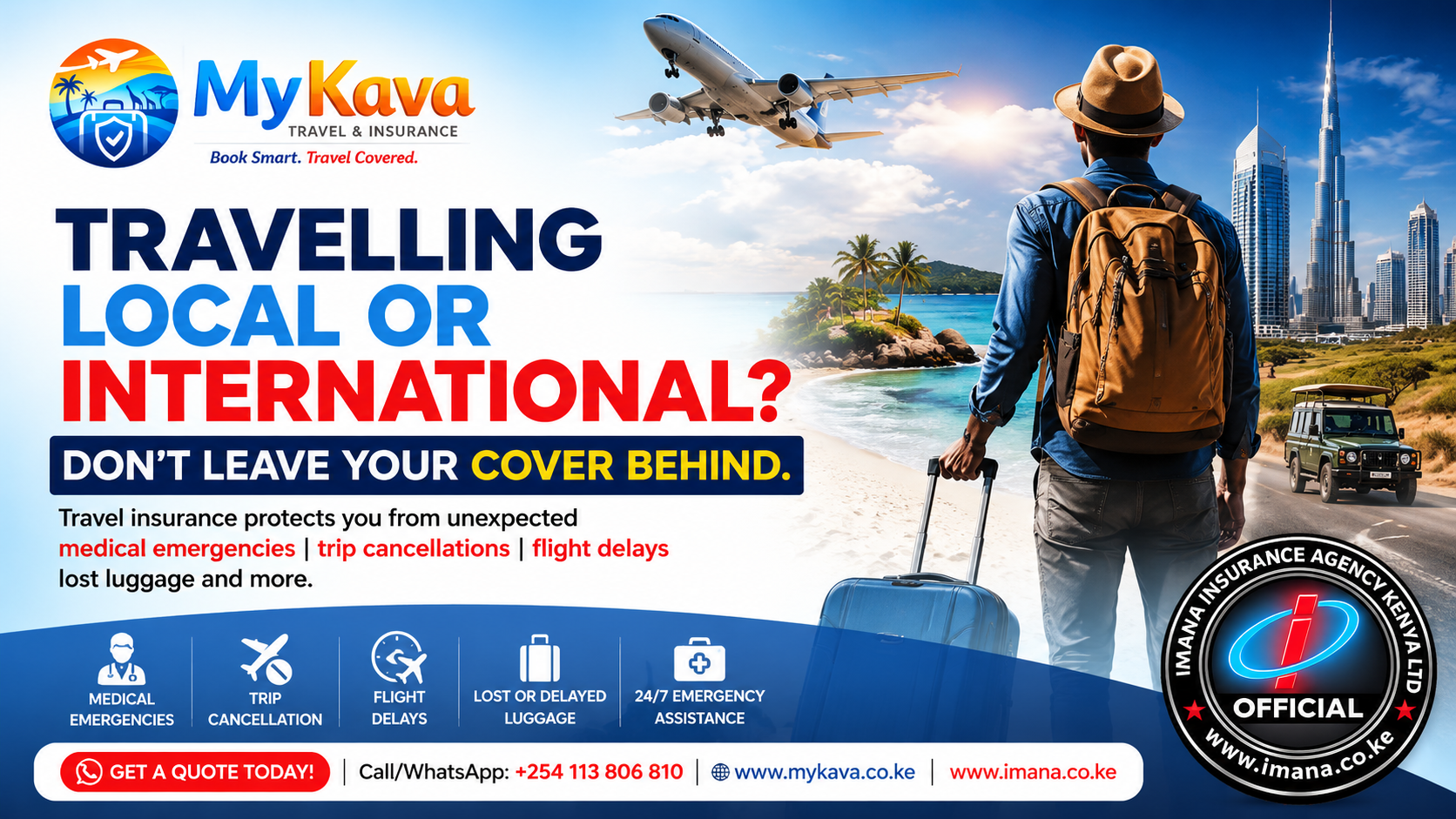
Travel insurance in Kenya helps protect travellers against selected financial losses arising from medical emergencies, trip cancellation, flight delays, lost luggage and other insured incidents.
Through the collaboration between MyKava Travel & Insurance and Imana Insurance Agency Kenya Ltd, travellers can receive assistance with flights, hotel accommodation, airport transfers, local safaris and suitable travel insurance—all within one connected travel-planning experience.
What Is Travel Insurance?
Travel insurance is a short-term insurance policy designed to protect you against specified risks before or during a journey.
Depending on the selected policy, travel insurance may cover:
- Emergency medical treatment
- Hospitalisation while travelling
- Medical evacuation
- Repatriation
- Trip cancellation or curtailment
- Flight delays
- Missed departures or connections
- Lost, stolen or delayed luggage
- Loss of a passport
- Personal accident
- Personal liability
- Emergency assistance services
Benefits, limits and exclusions differ between insurers. Always read the policy wording and benefit schedule before buying cover.
Why Is Travel Insurance Important?
A flight ticket and hotel reservation help you reach and stay at your destination. They do not automatically protect you from the financial consequences of an emergency.
Imagine arriving in another country and suddenly requiring urgent hospital treatment. Consider losing your suitcase, missing an important connection or cancelling a non-refundable journey because of an insured emergency.
Without suitable travel insurance, you may have to meet these expenses from your own pocket.
Travel insurance does not prevent disruptions from happening. It creates a financial safety net when an insured event occurs.
Does Travel Insurance Cover Local Trips Within Kenya?
Yes. Some policies can provide local travel insurance in Kenya for domestic holidays, business journeys, safaris and organised group trips.
Local cover may be useful when travelling to destinations such as:
- Mombasa
- Diani
- Malindi
- Watamu
- Lamu
- Kisumu
- Eldoret
- Naivasha
- Nanyuki
- Maasai Mara
- Amboseli
- Samburu
- Tsavo
A domestic traveller can still experience an accident, medical emergency, trip interruption, baggage problem or transport delay.
Local travel insurance may therefore be relevant for:
- Domestic flights
- SGR journeys
- Family holidays
- School trips
- Group tours
- Corporate retreats
- Local safaris
- Conferences
- Sporting trips
- Religious or community travel
However, not every policy automatically covers every domestic journey. Confirm the geographical scope, minimum travel distance and applicable benefits before purchasing.
What Is International Travel Insurance?
International travel insurance protects eligible travellers during trips outside Kenya, subject to the terms of the policy.
Policies may be arranged for destinations including:
- Europe and the Schengen Area
- The United Kingdom
- The United States
- Canada
- Australia
- Asia
- The Middle East
- Other African countries
- Worldwide destinations
The geographical region shown on your certificate must include every country you intend to visit or transit through where cover is required.
International policies may be issued for individuals, families, students, corporate travellers and organised groups.
What Does Travel Insurance in Kenya Cover?
1. Emergency medical expenses
This benefit may pay eligible expenses arising from sudden illness or accidental injury during the insured trip.
Depending on the policy, covered costs may include:
- Emergency consultation
- Diagnostic tests
- Prescription medication
- Hospital admission
- Surgery
- Ambulance services
- Emergency dental treatment
Routine check-ups, planned treatment and undeclared pre-existing medical conditions may not be covered unless specifically included.
2. Medical evacuation
Medical evacuation cover may meet eligible transportation expenses when suitable treatment is not available at the traveller’s location.
Evacuation decisions are usually coordinated through the insurer’s emergency assistance provider. Travellers should therefore contact the emergency assistance team as soon as reasonably possible.
3. Repatriation
Repatriation may include transporting an insured traveller back to Kenya for medical reasons when approved under the policy.
Some policies also provide repatriation-related benefits following a traveller’s death. The precise benefit and procedure will depend on the policy wording.
4. Trip cancellation
Trip cancellation cover may compensate the traveller for eligible prepaid and non-refundable expenses when a journey is cancelled because of a covered event.
Covered reasons vary between policies. Changing your mind, failing to obtain travel documents or cancelling for a known event is generally not automatically covered.
5. Trip curtailment
Curtailment occurs when a traveller has already started the journey but must return home earlier than planned because of an insured event.
The policy may reimburse eligible additional travel costs or unused prepaid arrangements, subject to its conditions and limits.
6. Flight delay
A travel policy may provide a fixed benefit or reimburse certain necessary expenses after a delay exceeds the waiting period stated in the policy.
Keep written confirmation from the airline and receipts for eligible expenses.
7. Missed departure or connection
Some policies cover reasonable additional expenses when an insured traveller misses a scheduled departure or connection for a covered reason.
Missing a flight because you left home late may not qualify. The cause of the missed departure must fall within the policy terms.
8. Lost or delayed baggage
Baggage cover may protect checked luggage and personal belongings against insured loss, theft, damage or delay.
Limits may apply to:
- Individual items
- Electronics
- Jewellery
- Cash
- Business equipment
- Unattended luggage
Report missing checked luggage to the airline immediately and obtain a Property Irregularity Report or equivalent written confirmation.
9. Loss of passport
A policy may reimburse eligible expenses incurred when replacing a lost passport or obtaining emergency travel documents.
The loss should be reported promptly to the police, relevant embassy or consular office and the insurer.
10. Personal liability
Personal liability cover may protect a traveller when they become legally liable for accidental bodily injury or accidental property damage involving another person.
It does not normally cover deliberate acts, contractual liability or incidents involving excluded activities.
Travel Insurance for Schengen Visa Applications
Applicants for a short-stay Schengen visa are generally required to provide medical insurance covering emergency medical care, hospitalisation and repatriation. The insurance must apply throughout the intended stay and across the relevant Schengen territory. (Migration and Home Affairs)
Because visa requirements can vary according to the traveller’s circumstances, destination and application centre, confirm the latest requirements before submitting your application.
A Schengen travel insurance certificate should accurately show:
- Traveller’s full name
- Passport details where required
- Period of insurance
- Geographical area
- Medical benefit
- Repatriation benefit
- Insurer details
- Policy or certificate number
The names and travel dates should match the details submitted in the visa application.
Travel Insurance for the UK, USA, Canada and Other Destinations
Travel insurance requirements differ by country and type of journey.
Even where insurance is not listed as a mandatory entry document, medical treatment abroad can be expensive. Suitable cover is therefore worth considering before departure.
The required policy limit will depend on factors such as:
- Destination
- Length of stay
- Traveller’s age
- Purpose of travel
- Activities planned
- Medical history
- Visa requirements
- Number of travellers
Do not assume that a policy purchased for one region automatically covers every country.
Single-Trip vs Annual Multi-Trip Travel Insurance
Single-trip insurance
Single-trip cover protects one specific journey for the dates shown on the certificate.
It may suit:
- Occasional holidaymakers
- One-time business travellers
- Students taking a specific trip
- Families going on one annual holiday
- Travellers making a visa application
Annual multi-trip insurance
Annual multi-trip insurance can cover several eligible journeys during a twelve-month policy period.
It may be more convenient for:
- Frequent business travellers
- Consultants working across several countries
- Families taking multiple holidays
- Company directors
- Regional sales teams
- Regular conference attendees
Each journey may still be subject to a maximum duration. An annual policy does not necessarily permit one uninterrupted year abroad.
Travel Insurance vs International Medical Insurance
Travel insurance and international medical insurance are related, but they serve different purposes.
Travel insurance is usually designed for temporary trips. It focuses on emergency medical treatment and travel-related disruptions such as delays, cancellations and baggage loss.
International medical insurance is designed for people living, working or studying outside their home country for an extended period. It may provide broader ongoing healthcare benefits, including inpatient, outpatient, chronic condition, maternity, dental or optical cover, depending on the plan.
A person relocating abroad may need international medical insurance rather than an ordinary short-term travel policy.
Who Should Consider Travel Insurance?
Travel insurance may be suitable for:
- Holidaymakers
- Business travellers
- International students
- Families travelling together
- Senior travellers
- Tour groups
- Religious groups
- Sports teams
- Conference delegates
- Employees travelling for work
- Safari travellers
- Travellers applying for visas
- People taking expensive prepaid trips
Senior travellers and people with existing medical conditions should disclose all relevant information and confirm whether additional terms or premiums apply.
What Is Usually Excluded?
Travel insurance does not cover every loss.
Common exclusions may include:
- Undeclared pre-existing medical conditions
- Routine or planned medical treatment
- Travelling against medical advice
- Self-inflicted or deliberate acts
- Incidents involving alcohol or prohibited substances
- Illegal activities
- War or civil disturbance, unless included
- High-risk sports not declared or covered
- Unattended belongings
- Cancellation because of a change of mind
- Known events that existed before buying the policy
- Failure to obtain the correct visa or travel documents
Exclusions differ. Review the actual policy rather than relying only on a brochure, poster or general online description.
How Much Does Travel Insurance Cost in Kenya?
There is no single fixed price for travel insurance.
The premium may depend on:
- Traveller’s age
- Destination
- Length of the trip
- Number of travellers
- Medical cover limit
- Selected benefits
- Single-trip or annual cover
- Purpose of travel
- Activities planned
- Existing medical conditions
- Optional extensions
A short regional journey may cost less than a long trip to a destination with higher healthcare costs. The cheapest quotation is not automatically the best policy.
Compare the premium alongside the medical limit, exclusions, excess, geographical scope and emergency assistance arrangements.
Information Needed to Get a Travel Insurance Quote
You may be asked to provide:
- Full name
- Date of birth
- Nationality
- Passport number
- Travel destination
- Departure date
- Return date
- Purpose of travel
- Number of travellers
- Details of any pre-existing condition
- Activities planned during the journey
- Required medical or visa limit
Providing accurate information helps ensure that the quotation and certificate match your journey.
When Should You Buy Travel Insurance?
Arrange cover as soon as your travel dates and major bookings are confirmed.
Buying early is especially important when you need trip-cancellation protection. A policy purchased after a known problem has emerged will not normally cover that existing event.
For visa applications, obtain the certificate early enough to review the names, dates, destination and medical limit before submission.
How to Make a Travel Insurance Claim
When an insured event occurs:
- Put personal safety and medical care first.
- Contact the insurer’s emergency assistance number.
- Inform the airline, hotel, police or relevant authority.
- Obtain written reports and confirmation.
- Keep receipts, invoices and medical records.
- Complete the claim form accurately.
- Submit the required documents within the stated period.
- Cooperate with requests for additional information.
For serious medical cases, contact the assistance provider before making major treatment or evacuation arrangements whenever circumstances permit.
Documents Commonly Required for a Claim
Depending on the type of claim, the insurer may request:
- Completed claim form
- Travel insurance certificate
- Passport and identification documents
- Boarding passes
- Flight itinerary
- Medical reports
- Hospital invoices
- Proof of payment
- Airline delay or cancellation confirmation
- Property Irregularity Report
- Police abstract
- Receipts for replacement items
- Evidence of prepaid bookings
- Communication with the airline or travel provider
Failure to provide supporting documents can delay assessment of the claim.
Book Your Journey with MyKava and Protect It Through Imana
Travel planning works better when the different parts of the journey connect.
MyKava Travel & Insurance assists travellers with:
- Flight comparison and booking
- Hotel accommodation
- Airport transfers
- SGR travel
- Local safaris
- National park visits
- Family and group travel
- Corporate travel planning
MyKava currently presents these services as part of its travel-planning offering. (MyKava)
Imana Insurance Agency Kenya Ltd assists clients in comparing suitable travel insurance quotations from licensed insurance providers. Kenya’s Insurance Regulatory Authority regulates and supervises the country’s insurance industry and publishes information on licensed insurers and intermediaries. (Insurance Regulatory Authority)
Together, the two businesses provide a simple journey:
Plan with MyKava. Protect with Imana. Travel covered.
Frequently Asked Questions
Is travel insurance compulsory when leaving Kenya?
Not for every destination. Some visa applications or travel programmes require evidence of insurance, while others do not. Even when it is optional, travel insurance can provide important financial protection.
Can I buy travel insurance after leaving Kenya?
Some insurers may not issue ordinary travel cover after the journey has started. Purchase the policy before departure and confirm its effective date.
Can one policy cover my whole family?
Yes, family travel policies may be available. Confirm the definition of a family, age limits for children and whether every traveller is named on the certificate.
Does travel insurance cover COVID-19 or other infectious diseases?
Cover varies by insurer and policy. Confirm the medical, cancellation, quarantine and destination restrictions before purchasing.
Are pre-existing conditions covered?
They may be excluded, covered subject to approval or accepted for an additional premium. Declare all relevant medical information honestly.
Does travel insurance cover pregnancy?
Policies may cover unforeseen pregnancy-related emergencies within stated limits and gestational periods. Routine maternity care and travel specifically for treatment may be excluded.
Can senior citizens buy travel insurance in Kenya?
Yes, but maximum entry ages, medical limits and premiums vary. Older travellers should compare policies early and disclose existing medical conditions.
Does ordinary medical insurance cover treatment abroad?
Some Kenyan medical policies provide limited regional or international benefits, but others do not. Check your medical policy before relying on it during travel.
Can I insure a local safari in Kenya?
A domestic travel policy may cover eligible local journeys, but the benefits and minimum trip requirements should be confirmed before departure.
Where can I get a travel insurance quotation in Kenya?
Contact MyKava Travel & Insurance for travel planning or Imana Insurance Agency Kenya Ltd for assistance comparing travel insurance options from trusted insurers.
Get a Travel Insurance Quote in Kenya
Do not wait until an emergency exposes the gaps in your travel plans.
Share your destination, travel dates, age and number of travellers with Imana Insurance Agency Kenya Ltd to compare suitable travel insurance quotations.
MyKava can also assist with flights, hotels, airport transfers, local safaris and complete travel arrangements.
Plan smart. Compare your options. Book your journey. Travel covered.
Policy benefits, premiums, territorial limits, waiting periods and exclusions differ between insurers. This article provides general information and does not replace the terms and conditions of an issued insurance policy.