- Author: Raymond
- Category: COMESA Yellow Card Insurance
- Category: Third Party Car Insurance in Kenya
Foreign-Registered Car Insurance in Kenya: Complete Guide
Learn how to insure and legally operate a foreign-registered vehicle in Kenya, including temporary import permits, COMESA Yellow Card cover, required documents and policy limitations.
Author: Raymond Momanyi, Founder and CEO, Imana Insurance Agency Kenya Ltd
Can a Foreign-Registered Vehicle Be Insured in Kenya?
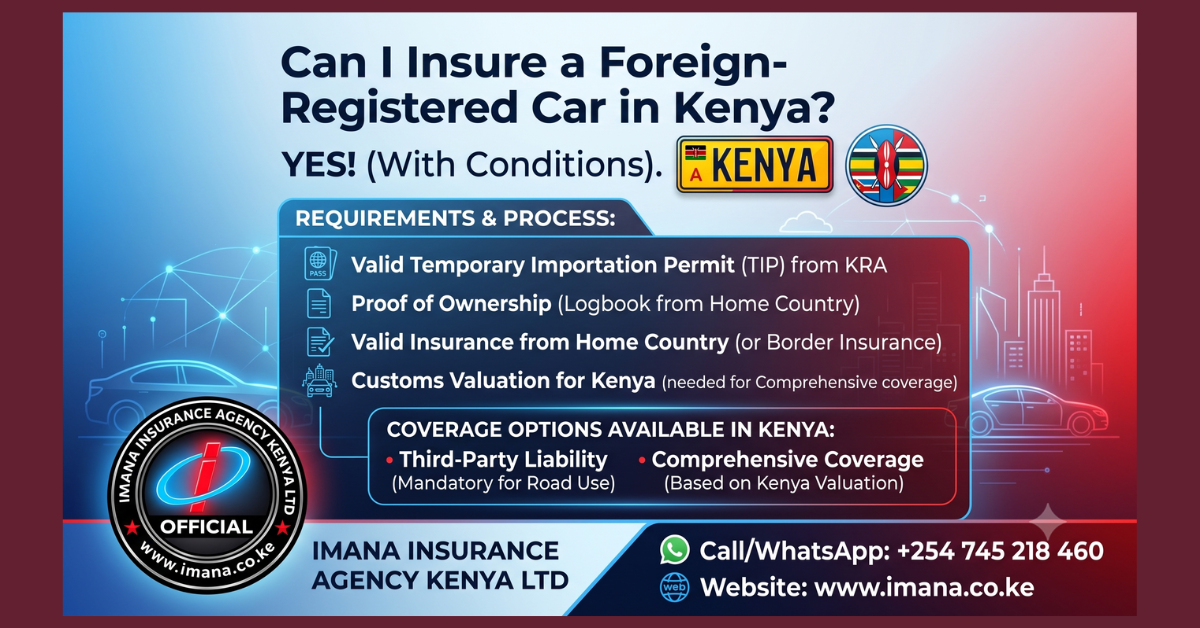
Yes. A foreign-registered car may be insured or recognised as insured for use in Kenya, provided that:
- It has legally entered Kenya.
- The owner or driver holds the required temporary importation and foreign-vehicle documents.
- It has valid third-party motor insurance recognised in Kenya.
- The vehicle is used only for the declared purpose.
- The insurance period matches the permitted stay.
- The issuing insurer accepts the vehicle and registration jurisdiction.
A foreign registration plate does not automatically prevent a vehicle from obtaining motor protection. However, insurance alone is not enough. The vehicle must also comply with Kenya Revenue Authority customs requirements, temporary importation rules and applicable road-traffic requirements.
KRA’s temporary-importation service requires a valid foreign registration document, driving licence, passport or other qualifying identification and a valid insurance certificate. The vehicle must also be re-exported before the relevant customs document expires.
The vehicle needs both legal permission to remain in Kenya and valid insurance to be driven on Kenyan roads.
Two Main Ways a Foreign Vehicle May Be Insured
The correct arrangement normally depends on the vehicle’s country of registration and the duration and purpose of its stay in Kenya.
1. COMESA Yellow Card Insurance
A vehicle registered in a participating country may enter Kenya using a valid COMESA Yellow Card issued in its home country.
The Yellow Card is a regional insurance certificate recognised by participating states. It provides third-party motor liability protection according to the compulsory insurance laws of the country where the accident occurs.
It may be available for:
- Private cars
- Commercial vehicles
- Tour vehicles
- Trucks
- Motorcycles
- Buses and passenger vehicles, subject to the issuing country’s arrangements
The scheme confirms that both private and commercial vehicles may qualify, although premiums vary according to vehicle type and use.
What the Yellow Card generally covers
It principally addresses eligible legal liability involving:
- Bodily injury to third parties
- Accidental death of third parties
- Damage to third-party property
- Passenger liability where applicable under the host country’s law
What it does not automatically cover
A COMESA Yellow Card does not ordinarily provide full protection for:
- Accidental damage to the foreign vehicle
- Theft of the vehicle
- Fire damage
- Windscreen damage
- Mechanical breakdown
- Personal belongings
- Road rescue
- Loss of use
The vehicle owner should ask the home-country insurer whether the original Comprehensive policy has been extended to Kenya.
2. Kenyan Short-Term or Local Motor Insurance
Where the foreign vehicle does not have a valid Yellow Card—or originates from a country outside the participating scheme—a Kenyan insurer may consider issuing suitable short-term third-party or other motor insurance.
Acceptance is subject to:
- Insurer underwriting
- Vehicle country of registration
- Temporary importation documents
- Foreign registration book
- Vehicle class and use
- Permitted period in Kenya
- Driver details
- Claims history
- Availability of the insurance product
A Kenyan policy should not extend beyond the vehicle’s lawful customs or foreign-permit period unless the relevant permits are formally extended.
The minimum requirement remains valid third-party insurance. Kenya’s Motor Vehicles Third Party Risks Act prohibits using or allowing another person to use a motor vehicle on a road without the required third-party protection.
What Is a Foreign Vehicle Permit?
A foreign vehicle permit authorises a foreign-registered vehicle to operate temporarily in Kenya.
KRA states that vehicles entering Kenya must have the relevant customs document and foreign permit before leaving the customs border station.
Depending on the circumstances, the vehicle may enter using:
- Form C32
- Carnet de Passage en Douane
- A temporary importation permit
- A paid foreign vehicle permit
- Another approved customs arrangement
Fourteen-day temporary permit
KRA indicates that a free 14-day temporary permit may be issued at the point of entry to vehicles entering with Form C32.
Vehicles travelling under a Carnet
A vehicle touring Kenya with an International Circulation Permit or Carnet de Passage may receive a paid foreign permit. KRA’s published guidance describes a one-month permit arrangement for qualifying touring vehicles, subject to renewal or further customs approval where applicable.
The customs permit and the motor-insurance certificate are separate documents.
Insurance does not extend the vehicle’s customs permission to remain in Kenya.
Documents Required to Operate a Foreign-Registered Vehicle
The precise documents depend on the owner, country of registration and method of temporary importation.
KRA may require:
- Foreign identification document
- Passport or travel document
- Valid visa or entry permit
- Proof of foreign residence where the driver is Kenyan
- Foreign vehicle registration book or logbook
- Valid driving licence
- Valid insurance certificate
- Form C32 or Carnet de Passage
- Foreign vehicle permit
- Power of Attorney or owner’s authority where the driver is not the registered owner
KRA warns that a person without the prescribed ownership, residence or authority documents may not be allowed to enter or locally operate the foreign-registered vehicle, and a non-compliant vehicle may be impounded.
Documents That May Be Required for Insurance
To request insurance through a Kenyan insurer, prepare:
- Foreign vehicle registration certificate
- Passport or foreign identification
- Driver’s licence
- Temporary importation permit
- Form C32 or Carnet de Passage
- Foreign vehicle permit
- Existing foreign insurance policy
- COMESA Yellow Card, where available
- Vehicle make and model
- Year of manufacture
- Chassis and engine details
- Seating capacity
- Vehicle value
- Intended use
- Entry and expected exit dates
- Owner’s authority where someone else is driving
The insurer may also request:
- Vehicle photographs
- Physical inspection
- Valuation
- Previous claims information
- Kenyan contact details
- Proposed travel routes
Can a Kenyan Resident Drive a Foreign-Registered Vehicle?
Possibly, but additional restrictions and evidence may apply.
Where the driver is Kenyan but normally resides outside Kenya, KRA may require proof of foreign residence. The foreign vehicle registration document should normally be in the driver’s name, or the driver must hold valid authority from the registered owner.
A foreign-registered vehicle should not be brought into Kenya temporarily and then used indefinitely by a person who does not qualify under the relevant customs arrangement.
The driver should confirm:
- Who is authorised to operate it
- The permitted use
- Whether local lending or hiring is allowed
- The customs expiry date
- The insurance driver restrictions
- Whether the vehicle may be used commercially
Can the Vehicle Be Used for Uber, Bolt or Taxi Work?
Not automatically.
A car temporarily imported for private touring or personal use should not be used for:
- Uber or Bolt operations
- Conventional taxi work
- Paid passenger transport
- Delivery services
- Car hire
- Tour operations
- Commercial carriage of goods
unless the customs permit, transport licences and insurance all expressly allow that use.
A private or touring policy may not cover an accident occurring during undeclared commercial activity.
The insurer must be told exactly how the vehicle will be used.
Can I Obtain Comprehensive Insurance for a Foreign Vehicle?
It may be possible, but it is more complicated than obtaining third-party protection.
Many insurers will first consider:
- Country of registration
- Vehicle value
- Availability of spare parts
- Repair arrangements
- Duration in Kenya
- Existing foreign policy
- Customs status
- Security controls
- Intended use
- Repatriation costs
The insurer may offer:
- Third-Party Only protection
- Third-Party, Fire and Theft
- Comprehensive protection
- A territorial extension to an existing foreign policy
- No own-damage protection
Short-term Comprehensive insurance may attract:
- A minimum premium
- A policy excess
- A compulsory valuation
- Restricted repair arrangements
- Theft-security requirements
- Territorial limitations
Do not assume that a foreign Comprehensive policy automatically operates in Kenya. Obtain written confirmation from the foreign insurer.
Can a Foreign Vehicle Obtain a COMESA Yellow Card in Kenya?
The Yellow Card is normally purchased in the vehicle’s country of registration or through the insurer providing its underlying motor policy.
Kenya is one of the issuing and participating countries, and Kenya Re serves as the Kenyan National Bureau under the scheme.
Where a foreign vehicle enters Kenya without a Yellow Card, the owner should seek guidance from:
- The vehicle’s home-country insurer
- The relevant national Yellow Card bureau
- A licensed Kenyan insurer or intermediary
- KRA officers at the point of entry
A Kenyan insurer may instead provide local third-party insurance where the risk is acceptable.
How Long Can the Insurance Last?
The policy period should not exceed:
- The foreign vehicle permit
- Form C32 validity
- Carnet validity
- Temporary importation approval
- The declared stay in Kenya
KRA’s online Temporary Importation of Motor Vehicles service indicates that a vehicle must be re-exported before the Carnet expires or within 12 months, whichever comes first, although the actual permissible period depends on the customs arrangement granted to that vehicle.
Possible insurance periods may include:
- Fourteen days
- One month
- Several months
- The remaining period under the Carnet
- An annual period, where legally and operationally appropriate
An insurance certificate does not authorise the owner to keep the vehicle in Kenya after the customs permit expires.
Can the Vehicle Remain in Kenya Permanently?
Temporary insurance and permits are not designed to legalise permanent local use.
Where the owner intends to retain the vehicle permanently, the vehicle may need to undergo the normal importation process, including:
- Customs clearance
- Payment of applicable taxes and duties
- Compliance with importation standards
- Registration in Kenya
- Issuance of Kenyan registration documents
- Kenyan motor insurance
KRA’s normal importation requirements include documents such as the original commercial invoice and the original logbook from the exporting country.
Import eligibility, vehicle-age rules and tax treatment should be confirmed directly with KRA and a licensed clearing agent before making permanent-importation plans.
What Happens After an Accident in Kenya?
1. Protect people
Check passengers, drivers and third parties for injuries and obtain emergency assistance.
2. Secure the scene
Use hazard lights and reflective triangles where safe.
3. Contact the police
Obtain:
- Police reference
- Accident report
- Police abstract
- Investigating officer’s details
4. Record evidence
Take photographs showing:
- Vehicle positions
- Foreign registration plates
- Damage
- Road conditions
- Traffic signs
- Third-party property
5. Exchange information
Record:
- Driver names
- Telephone contacts
- Identification details
- Vehicle registrations
- Insurance information
- Witness contacts
6. Notify the insurer or Yellow Card representative
Provide:
- Insurance certificate number
- Yellow Card number, where applicable
- Vehicle registration
- Accident location
- Police reference
- Third-party details
7. Do not admit liability
Do not privately promise payment or sign documents you do not understand.
8. Obtain approval before repairs
The insurer may need to inspect the vehicle and approve repairs, towing or repatriation.
What If the Foreign Vehicle Is Damaged?
Payment for damage to the foreign vehicle depends on whether own-damage protection exists.
With Yellow Card only
The Yellow Card ordinarily protects third-party liability—not repairs to the visiting vehicle.
With a foreign Comprehensive policy extended to Kenya
The home-country insurer may arrange:
- Local assessment
- Repairs in Kenya
- Vehicle recovery
- Repatriation
- Settlement after return to the home country
With Kenyan Comprehensive protection
The Kenyan insurer may assess the loss according to the policy, subject to:
- Excess
- Repair arrangements
- Parts availability
- Vehicle valuation
- Territorial and customs conditions
Contact the insurer before authorising major repairs.
Common Mistakes to Avoid
Arriving without valid insurance
Arrange the Yellow Card or another recognised policy before travelling where possible.
Assuming the foreign policy applies worldwide
Many domestic motor policies have limited territorial scope.
Confusing a customs permit with insurance
The permit allows temporary vehicle operation; insurance protects against specified risks.
Letting insurance expire before the permit
Both documents must remain valid throughout the vehicle’s use.
Using the vehicle commercially without disclosure
Undeclared taxi, tour or delivery use may invalidate or restrict the policy.
Allowing an unauthorised person to drive
The customs and insurance documents may limit authorised drivers.
Keeping the vehicle beyond its permitted period
An insurance certificate cannot extend customs approval.
Assuming the Yellow Card is Comprehensive
It principally provides regional third-party liability protection.
Frequently Asked Questions
Can a Ugandan-registered car be insured for use in Kenya?
Yes. It may enter with a valid COMESA Yellow Card and required temporary importation documents, or obtain another acceptable Kenyan insurance arrangement subject to underwriting.
Can a Tanzanian-registered car use its Yellow Card in Kenya?
A valid Yellow Card issued under the participating scheme may provide recognised third-party protection in Kenya, subject to its validity and correct vehicle details.
Can a vehicle from a non-COMESA country obtain insurance in Kenya?
Potentially, yes. A licensed Kenyan insurer may consider short-term third-party or other protection after reviewing the vehicle’s customs documents, registration, use and duration in Kenya.
Does a foreign vehicle need a Kenyan number plate?
Not during an approved temporary importation period. It must, however, display its valid foreign registration and carry the required customs, permit and insurance documents.
Does a COMESA Yellow Card cover theft?
Not ordinarily. The core Yellow Card benefit is third-party liability.
Can I buy insurance after entering Kenya?
It may be possible, but the vehicle should not be driven without valid recognised insurance. Arranging cover before arrival is safer.
Can I insure a foreign car for one month?
Potentially, provided the insurer accepts it and the insurance period fits within the valid temporary-importation permit.
Can a Kenyan insurer issue Comprehensive cover?
Possibly, subject to valuation, inspection, vehicle origin, parts availability, customs status and underwriting approval.
Can the vehicle be driven by someone other than the owner?
Only where the person is permitted by the customs and insurance arrangements and holds the required written authority and driving licence.
Can Imana help arrange the cover?
Yes. Imana can review the vehicle’s registration, temporary-importation documents, country of origin, intended use and existing insurance before requesting terms from suitable insurers.
Insure a Foreign-Registered Vehicle Through Imana
Imana Insurance Agency Kenya Ltd can assist visiting motorists, expatriates, diplomats, international organisations, tour operators and returning residents with reviewing insurance options for foreign-registered vehicles.
Support may include:
- Checking the country of registration.
- Reviewing the COMESA Yellow Card.
- Confirming the requested insurance period.
- Reviewing Form C32, Carnet or temporary-importation documents.
- Confirming the vehicle’s actual use.
- Requesting terms from suitable Kenyan insurers.
- Comparing third-party and available own-damage options.
- Coordinating certificate issuance.
- Supporting accident and claim notification.
Useful Imana links
- Motor Insurance: www.imana.co.ke/insurance/motor-insurance
- Car Insurance: www.imana.co.ke/car-insurance
- Get a Motor Quote: www.imana.co.ke/motor-quote
- COMESA Yellow Card: www.imana.co.ke/comesa-insurance
- Report a Claim: www.imana.co.ke/claims-request
- Website: www.imana.co.ke
Contact Imana Insurance Agency Kenya Ltd
Office: 4th Floor, Krishna Centre, Woodvale Grove, Westlands, Nairobi
Call/WhatsApp: +254 745 218 460 | +254 796 209 402
Website: www.imana.co.ke
Foreign number plate? Confirm the permit, arrange valid insurance and understand the territorial limits before driving in Kenya.
Foreign-vehicle permits, temporary-importation periods, insurance acceptance, premiums and required documents vary according to the vehicle’s country of registration, use and customs status. Obtain current confirmation from KRA, the insurer and the relevant authorities before travelling or operating the vehicle in Kenya.