- Author: Raymond
- Category: Tour Service Vehicles (TSV) Insurance
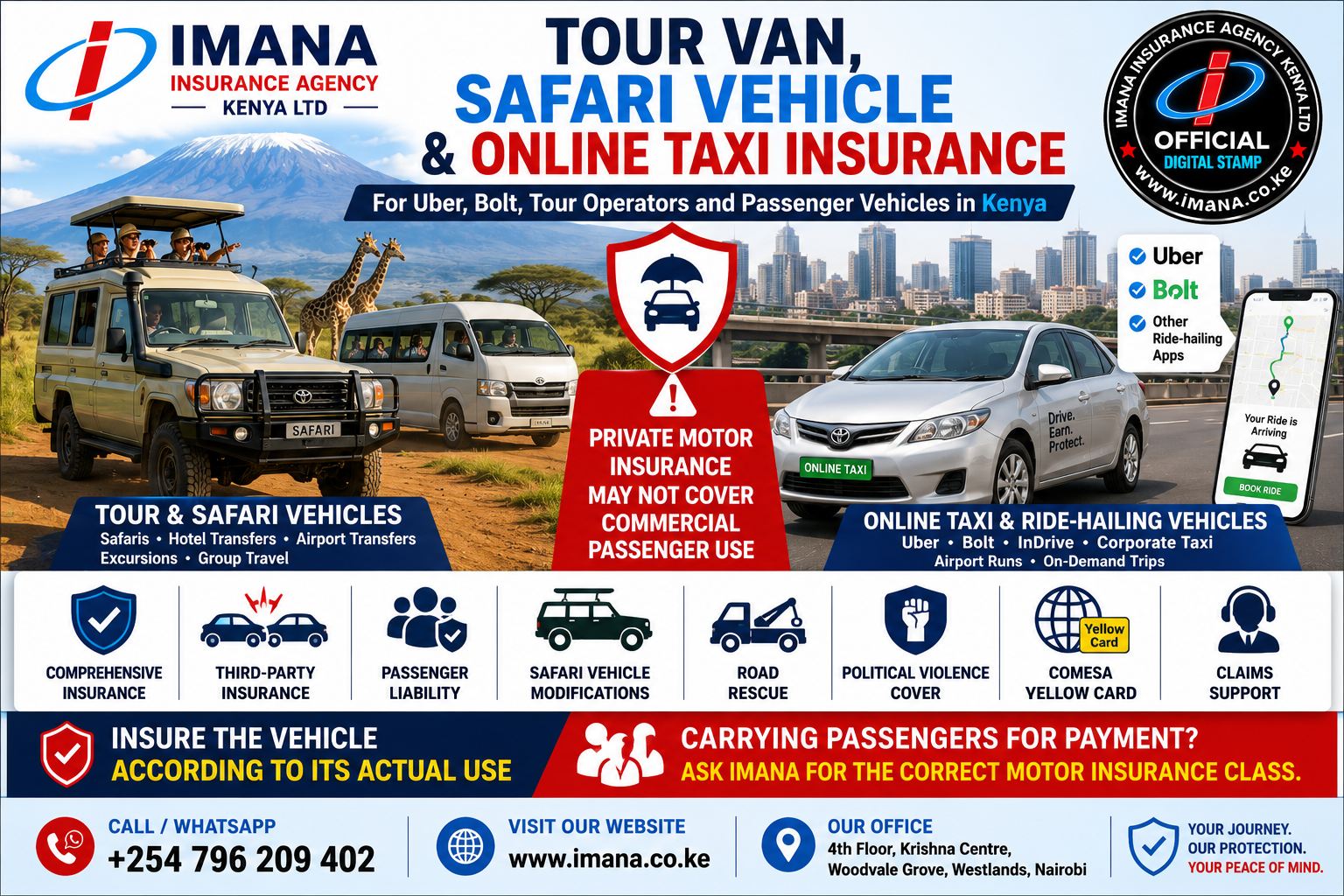
Tour Van, Safari Vehicle, Uber and Bolt Insurance in Kenya
Learn how motor insurance works for tour vans, safari vehicles, Uber, Bolt and other online taxis in Kenya, including correct vehicle classes, passenger liability, comprehensive cover, documents and claims.
Is Ordinary Private Motor Insurance Enough?
A vehicle may look like an ordinary private car, SUV, van or minibus but require a completely different insurance policy because of how it is used.
This is particularly important for:
- Tour vans
- Safari Land Cruisers
- Airport-transfer vehicles
- Hotel-transfer vehicles
- Chauffeur-driven cars
- Uber vehicles
- Bolt vehicles
- Other app-based taxis
- Conventional taxis
- Vehicles hired with a driver
These vehicles carry passengers for payment or as part of a commercial service. They should therefore not ordinarily be insured as vehicles used exclusively for private and social purposes.
A valid private motor certificate does not automatically provide suitable protection when a vehicle is being used commercially to transport passengers.
Kenya’s Transport Network Companies, Owners, Drivers and Passengers Regulations require a vehicle to have valid insurance before it is used to provide transport-network services. The Regulations also require relevant vehicle inspection and licensing documentation. (Kenya Law)
Tourist service vehicles are governed separately under the National Transport and Safety Authority’s tourist-service-vehicle regulations, which expressly require insurance through an insurer licensed under Kenya’s insurance framework. (Kenya Law)
Insurance follows the vehicle’s actual use—not merely its make, body shape or registration details.
Two Commercial Passenger-Transport Risks, One Insurance Principle
Tour vehicles and online taxis serve different customers, but they share an important insurance characteristic:
They transport passengers as part of a business activity.
Tour vans and safari vehicles
These may transport:
- International tourists
- Local holidaymakers
- Hotel guests
- Corporate groups
- Conference delegates
- Families on safari
- Airport-transfer passengers
- Tour guides and support staff
Their operations may involve:
- National parks
- Game reserves
- Rural roads
- Border crossings
- Long-distance travel
- Off-road or rough-road conditions
- Luggage and photography equipment
- Several days away from the operator’s base
Uber, Bolt and online taxis
These typically provide:
- Urban passenger transport
- Airport transfers
- Corporate trips
- On-demand app bookings
- Short-distance and inter-county trips
- Night-time transport
- Multiple passenger journeys each day
The vehicles are often ordinary saloon cars, station wagons, hatchbacks, SUVs or vans. However, their commercial use changes the insurance exposure.
What Is Tour Van and Safari Vehicle Insurance?
Tour van or safari vehicle insurance is motor insurance arranged for vehicles used to transport tourists and other passengers as part of a licensed tourism or transport operation.
Eligible vehicle types may include:
- Safari vans
- Tour-service Land Cruisers
- Minibuses
- Tour buses
- Airport-transfer vans
- Chauffeur-driven vehicles
- Hotel shuttle vehicles
- Specially modified safari vehicles
Tourism Regulatory Authority licensing includes safari operators among the regulated tourism-enterprise categories. Operators must separately comply with applicable tourism, vehicle and transport requirements. (Tourism Authority)
A tourism licence, however, is not a motor insurance policy. The operator must still arrange suitable insurance for each vehicle.
What Is Uber, Bolt and Online Taxi Insurance?
Online taxi insurance is motor cover arranged for vehicles used to provide paid passenger transport through digital-hailing platforms.
The regulations refer to these vehicles as transport network vehicles and require them to have valid insurance before offering transport-network services. They must also hold the relevant inspection and vehicle documentation required under the regulatory framework. (Kenya Law)
This category may include vehicles operating through:
- Ride-hailing applications
- Corporate taxi platforms
- Online airport-transfer services
- App-based chauffeur services
- Other registered transport-network companies
The insurer should be informed of the exact use.
Stating that a vehicle is “personal” while it is regularly used for paid online taxi trips may amount to a material misdescription of the risk.
Private Motor Insurance vs Commercial Passenger Insurance
Private motor insurance
Private motor cover is generally intended for:
- Social use
- Domestic use
- Personal commuting
- Private family travel
It does not ordinarily anticipate the vehicle being offered to members of the public for paid passenger transport.
Tour-service or taxi insurance
This cover recognises commercial passenger use and may provide for:
- Increased time on the road
- Multiple passengers
- Commercial driving
- Passenger liability
- Different driver arrangements
- Higher annual mileage
- Airport and long-distance operations
- Tourism or taxi licensing requirements
A private certificate should not be selected simply because it costs less.
The wrong motor class can create serious difficulties during a claim, even where the premium was paid and the certificate appears valid.
Types of Cover Available
Tour vans, safari vehicles and online taxis may generally be insured under one of the following arrangements, depending on insurer acceptance.
1. Third-Party Only Insurance
Third-Party Only insurance primarily covers eligible legal liability arising from:
- Third-party bodily injury
- Third-party death
- Third-party property damage
- Passenger liability where included and applicable
It does not ordinarily pay for accidental damage to the insured vehicle.
Example
An online taxi collides with another vehicle.
Third-Party Only cover may respond to eligible claims from:
- Occupants of the other vehicle
- Pedestrians
- Passengers in the insured taxi
- The owner of damaged third-party property
The policy does not ordinarily pay to repair the insured taxi itself.
2. Third-Party, Fire and Theft
This may provide:
- Third-party liability
- Fire damage to the insured vehicle
- Theft of the insured vehicle
It generally does not cover ordinary accidental collision damage to the insured vehicle.
Availability varies by insurer.
3. Comprehensive Insurance
Comprehensive insurance may protect against:
- Accidental damage
- Collision
- Overturning
- Fire
- Theft
- Third-party bodily injury
- Third-party property damage
- Passenger liability, subject to the policy
Optional extensions may include:
- Excess Protector
- Political Violence and Terrorism
- Windscreen cover
- Entertainment-system cover
- Road rescue
- Courtesy vehicle
- Personal Accident
- Special-perils protection
- COMESA Yellow Card
- Territorial extensions
Comprehensive cover is particularly important where:
- The vehicle is financed
- The vehicle has a high replacement value
- Business income depends on the vehicle
- Repairs would be difficult to finance personally
- The vehicle operates frequently or over long distances
Why Passenger Liability Matters
Passenger transport creates an exposure that does not arise to the same extent under ordinary private use.
Passengers may suffer injury during:
- Collisions
- Overturning
- Sudden braking incidents
- Boarding or alighting
- Vehicle fires
- Other insured road accidents
A suitable commercial passenger policy should clearly address passenger liability.
The policyholder should confirm:
- Maximum seating capacity
- Number of passengers insured
- Whether the driver and conductor are covered
- Whether tour guides are treated as passengers or employees
- Applicable liability limits
- Whether overloading affects the policy
- Whether every seat must have a functional safety belt
A vehicle insured for seven passengers should not carry ten passengers.
Operating beyond the legally approved or insured capacity can create regulatory, safety and insurance complications.
Tour Van and Safari Vehicle Insurance Explained
Common vehicles insured
Safari and tour operators may use:
- Toyota Hiace safari vans
- Toyota Land Cruisers
- Land Rover vehicles
- Minibuses
- Coasters
- Luxury SUVs
- Chauffeur-driven saloon cars
- Specially modified game-viewing vehicles
The insurer may consider:
- Vehicle age
- Seating capacity
- Body modifications
- Pop-up roof
- Four-wheel-drive system
- Accessories
- Radio equipment
- Refrigeration or camping equipment
- Intended routes
- Annual mileage
- Countries visited
- Driver experience
- Claims history
Modified safari vehicles
Many safari vehicles have modifications such as:
- Pop-up roofs
- Raised suspension
- Reinforced bumpers
- Roof racks
- Additional fuel tanks
- Snorkels
- Winches
- Communication equipment
- Charging systems
- Safari seats
- Refrigeration boxes
These changes should be disclosed.
The standard vehicle value may not automatically include the cost of specialist modifications and accessories.
The policyholder should confirm whether modifications are:
- Included in the vehicle value
- Listed separately
- Subject to an accessories limit
- Approved by the insurer
- Reflected in the valuation report
Off-road and national-park use
Tour vehicles may travel on:
- Gravel roads
- Muddy tracks
- Rough rural roads
- National-park routes
- Private conservancy roads
The policyholder should ask whether normal authorised safari-road use is covered.
Competitive off-roading, reckless use, prohibited routes and deliberate entry into unsafe areas may not be covered.
Animal-related damage
Safari vehicles may be exposed to damage involving wildlife.
Whether animal impact or other wildlife-related damage is covered depends on:
- Cause of damage
- Policy wording
- Comprehensive cover
- Exclusions
- Driver conduct
- Location and circumstances
Do not assume every wildlife-related incident is automatically covered.
Cross-Border Safari Operations
Tour operators may take vehicles from Kenya into countries such as:
- Uganda
- Tanzania
- Rwanda
- Zambia
- Zimbabwe
- Other regional destinations
A Kenyan motor certificate may not provide adequate third-party protection outside Kenya.
The operator may need:
- COMESA Yellow Card
- Own-damage territorial extension
- Cross-border road rescue
- Travel Insurance for passengers
- Goods or equipment protection
- Country-specific road and border documents
The COMESA Yellow Card mainly extends recognised third-party liability across participating countries. It does not automatically provide comprehensive protection for damage to the tour vehicle.
Before departure, confirm:
- Destination countries
- Transit countries
- Travel dates
- Vehicle details
- Territorial extension
- Emergency contacts
- Claims procedure outside Kenya
Uber, Bolt and Online Taxi Insurance Explained
Why online taxis are not ordinary private cars
A ride-hailing vehicle may spend many hours each day:
- Searching for passengers
- Driving in congested traffic
- Operating at night
- Entering airports and shopping centres
- Travelling to unfamiliar locations
- Carrying multiple unrelated passengers
- Completing many short trips
This increased use may result in:
- Higher annual mileage
- Increased accident exposure
- Greater wear and tear
- More frequent driver changes
- Passenger-related claims
- Increased theft and security exposure
The insurer must therefore price and classify the vehicle according to its commercial passenger use.
Transport network vehicle requirements
Before use, a transport network vehicle must hold valid insurance and the required inspection and vehicle documentation. Drivers must also comply with the applicable licensing and identification requirements under the regulations. (Kenya Law)
NTSA provides digital services for vehicle registration, inspection and PSV-related applications through its online platforms. (NTSA Service Portal)
Insurance does not replace:
- Vehicle inspection
- Driver licensing
- Platform approval
- Transport-network compliance
- Road-service licensing
- Other applicable NTSA requirements
Can a Privately Owned Car Be Used for Online Taxi Work?
A privately owned vehicle may potentially be converted or approved for online taxi operations, subject to:
- Platform eligibility
- NTSA requirements
- Correct insurance classification
- Vehicle inspection
- Driver licensing
- Financier consent where applicable
- Other regulatory conditions
The owner should arrange the correct insurance before beginning commercial operations.
Do not wait for an accident to inform the insurer that the car was being used for paid passenger transport.
What If the Car Is Used for Uber Only Occasionally?
Occasional commercial use remains commercial use.
Examples include:
- Driving on the platform only during weekends
- Accepting trips after work
- Operating only during holidays
- Providing airport transfers occasionally
- Allowing another person to use the car for ride-hailing
A private policy is not automatically suitable because the taxi activity is part-time.
The actual use should be declared and accepted by the insurer.
Can One Vehicle Be Used for Both Private and Online Taxi Purposes?
A vehicle may be used privately when it is not carrying paying passengers, but its insurance classification should still recognise its ride-hailing or taxi activity.
The commercial use is the material exposure.
The policyholder should not switch informally between private and taxi certificates depending on the day’s intended activity.
Vehicle Valuation for Tour and Taxi Vehicles
Comprehensive insurance requires an appropriate vehicle value.
The insured value should ordinarily reflect the vehicle’s reasonable market value, including declared permanent modifications where applicable.
A professional valuation may establish:
- Vehicle condition
- Make and model
- Year of manufacture
- Chassis and engine details
- Current market value
- Accessories
- Safari modifications
- Existing damage
Why accurate valuation matters
Overinsurance
Insuring a vehicle above its reasonable value does not necessarily mean the insurer will pay the inflated amount after a total loss.
Underinsurance
Insuring below the appropriate value can result in:
- Reduced settlement
- Application of average
- Inadequate funds to replace the vehicle
- Financial pressure on the operator
High-use vehicles should be revalued periodically because mileage and condition can change quickly.
Accessories and Equipment That Should Be Declared
Tour operators and online taxi owners may install:
- Tracking devices
- Dashboard cameras
- Radios
- Roof racks
- Extra seats
- Refrigeration units
- Wi-Fi equipment
- Mobile-payment devices
- Charging systems
- Entertainment equipment
- Special lighting
- Bull bars
- Winches
The policy should clarify:
- Whether accessories are included
- Maximum payable limit
- Whether theft is covered
- Whether portable equipment is excluded
- Whether the item must be permanently fitted
Passenger belongings are not automatically insured as vehicle accessories.
Does Motor Insurance Cover Passenger Baggage?
Not ordinarily under the basic motor section.
A tour operator may carry:
- Suitcases
- Cameras
- Laptops
- Travel documents
- Camping equipment
- Photography equipment
Passenger belongings may require:
- Travel Insurance
- Baggage Insurance
- All Risks Insurance
- Goods in Transit cover
- Tour Operator’s Liability protection
The operator should avoid promising that every passenger’s luggage is fully insured unless there is a specific policy providing that benefit.
Additional Insurance for Tour Operators
A tour company may require more than motor insurance.
Tour Operator’s Liability
This may protect against eligible legal claims arising from the operator’s business activities.
Public Liability
This may address accidental third-party injury or property damage connected to the operator’s premises or general activities.
Professional Indemnity
This may be relevant where customers allege financial loss caused by professional errors, incorrect bookings or negligent travel arrangements, subject to policy terms.
Travel Insurance
Group or individual Travel Insurance may protect travellers against:
- Medical emergencies
- Evacuation
- Cancellation
- Baggage loss
- Personal Accident
WIBA Insurance
Tour companies employing:
- Drivers
- Guides
- Office staff
- Mechanics
- Cleaners
- Casual employees
should maintain suitable work-injury protection.
Group Personal Accident
This may provide broader accident benefits to employees on a 24-hour basis.
Property and Office Insurance
This may protect:
- Office equipment
- Computers
- Furniture
- Booking systems
- Communication equipment
Cyber Insurance
Tour operators process:
- Passport details
- Payment information
- Travel itineraries
- Customer contacts
Cyber cover may help address eligible data breaches and system interruptions.
Additional Insurance for Online Taxi Owners and Fleet Operators
A person operating one or several ride-hailing vehicles may also consider:
- Driver Personal Accident
- WIBA where drivers are employees
- Group Personal Accident
- Road rescue
- Loss-of-use arrangements
- Political Violence and Terrorism
- Cyber or data protection for fleet platforms
- Fidelity or crime protection for employed drivers
- Business Interruption where available and appropriate
The owner should establish the legal relationship with each driver.
A vehicle hired to a driver under a daily-target or revenue-sharing arrangement may create different responsibilities from a normal employer–employee arrangement.
Legal and employment advice may be necessary where the relationship is unclear.
Does Comprehensive Insurance Cover Loss of Daily Taxi Income?
Not automatically.
When an online taxi or tour vehicle is damaged, the owner may lose income while it is being repaired.
Ordinary comprehensive insurance mainly addresses physical vehicle damage and liability.
It does not necessarily reimburse:
- Missed taxi trips
- Lost platform earnings
- Cancelled safari bookings
- Driver targets
- Loan instalments
- Lost commissions
- Customer refunds
Some insurers may offer:
- Loss-of-use benefits
- Courtesy vehicle
- Business Interruption-type extensions
- Daily cash benefits
These must be expressly included.
Do not assume that the insurer will pay daily income merely because the vehicle was comprehensively insured.
Common Optional Motor Extensions
Excess Protector
This may protect the policyholder against paying specified accidental-damage excesses.
It may not remove every excess.
Special excesses may still apply to:
- Young drivers
- Inexperienced drivers
- Theft
- Total loss
- Windscreen claims
- Political violence
- Unauthorised drivers
Political Violence and Terrorism
This may extend protection for qualifying loss caused by:
- Riots
- Civil commotion
- Political violence
- Terrorism
- Specified malicious acts
Windscreen Cover
Tour and taxi vehicles spend long periods on the road and may face windscreen damage.
Confirm:
- Annual limit
- Excess
- Number of claims
- Whether side and rear glass are included
Road Rescue
Road rescue may include:
- Towing
- Battery assistance
- Tyre assistance
- Emergency fuel delivery
- Recovery after an accident
Tour operators should check the geographical radius, particularly for remote safari routes.
Courtesy Vehicle
A courtesy vehicle may be provided subject to:
- Availability
- Maximum number of days
- Approved repair duration
- Vehicle class
- Policy conditions
A standard saloon courtesy vehicle may not replace a specialised safari van.
Personal Accident
This may provide fixed benefits for the insured driver or named occupants following an eligible accident.
Who Is Allowed to Drive the Vehicle?
The policy may cover:
- Named drivers
- Authorised drivers
- Employed drivers
- Drivers within a stated age range
- Drivers holding the correct licence class
Claims may be affected where the driver:
- Has no valid licence
- Uses an incorrect licence class
- Is not authorised
- Is intoxicated
- Uses the vehicle outside permitted operations
- Allows an unapproved person to drive
- Breaches the policy’s driver restrictions
Tour operators and taxi-fleet owners should maintain:
- Driver files
- Licence copies
- PSV documentation
- Employment or hiring agreements
- Training records
- Incident history
- Medical or competence records where required
Documents Required for a Quotation
Vehicle documents
- Logbook or eLogbook
- Current insurance certificate
- Vehicle registration
- Make and model
- Year of manufacture
- Engine capacity
- Seating capacity
- Vehicle value
- Inspection report where required
- Valuation report for comprehensive cover
NTSA introduced electronic motor-vehicle registration certificates through its eCitizen-linked services in 2026, and vehicle owners can access the relevant eLogbook services through their registered accounts. (NTSA)
Owner documents
- National ID or passport
- KRA PIN
- Company registration documents
- CR12 or current company information
- Business permit
- Contact details
Operational documents
For online taxis:
- Platform details
- Transport-network documentation
- Vehicle inspection
- Driver details
- PSV-related documentation
- Expected use and operating area
For tour vehicles:
- Tourism operator details
- Tour-service licence
- Routes
- Countries visited
- Driver and guide information
- Vehicle modifications
- Expected annual mileage
Claims history
The insurer may request:
- Previous insurer
- Previous claims
- Accident history
- Theft history
- Driver-loss experience
- Number of vehicles in the fleet
How Much Does Tour Van or Online Taxi Insurance Cost?
There is no universal premium.
Pricing may depend on:
- Vehicle value
- Third-Party or Comprehensive cover
- Online taxi or tour use
- Seating capacity
- Vehicle age
- Driver age and experience
- Claims history
- Operating area
- Annual mileage
- Vehicle modifications
- Security and tracking
- Selected extensions
- Policy excess
- Number of vehicles
A tour Land Cruiser worth several million shillings will not be priced in the same way as an older online taxi saloon car.
A fleet may also receive different terms from a single-vehicle owner.
Obtain a current written quotation based on the actual vehicle and use.
What to Do After an Accident
1. Protect people
Check passengers, drivers and third parties for injuries.
Arrange emergency assistance where necessary.
2. Secure the scene
Use hazard lights, reflective triangles and safe positioning where possible.
3. Contact the police
Obtain the relevant police report or abstract.
4. Record evidence
Take clear photographs and videos showing:
- Vehicle positions
- Registration plates
- Damage
- Road conditions
- Passenger areas
- Traffic signs
- Third-party property
- Surrounding environment
5. Collect information
Record:
- Passenger names
- Third-party driver details
- Vehicle-owner details
- Witness contacts
- Police officer details
- Platform trip reference
- Tour itinerary where applicable
6. Notify the insurer or intermediary
Report the accident immediately, even where damage appears minor.
7. Do not admit liability
Provide factual assistance but do not promise private compensation or accept legal responsibility before assessment.
8. Preserve platform and trip records
Online taxi drivers should retain:
- Trip details
- Pickup and destination information
- Passenger information available through the platform
- App screenshots
- Communication records
Tour operators should retain:
- Passenger manifest
- Booking record
- Itinerary
- Driver assignment
- Vehicle movement records
Common Claim Documents
The insurer may request:
- Completed claim form
- Policy schedule
- Motor certificate
- Police abstract
- Driver’s licence
- Driver’s PSV documentation where applicable
- Vehicle logbook
- Inspection certificate
- Photographs
- Repair estimate
- Assessor’s report
- Passenger list
- Trip details
- Platform-trip record
- Tour booking records
- Witness statements
- Third-party demand
- Court documents
- Medical reports
- Tracking report
The documents depend on the type of claim.
Common Reasons Claims May Be Delayed or Declined
Claims may face difficulties because of:
- Wrong insurance class
- Undeclared online taxi or tour use
- Unlicensed driver
- Expired policy
- Expired inspection
- Incorrect seating capacity
- Overloading
- Undeclared vehicle modifications
- Unauthorised driver
- Driving outside the territorial limits
- Late reporting
- Repairs undertaken without approval
- Fraudulent documents
- Intoxication
- Deliberate or reckless conduct
- Wear and tear rather than accidental damage
The policyholder should read:
- Schedule
- Certificate
- Endorsements
- Policy wording
- Excess requirements
- Driver conditions
- Territorial limits
Common Mistakes Vehicle Owners Make
Insuring an online taxi as a private car
This is one of the most serious classification errors.
Using an ordinary taxi policy for a tour vehicle
Tour-service operations involve different routes, vehicle types and regulatory requirements.
Failing to declare vehicle modifications
Safari roofs and specialist equipment may not be automatically included.
Assuming comprehensive means everything
Comprehensive cover still contains exclusions, excesses and conditions.
Ignoring passenger capacity
The insurer must know the correct authorised seating capacity.
Allowing unapproved drivers
The policy may restrict who can drive.
Insuring at an unrealistic value
Underinsurance can reduce claims, while overinsurance does not guarantee an inflated settlement.
Ignoring cross-border requirements
A Kenyan policy may require additional documents and territorial extensions.
Assuming lost income is covered
Loss of daily taxi or safari income is not automatically included.
Choosing only by premium
A cheaper quotation may omit:
- Passenger liability
- Excess Protector
- Political Violence
- Road rescue
- Appropriate territorial cover
- Important driver extensions
How to Compare Quotations
Give every insurer the same information.
Then compare:
- Vehicle class
- Insured use
- Third-Party or Comprehensive benefits
- Passenger liability
- Vehicle value
- Policy excess
- Excess Protector
- Theft requirements
- Political Violence and Terrorism
- Windscreen
- Road rescue
- Courtesy vehicle
- Territorial limits
- COMESA options
- Authorised drivers
- Claims procedures
- Premium instalment terms
- Exclusions
The lowest quotation is not necessarily the best quotation.
The most important question is:
Does the certificate and policy correctly describe what the vehicle actually does?
How Imana Helps Tour Operators and Online Taxi Owners
Imana Insurance Agency Kenya Ltd helps vehicle owners, taxi drivers, fleet managers, tour operators and safari companies compare suitable motor-insurance quotations from licensed insurers.
The process may include:
- Confirming how the vehicle is used.
- Identifying the appropriate motor class.
- Reviewing vehicle and driver documents.
- Arranging comprehensive valuation where required.
- Comparing Third-Party and Comprehensive options.
- Reviewing passenger liability.
- Checking excesses and optional extensions.
- Coordinating policy and certificate issuance.
- Supporting changes, renewals and additions.
- Assisting with claim notification and follow-up.
Related solutions may include:
- Online Taxi Insurance
- Tour Van and Safari Vehicle Insurance
- PSV Insurance
- Commercial Motor Insurance
- COMESA Yellow Card
- Travel Insurance
- WIBA
- Group Personal Accident
- Public Liability
- Tour Operator’s Liability
- Cyber Insurance
- Business Insurance
Tour Vehicle and Online Taxi Insurance in Westlands and Across Kenya
Imana Insurance Agency Kenya Ltd
4th Floor, Krishna Centre
Woodvale Grove, Westlands
Nairobi, Kenya
Website: www.imana.co.ke
Call or WhatsApp: +254 796 209 402
Whether you carry tourists across Kenya or passengers across Nairobi, insure the vehicle according to its actual commercial use.
Frequently Asked Questions
Can I use private motor insurance for Uber or Bolt?
Not ordinarily. Paid ride-hailing use should be declared and insured under a suitable commercial passenger or online taxi class.
What insurance does an online taxi need?
The vehicle requires valid motor insurance appropriate for its transport-network use, together with the relevant inspection, vehicle and driver compliance documents. (Kenya Law)
Can I insure an Uber vehicle comprehensively?
Yes, subject to the insurer’s underwriting requirements, vehicle condition, value and documentation.
What is safari vehicle insurance?
It is motor insurance designed for vehicles used to transport tourists and other passengers as part of a tour-service operation.
Is a tour van considered a PSV?
Tourist service vehicles operate under applicable tourist-service and passenger-transport regulations and require suitable insurance and licensing. (Kenya Law)
Does tour van insurance cover passengers?
A suitable policy may include passenger liability, subject to the seating capacity, limits and policy wording.
Does comprehensive insurance cover passenger luggage?
Not automatically. Separate Travel, Baggage, All Risks or other appropriate insurance may be needed.
Does online taxi insurance cover lost daily income?
Not ordinarily unless a specific loss-of-use, daily cash or related extension is included.
Can two drivers use the same taxi vehicle?
Possibly, but both drivers must meet the insurer’s authorisation conditions and the applicable licensing requirements.
Are safari vehicle modifications covered?
They may be covered where disclosed, accepted, valued and included in the policy.
Can a tour vehicle travel outside Kenya?
Yes, subject to relevant border requirements, territorial extensions, a COMESA Yellow Card where applicable and other required documents.
Can one policy cover a fleet?
Yes. A fleet policy may cover several declared vehicles, subject to underwriting and accurate schedules.
Can Imana compare online taxi and safari vehicle insurance?
Yes. Imana can compare suitable motor classes, premiums, passenger benefits, excesses and extensions from available licensed insurers.
The Bottom Line
Tour vans, safari vehicles, Uber vehicles, Bolt vehicles and other online taxis generate income by transporting passengers.
That commercial use must be reflected in the insurance.
Before purchasing cover:
- Declare the exact vehicle use.
- Select the correct motor class.
- Confirm passenger liability.
- Insure the correct seating capacity.
- Use authorised and properly licensed drivers.
- Value the vehicle accurately.
- Declare safari modifications and accessories.
- Review territorial limits.
- Obtain cross-border protection where required.
- Compare excesses and optional benefits.
- Keep inspection and licensing documents current.
- Report accidents immediately.
A private-looking vehicle can still be a commercial passenger vehicle. What matters is not how the car looks—it is how the vehicle earns its income and carries its passengers.
Imana Insurance Agency Kenya Ltd
Call or WhatsApp: +254 796 209 402
Website: www.imana.co.ke**
Correct class. Proper passenger protection. Reliable support for every journey.
Motor-insurance premiums, classifications, passenger limits, excesses, territorial extensions and underwriting requirements differ between insurers. Transport, tourism and inspection requirements may change. Obtain current confirmation from the relevant authorities, insurer and licensed intermediary before operating or insuring the vehicle.