- Author: Raymond
- Category: international Medical Insurance
Kenya Mandatory Inbound Travel Health Insurance Requirements 2026
Kenya has published minimum benefit limits for mandatory inbound travel health insurance. Learn about the US$50,000 requirement, medical expenses, emergency evacuation, medicines, mental-health treatment and repatriation benefits.
Kenya Publishes New Travel Health Insurance Benefit Limits
Kenya has officially published minimum benefit limits for mandatory inbound travel health insurance.
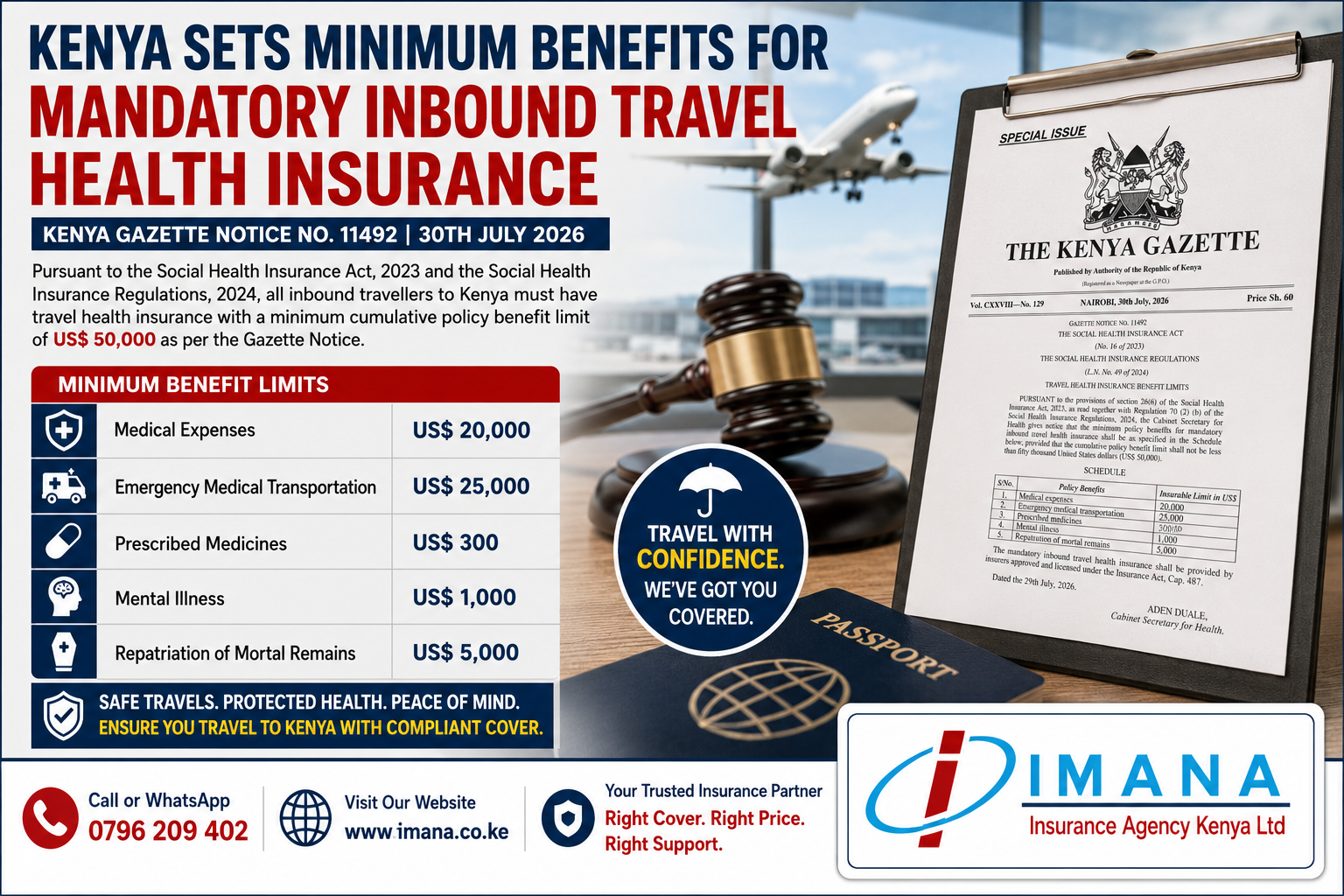
The requirements appear in Gazette Notice No. 11492, published in a Special Issue of the Kenya Gazette dated 30 July 2026. The notice was issued under the Social Health Insurance Act, 2023 and the Social Health Insurance Regulations, 2024.
The Gazette states that the cumulative policy-benefit limit for mandatory inbound travel health insurance must be at least US$50,000.
This is an important development for:
- International visitors travelling to Kenya
- Tourists and safari travellers
- Business visitors
- Expatriates entering Kenya
- Airlines and travel agencies
- Tour operators
- Hotels and hospitality businesses
- Immigration and relocation consultants
- Licensed insurance companies and intermediaries
The new Gazette Notice establishes the minimum medical and repatriation benefits that a qualifying inbound travel health insurance policy must provide.
What Is Mandatory Inbound Travel Health Insurance?
Inbound travel health insurance is medical protection arranged for a person entering Kenya from another country.
Its purpose is to cover eligible healthcare and emergency expenses that may arise while the traveller is in Kenya.
Depending on the policy, protection may include:
- Emergency medical treatment
- Hospitalisation
- Ambulance services
- Emergency medical evacuation
- Prescribed medicines
- Mental-health treatment
- Repatriation following death
- Other approved medical benefits
The Ministry of Health has been developing an administrative framework for implementing a mandatory inbound travel health insurance programme as part of Kenya’s wider Social Health Insurance framework.
This type of cover should not be confused with ordinary trip insurance that mainly protects:
- Flight cancellation
- Lost baggage
- Travel delays
- Missed departures
- Personal belongings
A comprehensive travel policy may contain both medical and non-medical benefits, but it must satisfy the prescribed inbound health-insurance limits where the mandatory requirement applies.
Minimum Benefits Under the July 2026 Gazette Notice
The Gazette establishes the following minimum insurable benefit limits.
1. Medical Expenses — US$20,000
The policy must provide a medical-expenses benefit of at least:
US$20,000
This benefit may be used for eligible healthcare expenses such as:
- Hospital admission
- Doctors’ consultations
- Emergency treatment
- Diagnostic tests
- Surgery
- Other medically necessary treatment
Actual claims remain subject to the policy wording, medical necessity, provider requirements and exclusions.
2. Emergency Medical Transportation — US$25,000
The minimum benefit for emergency medical transportation is:
US$25,000
This is particularly important for travellers visiting areas far from advanced medical facilities.
Emergency transportation may include:
- Ground ambulance
- Air ambulance
- Transfer to an appropriate hospital
- Medical evacuation
- Movement between healthcare facilities
Travellers visiting wildlife parks, remote lodges, rural counties or distant project sites should check whether the policy provides suitable evacuation arrangements.
3. Prescribed Medicines — US$300
The policy must provide at least:
US$300 for prescribed medicines
This benefit may help pay for medicines prescribed as part of eligible treatment during the insured visit.
The policy may still require:
- A valid prescription
- Treatment by an approved medical practitioner
- Pharmacy receipts
- Medical records
- Prior approval in some circumstances
Non-prescription products and routine medicines may be restricted.
4. Mental-Health Treatment — US$1,000
The minimum benefit for mental illness is:
US$1,000
The inclusion of mental-health treatment recognises that travellers may experience medical emergencies involving psychological or psychiatric conditions.
Cover may be subject to:
- Medical assessment
- Emergency-treatment requirements
- Hospital or specialist limits
- Pre-existing-condition exclusions
- Policy definitions
Travellers should not assume that every mental-health condition or planned treatment is covered.
5. Repatriation of Mortal Remains — US$5,000
The policy must provide at least:
US$5,000 for repatriation of mortal remains
This benefit assists with eligible costs of returning the remains of a deceased traveller to their home country.
Costs may include:
- Preparation of the remains
- Required documentation
- Specialised transport arrangements
- Coffin or approved container
- Coordination with airlines and authorities
The benefit does not necessarily cover funeral or burial costs unless these are separately included.
Summary of the Minimum Benefit Limits
The Gazette Notice specifies:
Minimum limit Medical expenses | US$20,000
Emergency medical transportation | US$25,000
Prescribed medicines | US$300
Mental illness | US$1,000
Repatriation of mortal remains | US$5,000
The notice further provides that the cumulative policy-benefit limit must not be less than US$50,000.
These figures are insurance benefit limits, not the amount a visitor must pay as a premium.
The insurance premium will depend on factors such as:
- Traveller’s age
- Length of stay
- Country of origin
- Medical history
- Selected insurer
- Additional benefits
- Activities planned in Kenya
- Individual or group arrangement
Who Will Be Required to Have the Cover?
The Gazette refers specifically to mandatory inbound travel health insurance.
The wider implementation framework has been developed for non-citizens and foreign visitors entering Kenya, particularly persons staying for a limited period rather than permanent Kenyan residents. The final practical application should follow the implementation instructions issued by the Ministry of Health, immigration authorities and the relevant insurance regulators.
Potentially affected travellers may include:
- Tourists
- Business visitors
- Conference delegates
- Short-term consultants
- Visiting family members
- International volunteers
- Researchers
- Students on short programmes
- Digital nomads
- Foreign professionals on temporary assignments
Travellers should confirm the current entry requirements before departure because implementation procedures, exempt categories and approved purchase channels may be clarified or updated.
Who Can Provide the Mandatory Insurance?
The Gazette states that mandatory inbound travel health insurance must be provided by insurers that are:
- Approved
- Licensed under Kenya’s Insurance Act
This means travellers should not purchase the required cover from an unverified seller simply because the document looks official.
Before paying, confirm:
- Name of the underwriting insurer
- Whether the insurer is licensed in Kenya
- Policy-benefit limits
- Period of insurance
- Traveller’s passport details
- Official payment channel
- Certificate-verification method
- Emergency contact information
The requirement is designed around insurance supplied through approved and regulated insurance providers—not informal travel documentation.
Will an Existing International Travel Policy Be Accepted?
This will depend on the implementation and verification rules applied to inbound travellers.
A visitor may already hold:
- Annual worldwide travel insurance
- Employer-sponsored travel cover
- International medical insurance
- Credit-card travel insurance
- Group corporate travel insurance
However, possessing an international policy does not automatically prove that it meets Kenya’s prescribed requirements.
The policy should be checked for:
- A cumulative limit of at least US$50,000
- At least US$20,000 in medical expenses
- At least US$25,000 in emergency medical transportation
- At least US$300 for prescribed medicines
- At least US$1,000 for mental-health treatment
- At least US$5,000 for repatriation of mortal remains
- Valid coverage within Kenya
- Coverage for the complete duration of the visit
- Acceptable verification and documentation
Some international plans may provide higher overall limits but exclude or restrict a specific benefit required by the Gazette.
Why Kenya Is Introducing Mandatory Inbound Health Cover
The requirement can help ensure that international visitors have financial protection when they require treatment in Kenya.
Potential benefits include:
Reduced unpaid medical bills
Hospitals may face difficulties where an uninsured visitor receives emergency care but cannot meet the bill.
Travel health insurance creates a defined source of payment, subject to policy terms.
Faster access to emergency assistance
A suitable travel policy may provide access to:
- Emergency hotlines
- Ambulance coordination
- Hospital referrals
- Medical evacuation
- Claims assistance
Protection against evacuation costs
Emergency evacuation can be expensive, especially from:
- National parks
- Remote safari camps
- Mountain areas
- Islands
- Rural project locations
The US$25,000 minimum emergency-transportation benefit is therefore one of the largest prescribed sublimits.
Clear minimum standards
Previously, visitors could arrive with policies containing widely different medical limits.
The Gazette creates a defined baseline for qualifying cover.
Greater regulatory oversight
Requiring policies to be provided by approved and licensed insurers can help reduce:
- Fraudulent certificates
- Inadequate policies
- Unregulated providers
- Claims uncertainty
- Unverifiable documents
What Is Not Clearly Covered by the Gazette Notice?
The notice establishes minimum benefit limits, but it does not provide every operational detail in the visible schedule.
Further guidance may be required on matters such as:
- Effective enforcement date
- Exempt traveller categories
- Treatment of existing foreign policies
- Verification at entry
- Approved purchase platform
- Policy pricing
- Minimum and maximum period of cover
- Treatment of transit passengers
- Requirements for children
- Diplomatic exemptions
- Long-stay visitor arrangements
- Claims administration
Travellers and industry participants should therefore follow subsequent official communication from the Ministry of Health, Immigration, SHA and insurance regulators.
What Travellers Should Check Before Buying the Policy
Before accepting a travel health insurance quotation, check the following.
Traveller details
Confirm that the certificate correctly shows:
- Full name
- Passport number
- Nationality
- Date of birth
- Travel dates
- Kenya as the insured destination
Medical limits
Check that the policy meets or exceeds every prescribed benefit.
Territorial scope
The policy must apply while the visitor is in Kenya.
Policy duration
Cover should extend across the intended period of stay.
Emergency contact
The visitor should have access to a 24-hour assistance number.
Hospital and payment process
Ask whether the policy operates through:
- Direct hospital billing
- Reimbursement
- Pre-authorisation
- A local assistance company
- A specified provider network
Exclusions
Review exclusions involving:
- Pre-existing medical conditions
- Planned treatment
- Pregnancy
- Alcohol or substance-related incidents
- Hazardous activities
- Adventure sports
- Undeclared medical conditions
- War or civil unrest
Travel Insurance for Safari Visitors
Visitors coming to Kenya for safari travel should pay particular attention to emergency transportation.
A safari itinerary may include areas such as:
- Maasai Mara
- Amboseli
- Samburu
- Tsavo
- Laikipia
- Meru
- Remote coastal destinations
Medical facilities in these locations may be far from a hospital capable of handling a serious emergency.
Travellers should ask whether the policy covers:
- Air evacuation
- Ground ambulance
- Evacuation from a national park
- Transfer to Nairobi or another suitable city
- Emergency stabilisation
- Medical repatriation to the home country
The statutory minimum is a starting point. Travellers with complex itineraries may choose higher benefits.
Travel Agencies, Hotels and Tour Operators Should Prepare
Kenyan travel and hospitality businesses may need to update their customer communication.
They should avoid promising that a particular policy is compliant unless it has been confirmed by the authorised insurer or programme.
Useful preparation may include:
- Informing visitors of the requirement before departure
- Referring clients to licensed insurers or intermediaries
- Checking whether certificates contain accurate details
- Including insurance reminders in booking confirmations
- Training reservation staff
- Providing emergency contact information
- Avoiding unverified insurance sellers
Travel agencies should also distinguish between:
- Mandatory inbound travel health insurance
- Optional trip-cancellation insurance
- Baggage insurance
- Personal Accident cover
- Emergency evacuation extensions
How to Make an Inbound Travel Health Insurance Claim
The exact process depends on the insurer, but visitors should generally take the following steps.
1. Contact the emergency-assistance number
Notify the insurer immediately, especially before non-emergency admission or evacuation.
2. Present the insurance certificate
Provide the hospital with:
- Policy number
- Traveller’s passport
- Insurer details
- Assistance-company contact
3. Obtain pre-authorisation
Planned or expensive treatment may require prior approval.
4. Keep medical documents
Retain:
- Medical reports
- Prescriptions
- Invoices
- Receipts
- Test results
- Discharge summary
- Ambulance records
5. Follow the claims procedure
Some expenses may be paid directly, while others may be reimbursed after the traveller submits documentation.
Documents That May Be Required
A travel medical claim may require:
- Completed claim form
- Passport copy
- Travel itinerary
- Entry records
- Insurance certificate
- Medical report
- Prescriptions
- Original receipts
- Hospital invoice
- Proof of payment
- Ambulance report
- Death certificate and repatriation documents where applicable
Incomplete documentation can delay reimbursement.
Common Mistakes Visitors Should Avoid
Buying only flight-cancellation insurance
A trip-cancellation policy may not satisfy Kenya’s medical-benefit requirements.
Looking only at the total limit
The overall policy may exceed US$50,000 while one required sublimit remains too low.
Using incorrect travel dates
The policy should cover the entire stay.
Providing an incorrect passport number
Certificate and immigration details should match.
Assuming credit-card insurance is automatically sufficient
The underlying benefits and verification requirements must be checked.
Buying from an unlicensed seller
The Gazette requires cover to be provided by approved and licensed insurers.
Ignoring emergency-assistance procedures
Treatment or evacuation undertaken without required authorisation may create claim problems.
How Imana Can Assist With Travel Insurance
Imana Insurance Agency Kenya Ltd can help travellers, sponsors, travel agencies and international organisations compare travel insurance options from suitable licensed insurers.
Support may include:
- Confirming the traveller’s details.
- Reviewing the travel dates and itinerary.
- Comparing available policy benefits.
- Checking medical and evacuation limits.
- Coordinating policy issuance.
- Providing the digital certificate.
- Explaining emergency contact procedures.
- Assisting with claims notification.
A suitable travel policy may also include optional benefits such as:
- Trip cancellation
- Trip interruption
- Lost baggage
- Travel delay
- Passport loss
- Personal liability
- Personal Accident
- Higher medical limits
- Medical repatriation
Travel Insurance Services in Kenya
Imana Insurance Agency Kenya Ltd
4th Floor, Krishna Centre
Woodvale Grove, Westlands
Nairobi, Kenya
Website: www.imana.co.ke
Call or WhatsApp: +254 796 209 402
Confirm the limits. Check the insurer. Insure the complete journey. Let Imana help you compare suitable options.
Frequently Asked Questions
What did the Kenya Gazette announce?
Gazette Notice No. 11492 established minimum benefit limits for mandatory inbound travel health insurance, including an overall policy-benefit limit of at least US$50,000. (Kenya Law)
What is the minimum medical-expenses benefit?
The minimum is US$20,000.
What is the minimum emergency-transportation benefit?
The minimum is US$25,000.
Are prescribed medicines included?
Yes. The prescribed minimum benefit is US$300.
Is mental-health treatment included?
Yes. The minimum stated benefit is US$1,000.
Does the policy cover repatriation after death?
It must provide at least US$5,000 for repatriation of mortal remains.
Is US$50,000 the insurance premium?
No. It is the minimum cumulative policy-benefit limit. The premium will be much lower and will depend on the insurer, traveller and duration.
Can any company issue the policy?
The Gazette states that it should be provided by insurers approved and licensed under Kenya’s Insurance Act.
Does ordinary travel insurance qualify?
Only where it satisfies the prescribed benefits and any applicable verification or implementation requirements.
Should travellers wait until they arrive in Kenya?
It is safer to confirm and arrange the required cover before travel, once the approved purchase and verification process has been established.
Can the limits change?
Yes. Government requirements and implementation procedures may be amended through later notices or regulations.
The Bottom Line
Kenya’s July 2026 Gazette Notice creates a clear minimum-benefit structure for mandatory inbound travel health insurance.
A compliant policy must provide a cumulative benefit limit of at least US$50,000, supported by minimum benefits for:
- Medical expenses
- Emergency medical transportation
- Prescribed medicines
- Mental-health treatment
- Repatriation of mortal remains
The announcement is significant for travellers, insurers, tour operators, hotels, airlines and Kenya’s wider tourism industry.
Travel documentation should not end with a passport and ticket. Suitable health insurance ensures that an unexpected medical emergency does not become an unmanageable financial crisis.
Imana Insurance Agency Kenya Ltd
Website: www.imana.co.ke
Call or WhatsApp: +254 796 209 402
Visit Kenya prepared. Confirm the benefits. Travel with suitable medical protection.
This article is based on Gazette Notice No. 11492 published in the Kenya Gazette on 30 July 2026. The notice establishes minimum benefits but does not contain every implementation detail. Travellers and service providers should confirm subsequent guidance, effective dates, approved channels, exemptions and verification requirements through the relevant Kenyan authorities before travel.