- Author: Raymond
- Category: COMESA Yellow Card Insurance
Injured by a Foreign Vehicle in Kenya? How to Claim Compensation Through COMESA
Roads don’t ask for passports. Accidents don’t care about borders. One minute Kevin is walking through Nairobi CBD, the next — impact. A Ugandan-registered vehicle hits him. The car is foreign, the insurance is foreign, but the pain? The hospital bills? The disruption to life? All local. All real.
So what happens next?
If the foreign vehicle had a valid COMESA Yellow Card, Kevin can claim compensation right here in Kenya. Let’s break it down — clearly, practically, step by step.
Understanding COMESA Yellow Card — The Cross-Border Protection
The COMESA Yellow Card Scheme is a regional motor insurance system that allows vehicles to move across member countries while maintaining valid third-party liability cover.
If a foreign vehicle causes injury in Kenya and holds a valid COMESA Yellow Card, the victim does not need to pursue the insurer in the foreign country.
The claim is handled locally through the:
Kenya National Bureau,
which is managed by:
Kenya Reinsurance Corporation.
They act on behalf of the foreign insurer (in this case, the Ugandan insurance company) to process compensation for injured third parties like Kevin.
Step 1 — The Police Abstract: The Birth of the Claim
Everything begins here.
After the accident, Kevin must obtain:
- Police Abstract
- OB number
- Confirmation the Ugandan vehicle was involved
- Preliminary indication of fault (if available)
If the foreign vehicle is not properly recorded in the police report, the claim becomes difficult to prove. Documentation is power.
Step 2 — Confirm the COMESA Cover Was Valid
Not every foreign vehicle is properly insured. Kevin (or his advisor) must confirm:
- The vehicle had a valid COMESA Yellow Card
- The policy was active on the accident date
This verification is done through police records and the Kenya National Bureau.
If the COMESA cover was invalid or expired, the claim becomes more complex and may shift toward direct legal recovery from the vehicle owner.
Step 3 — Medical Evidence Builds the Value of the Claim
Injury claims live and die on documentation. Kevin must preserve:
- Treatment notes and hospital records
- P3 Form (medical legal report in Kenya)
- Doctor’s medical report
- All medical bills and receipts
- X-rays, scans, lab reports
- Future treatment or disability assessment
No documents = weak claim.
Clear medical evidence = stronger compensation.
Step 4 — Issue a Legal Demand
Most bodily injury claims under COMESA require legal representation.
An advocate prepares and serves a demand letter to the Kenya National Bureau, attaching:
- Police abstract
- Medical evidence
- Proof of negligence
- Claim valuation
This formally notifies the COMESA system of the injury claim.
Step 5 — Most COMESA Injury Claims Go Through Court
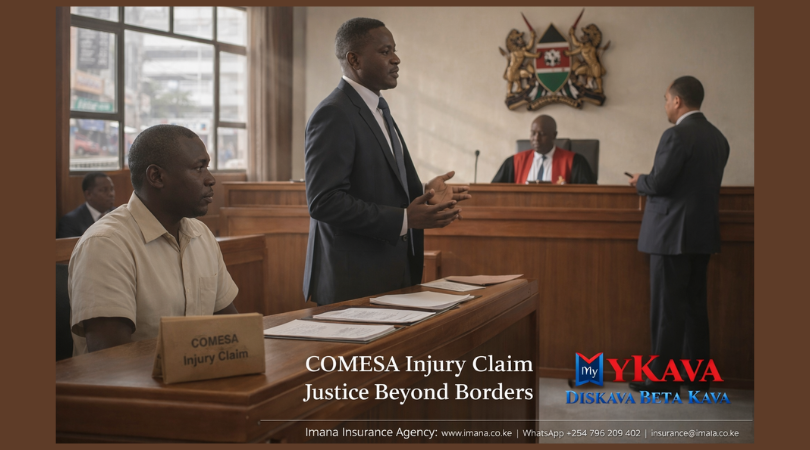
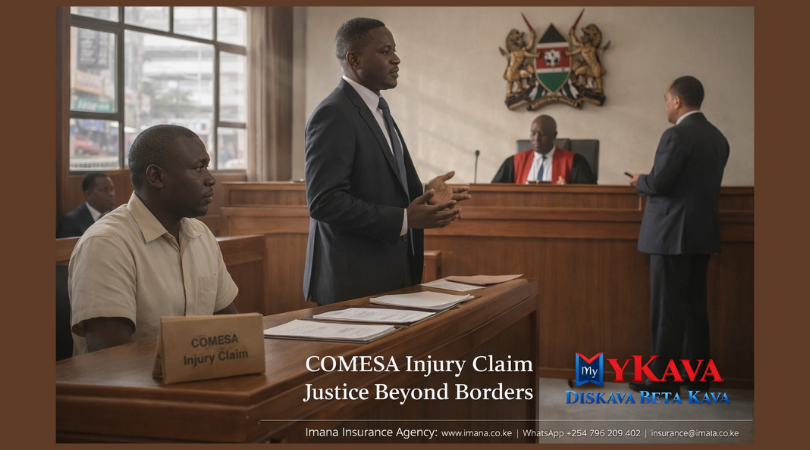
Here’s the reality: injury compensation under COMESA is usually determined by a court.
The process flows like this:
- Lawyer files a personal injury suit in Kenya
- Kenya National Bureau appoints lawyers to defend on behalf of the foreign insurer
- Medical evidence is reviewed
- Court determines liability and compensation
- Payment is processed through the Kenya National Bureau
Patience matters. Proper documentation matters more.
What Compensation Can Kevin Receive?
Depending on injury severity, compensation may include:
- Pain and suffering
- Medical expenses (past and future)
- Loss of income
- Reduced earning ability
- Permanent disability
- Emotional and psychological impact (in some cases)
The amount depends on medical evidence, injury seriousness, and court assessment.
Critical Legal Facts Every Victim Must Know
1. Time Limit (Limitation Period)
In Kenya, personal injury claims must be filed within 3 years from the accident date.
2. COMESA Covers Third-Party Victims Only
It compensates injured persons like Kevin — not the foreign driver’s own injuries or vehicle damage.
3. Court Process Takes Time
This is not instant compensation. Proper legal handling ensures the best outcome.
4. Documentation Determines Success
Police records + medical evidence + legal structure = successful claim.
The Claim Journey — Simple Flow
Accident → Police Abstract → Medical Evidence → Legal Demand → Court → Judgment → Compensation via Kenya National Bureau (Kenya Re)
Practical Advice for Accident Victims
If someone like Kevin wants a smooth, successful claim:
- Keep all medical documents
- Confirm COMESA validity early
- Avoid informal settlements without records
- Use an advocate experienced in motor injury and cross-border claims
- Act within the 3-year legal timeline
Need Guidance or Claim Support?
If you or someone you know is injured by a foreign vehicle in Kenya and needs structured claim guidance, documentation support, or professional follow-up:
🌐 Website: www.imana.co.ke
📧 Email: insurance@imana.co.ke
📱 WhatsApp: +254 796 209 402
📍 Office: 4th Floor, Krishna Centre, Woodvale Grove, Westlands, Nairobi