- Author: Raymond
- Category: Insurance Bonds in Kenya
Insurance Bonds in Kenya: Compare 5 Common Types
Compare performance, bid, customs, immigration and advance payment bonds in Kenya. Understand their uses, costs and application requirements.
Author: Raymond Momanyi, Founder & CEO, Imana Insurance Agency Kenya Ltd
Businesses in Kenya frequently encounter insurance bonds when bidding for contracts, importing goods, undertaking construction projects, sponsoring foreign nationals or receiving advance payments.
However, a bid bond, performance bond, customs bond, immigration bond and advance payment bond do not guarantee the same obligation.
Submitting the wrong bond—or presenting one with incorrect wording, value or validity—can delay customs clearance, prevent contract signing or disqualify an otherwise competitive tender.
This insurance bonds authority guide explains the common types of bonds in Kenya, their purposes, approximate pricing, application requirements and the important details businesses should compare before purchasing them.
What Is an Insurance Bond?
An insurance bond is a financial guarantee issued by an insurance company on behalf of a contractor, supplier, importer, employer or another applicant.
A bond generally involves three parties:
- The principal: The contractor, bidder, importer, employer or applicant whose obligation is being guaranteed.
- The beneficiary or obligee: The client, procuring entity, government agency or organisation requiring the bond.
- The surety or guarantor: The insurance company or financial institution issuing the bond.
If the principal fails to meet the guaranteed obligation and the beneficiary makes a valid demand, the surety may be required to pay up to the bond amount.
The Kenya Revenue Authority describes a customs bond as a legal undertaking under which the parties bind themselves to pay a specified amount if the conditions of the bond are not fulfilled.
Is an Insurance Bond the Same as an Insurance Policy?
Not exactly.
A conventional insurance policy generally protects the insured against specified accidental losses. A bond guarantees that the principal will fulfil a contractual, financial or legal obligation.
If an insurer pays a valid bond demand, it may seek reimbursement from the principal under the counter-indemnity agreement.
This means applicants should not treat bonds as substitutes for:
- Contractors All Risks insurance
- WIBA insurance
- Public Liability insurance
- Professional Indemnity insurance
- Marine Cargo insurance
- Goods in Transit insurance
- Property insurance
- Motor Fleet insurance
A contractor may need both a performance bond and relevant insurance policies for the same project.
Quick Comparison of Insurance Bonds in Kenya
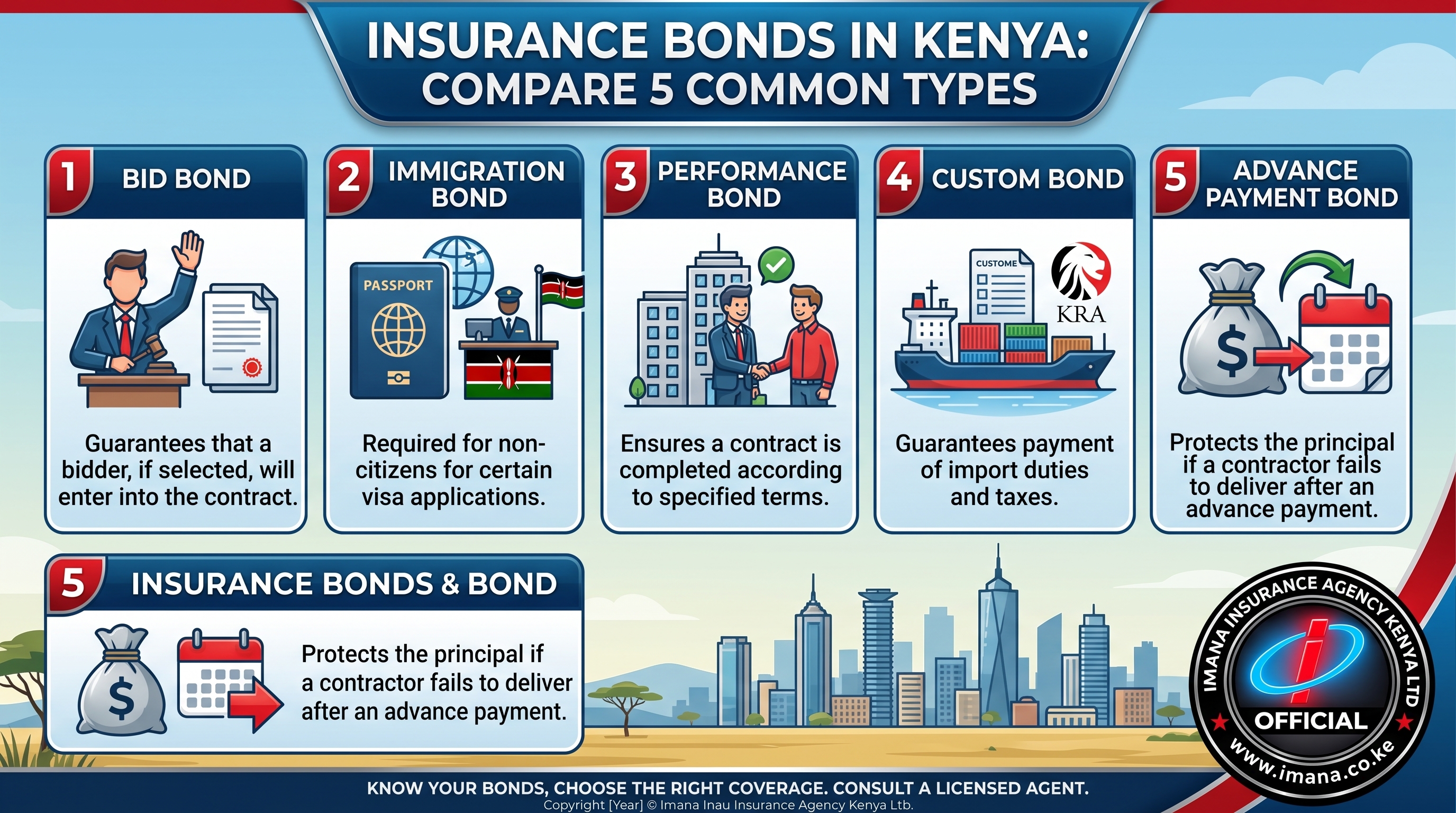
The five common bonds serve different purposes:
- A bid bond supports a bidder’s commitment during the tender process.
- A performance bond guarantees the successful bidder’s performance after the contract is awarded.
- A customs bond secures customs duties, taxes and compliance obligations.
- An immigration bond guarantees specified obligations involving a foreign national, employer or sponsor.
- An advance payment bond protects money released before work is completed or goods are supplied.
The correct bond should always be determined from the tender document, contract, KRA instruction, immigration requirement or beneficiary’s prescribed wording.
1. Performance Bonds in Kenya
A performance bond guarantees that a contractor, supplier or service provider will perform an awarded contract according to the agreed conditions.
It is normally requested after a bidder has won the tender but before the contract is signed or implementation begins.
Who may require a performance bond?
Performance bonds are commonly requested from:
- Building contractors
- Road and civil-works contractors
- Engineering companies
- Equipment suppliers
- ICT service providers
- Cleaning and security companies
- Consultants
- Government suppliers
- Manufacturers
- Companies undertaking large private contracts
How much performance security is required?
The performance security is normally expressed as a percentage of the contract value.
Tender documents frequently specify an amount equivalent to approximately 5% or 10% of the contract value, although the beneficiary may require a different percentage.
The Public Procurement and Asset Disposal Regulations require procuring entities to state their performance-security requirements in the bidding documents.
Approximate performance bond premium
An insurance performance bond may attract an indicative premium of approximately 1%–4% of the bond amount per year.
For example:
- A KSh 5 million contract requiring a 5% performance bond produces a bond amount of KSh 250,000. At an illustrative 2% premium rate, the estimated premium would be KSh 5,000.
- A KSh 10 million contract requiring a 10% performance bond produces a bond amount of KSh 1 million. At an illustrative 2% rate, the estimated premium would be KSh 20,000.
- A KSh 50 million contract requiring a 10% performance bond produces a bond amount of KSh 5 million. At an illustrative 2% rate, the estimated premium would be KSh 100,000.
These examples are not binding quotations. Minimum premiums, taxes, collateral, duration and counter-indemnity requirements may affect the final price.
Read more in Imana’s existing guides:
2. Bid Bonds and Tender Securities
A bid bond—also called a tender bond, bid security or tender security—supports a bidder’s commitment during the tendering process.
The bond may protect the procuring entity if the bidder:
- Withdraws the bid during its validity period
- Refuses to accept the award
- Fails to sign the contract
- Fails to provide the required performance security
- Breaches another condition stated in the tender
A bid bond does not guarantee the completion of the project. That is the role of a performance bond.
How much is a bid bond?
The tender document should state:
- The required bond amount
- Whether it is a fixed amount or percentage
- The permitted form of security
- The required validity period
- Acceptable issuers
- Required bond wording
A tender may require a fixed security such as KSh 50,000, while another may calculate the security as a percentage of the tender value.
PPRA tender documents demonstrate that bid securities may be issued by acceptable banks or insurance companies. PPRA also publishes a list of insurance companies authorised to issue bid securities. (ppra.go.ke)
Approximate bid bond premium
Bid bonds generally sit at the lower end of the insurance-bond price range.
An indicative premium may be approximately 0.5%–2% of the bond amount, subject to the issuing insurer’s minimum premium.
Small bid bonds may therefore be charged at the insurer’s minimum premium rather than through a strict percentage calculation.
Documents commonly required
An applicant may need:
- The complete tender document
- The tender-security section
- Prescribed bond wording
- Completed proposal form
- Certificate of incorporation
- Company KRA PIN
- Current CR12
- Directors’ identification documents
- Business profile
- Evidence of relevant experience
- Financial information where required
Read Imana’s dedicated Bid Bonds in Kenya guide.
3. Customs and Import Bonds
A customs bond guarantees specified obligations owed to the Kenya Revenue Authority when goods are imported, warehoused, moved under customs control or temporarily admitted without immediate payment of all applicable duties.
KRA explains that where customs cannot recover the relevant duties, taxes, fines or penalties from the importer, the surety may be called upon under the bond.
When is a customs bond required?
Customs security may be required for:
- Goods in transit
- Temporary importation
- Bonded warehouses
- Manufacture under bond
- Transit godowns
- Duty remission or exemption
- Export Processing Zone movements
- Removal of goods under customs control
- Disputed customs assessments
- Regional customs movements
KRA confirms that bond guarantees are required for goods declared for warehousing, temporary importation, transit and certain duty-remission or exemption arrangements.
Kenya also rolled out the EAC Customs Bond in March 2026 to support regional customs movements within the East African Community framework.
Approximate customs bond premium
A customs bond may attract an indicative premium of approximately 0.5%–3% of the guaranteed amount per year.
The actual rate depends on:
- Type of customs bond
- Required bond amount
- Validity period
- Nature and value of the goods
- Customs exposure
- Importation history
- Previous customs compliance
- Financial strength of the applicant
- Required collateral or counter-security
Applicants should obtain the correct KRA instruction, customs entry or prescribed bond form before requesting a quotation.
4. Immigration or Security Bonds
An immigration bond guarantees specified obligations connected to a foreign national’s stay, employment, business activities or immigration status in Kenya.
It may provide financial security for costs or obligations that arise if the applicable immigration conditions are breached.
Who may need an immigration bond?
An immigration bond may be requested from:
- Employers sponsoring foreign employees
- Work-permit applicants
- Foreign contractors
- International consultants
- Investors and business owners
- Sponsors of non-citizens
- Applicants directed to provide security by immigration authorities
What determines the immigration bond premium?
Pricing depends on:
- Required bond amount
- Immigration instructions
- Applicant’s status
- Employer or sponsor profile
- Period of the bond
- Prescribed wording
- Supporting documents
- Insurer’s minimum premium
- Underwriting assessment
For initial budgeting, an immigration bond may attract a minimum premium or an indicative charge of approximately 1%–4% of the bond amount.
The insurer must review the official requirement before providing a firm quotation.
5. Advance Payment Bonds
An advance payment bond protects a client or procuring entity that releases money to a contractor or supplier before the contracted work is completed or goods are delivered.
The bond may be called if the recipient fails to use, account for or repay the advance according to the contract.
Advance payment bond example
Suppose a contractor wins a KSh 20 million project and receives a 20% advance for mobilisation, labour, equipment and materials.
The advance payment is KSh 4 million.
If the contract requires security equal to the advance, the contractor must provide an advance payment bond of KSh 4 million before receiving the money.
Under Kenya’s public-procurement framework, an advance payment may, in exceptional circumstances, be up to 20% of the tender price and supported by security equivalent to the advance. The applicable procurement documents must always be followed.
Approximate advance payment bond premium
An indicative premium may be approximately 1%–4% of the bond amount per year.
Advance payment bonds generally receive detailed underwriting because the beneficiary releases money before the principal completes the obligation.
The insurer may request:
- Signed contract
- Award letter
- Advance-payment clause
- Project implementation schedule
- Audited financial statements
- Recent management accounts
- Bank statements
- Evidence of similar completed projects
- Directors’ counter-indemnity
- Collateral or additional security
- Details explaining how the advance will be used
Approximate Insurance Bond Price Index in Kenya
Businesses can use the following ranges for preliminary budgeting:
- Bid Bonds: Approximately 0.5%–2% of the bond amount.
- Performance Bonds: Approximately 1%–4% of the bond amount per year.
- Customs Bonds: Approximately 0.5%–3% of the guaranteed amount per year.
- Immigration Bonds: Approximately 1%–4% of the bond amount or the insurer’s minimum premium.
- Advance Payment Bonds: Approximately 1%–4% of the bond amount per year.
These figures are approximate planning indicators—not standard market tariffs or guaranteed quotations.
Bond Amount Versus Bond Premium
The bond amount and the premium are not the same thing.
If a tender requires a KSh 1 million performance bond, the applicant does not necessarily pay KSh 1 million to the insurer.
The insurer charges a smaller premium for issuing the guarantee. The principal may also be required to provide collateral, a counter-indemnity or another form of security.
The final cost may include:
- Basic premium
- Insurance Premium Levy
- Policyholder Compensation Fund contribution
- Stamp duty
- Other applicable statutory charges
- Collateral or security costs
- Extension or renewal charges
Always request a complete quotation showing the premium, taxes and underwriting conditions.
What Determines Whether a Bond Is Approved?
Insurance companies may consider:
- Applicant’s financial position
- Contract value and duration
- Required bond amount
- Experience with similar contracts
- Existing projects and current workload
- Credit history
- Previous bond claims
- Tender or contract conditions
- Beneficiary’s prescribed wording
- Directors’ profiles
- Available collateral
- Counter-indemnity arrangements
- Related insurance policies
- Applicant’s ability to complete the obligation
A bond is not automatically issued simply because the applicant is willing to pay the premium.
The insurer must be satisfied that the principal has the technical and financial ability to meet the guaranteed obligation.
Documents Required for an Insurance Bond Quotation
Requirements vary according to the type and amount of the bond.
Applicants should generally prepare:
- Formal bond request
- Tender document or signed contract
- Prescribed bond wording
- Award letter, where applicable
- Certificate of incorporation
- Company KRA PIN
- Current CR12
- Directors’ identification documents
- Directors’ KRA PINs
- Business profile
- Audited financial statements
- Recent management accounts
- Bank statements
- Evidence of previous projects
- Existing contracts and work schedules
- Counter-indemnity documents
- Customs or immigration instructions, where applicable
Providing complete documents early helps prevent delays—especially when a tender closing date is approaching.
Common Insurance Bond Application Mistakes
Businesses should avoid:
- Requesting a performance bond when the tender requires a bid bond
- Calculating the bond using the wrong contract percentage
- Ignoring the prescribed wording
- Using an issuer not accepted by the beneficiary
- Providing an insufficient validity period
- Applying on the tender-closing date
- Confusing the bond amount with the premium
- Failing to disclose existing bonds and financial obligations
- Assuming every bond application will be approved
- Selecting the cheapest option without checking compliance
- Allowing an active bond to expire before obtaining an extension
One missing word, incorrect date or insufficient validity period can turn an affordable bond into a very expensive mistake.
How to Compare Insurance Bond Quotations
Do not compare premiums alone.
Consider:
- Whether the insurer is acceptable to the beneficiary
- Total premium and statutory charges
- Required collateral
- Counter-indemnity terms
- Bond wording
- Validity period
- Processing time
- Renewal or extension costs
- Cancellation conditions
- Claim provisions
- Recovery rights after a valid claim
For public procurement, applicants should verify the tender document and current PPRA requirements before submitting the security. PPRA maintains a list of insurance companies authorised to issue bid securities.
Frequently Asked Questions About Insurance Bonds in Kenya
Is a bid bond the same as a performance bond?
No. A bid bond supports the bidder’s commitment during the tender process. A performance bond is normally provided after the contract is awarded to guarantee performance.
Is a tender security the same as a bid bond?
The terms are often used interchangeably. However, the tender document determines the permitted type and format of security.
Can an insurance company issue a bid bond in Kenya?
Yes, where the tender permits an insurance-company guarantee and the issuing insurer meets the procuring entity’s requirements.
Is the insurance bond premium refundable?
The premium pays for the guarantee provided during the stated period and is generally not automatically refundable. Applicants should confirm cancellation and refund conditions before payment.
Does every applicant qualify for an insurance bond?
No. Approval depends on the applicant’s financial capacity, experience, documentation, credit profile and acceptance of the insurer’s counter-indemnity or collateral requirements.
Can a performance bond be extended?
It may be extended with the insurer’s approval. Apply before the existing bond expires and provide the beneficiary’s extension request, updated contract information and any additional premium or security required.
What happens when a bond is called?
The beneficiary makes a demand according to the bond wording. If the demand is valid, the surety may pay up to the guaranteed amount and seek recovery from the principal under the counter-indemnity.
How quickly can a bond be issued?
A straightforward bid bond may be processed quickly when the documents are complete. Performance, customs and advance payment bonds normally require deeper underwriting and may take longer.
Can a new company obtain a performance bond?
Possibly, but the insurer may require stronger financial evidence, directors’ guarantees, collateral, relevant professional experience or proof that the company can complete the contract.
Request an Insurance Bond Quotation in Kenya
Imana Insurance Agency Kenya Ltd is a Westlands-based insurance intermediary helping individuals, families and businesses compare insurance quotations from licensed Kenyan insurers across Motor, Medical, WIBA, PSV, Travel, Motorcycle, Corporate and other insurance classes.
Imana can assist businesses with quotations and requirements for:
- Performance bonds
- Bid bonds and tender securities
- Customs and import bonds
- Immigration bonds
- Advance payment bonds
- Other contract-related guarantees
Imana can also help contractors and businesses compare related protection, including:
- Corporate Insurance
- WIBA Insurance
- Professional Indemnity Insurance
- Contractors Insurance and Tender Requirements
- Bid Bonds and Performance Bonds in Kenya
- Tender and Performance Bond Quotations
- Compare Insurance Quotations in Kenya
Contact Imana Insurance Agency Kenya Ltd
Office: 4th Floor, Krishna Centre, Woodvale Grove, Westlands, Nairobi
Call/WhatsApp: +254 796 209 402
Email: insurance@imana.co.ke
Quotation website: www.imanainsurance.com
Insurance information: www.imana.co.ke
Online comparison platform: www.mykava.co.ke
Compare. Buy. Save.
About the Author
Raymond Momanyi is the Founder and CEO of Imana Insurance Agency Kenya Ltd. His areas of expertise include motor insurance, medical insurance, WIBA, PSV insurance comparison, business risk, insurance bonds and claims support.
Disclaimer: The premium ranges and examples provided in this guide are approximate planning indicators. They are not binding quotations, statutory tariffs or guarantees of approval. Final pricing, taxes, wording, collateral, validity and issuance are subject to the beneficiary’s requirements and the issuing insurer’s underwriting.