- Author: Raymond
- Category: Car Insurance in Kenya
- Category: Comprehensive Car Insurance in Kenya
Salvage Vehicles in Kenya: What Car Owners, Buyers and Repairers Should Know Under the 2026 Motor Vehicle Inspection Rules
Buying a car in Kenya is already a serious financial decision. For many people, it is not just transport. It is savings, sacrifice, business, family convenience and sometimes even a dream finally achieved.
But when it comes to salvage vehicles, that dream can quickly become a nightmare if you do not understand what you are buying.
With the introduction of the 2026 Motor Vehicle Inspection Rules, Kenya is moving towards stricter control of vehicle roadworthiness, inspection, re-registration, accident assessment and salvage vehicle classification. This is an important shift for car owners, buyers, garages, motor dealers, insurance companies and anyone involved in accident-damaged vehicles.
The biggest message is simple:
Do not buy, repair or insure a salvage vehicle blindly.
What Is a Salvage Vehicle?
A salvage vehicle is generally a vehicle that has been damaged to the extent that its safety, structure, value or roadworthiness has been seriously affected.
This damage may arise from:
- A major road accident
- Fire damage
- Flood damage
- Structural damage
- Severe mechanical impact
- Theft recovery damage
- An insurance write-off
- A vehicle declared uneconomical or unsafe to repair
In the past, many damaged vehicles found their way back onto Kenyan roads after repairs that were not always properly inspected. Some were repaired well. Others were repaired cosmetically, looking clean outside while carrying serious structural weaknesses underneath.
That is exactly where the risk begins.
A car may look beautiful in the yard, but the chassis, frame, pillars, suspension mounting points or safety systems may have been badly affected. Without proper inspection and documentation, the buyer may only discover the truth after paying.
Why the 2026 Rules Matter
The 2026 Motor Vehicle Inspection Rules are intended to improve road safety, strengthen vehicle inspection standards and reduce the number of unsafe vehicles operating on public roads.
For salvage vehicles, the rules introduce a more serious approach to classification and roadworthiness. This matters because not every damaged vehicle should return to the road.
Some vehicles can be repaired safely.
Some should never be driven again.
The law now seeks to separate these vehicles more clearly through a structured classification system.
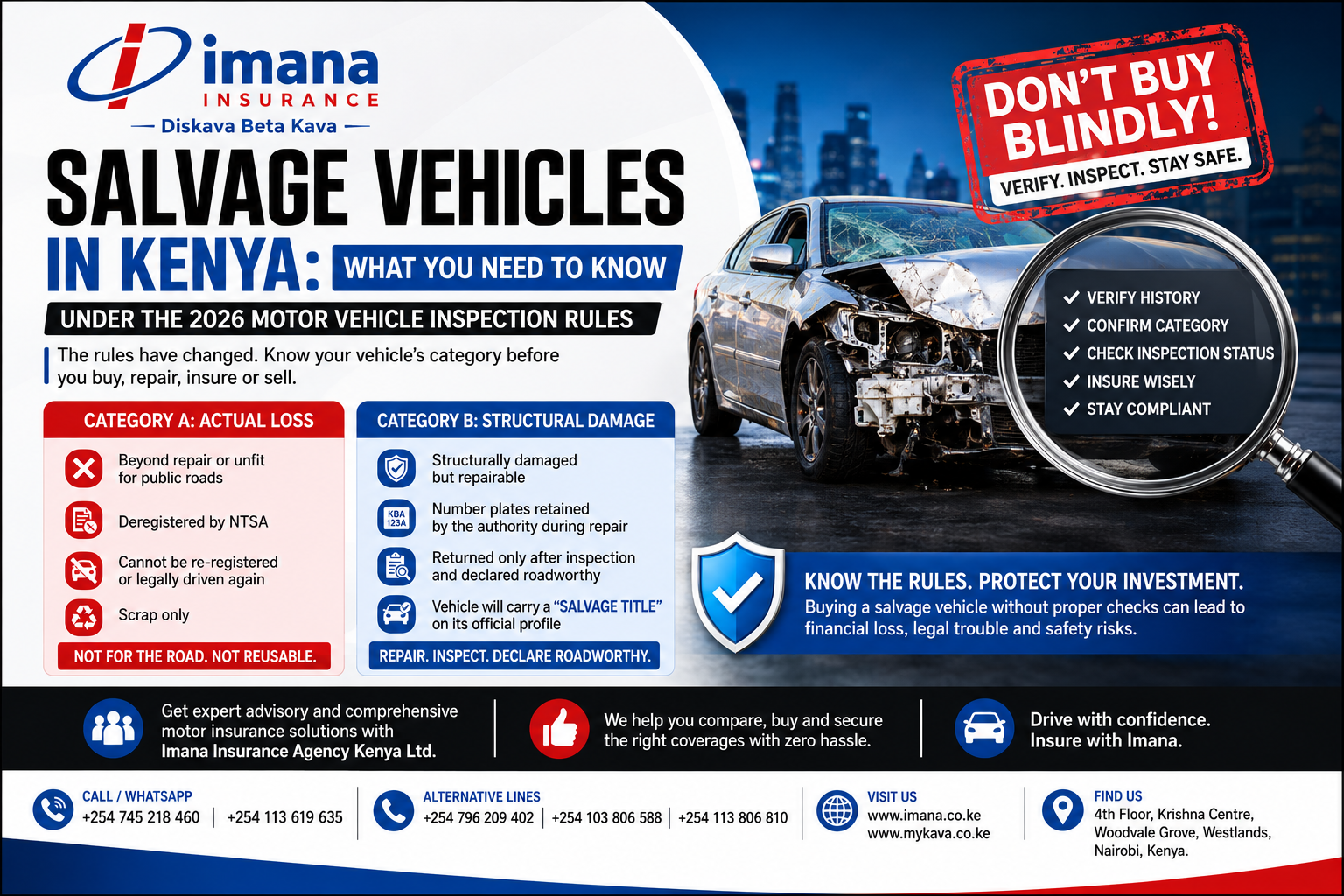
Category A: Actual or Total Loss
Category A refers to vehicles that are considered actual loss.
These are vehicles that are deemed completely unsuitable for public roads or beyond repair. In simple language, this is the category for vehicles that should not return to the road.
A Category A vehicle may be one that has suffered such severe damage that repair is either impossible, unsafe or not legally acceptable.
What Happens to a Category A Vehicle?
A vehicle classified under Category A may be:
- Declared unfit for public roads
- Treated as beyond repair
- Deregistered by NTSA
- Barred from being re-registered
- Prohibited from legally returning to the road
In practical terms, this kind of vehicle is suitable for scrap only.
For buyers, this is extremely important. If you unknowingly buy a Category A vehicle, you may end up with a car that cannot be legally registered, insured or driven.
That is not a small mistake. That is money trapped in metal.
Category B: Structural Damage
Category B refers to vehicles that have suffered structural damage but are considered repairable.
This means the vehicle has been damaged in a serious way, especially around areas that affect strength, alignment and safety. However, unlike Category A, the vehicle may still be allowed back on the road after proper repairs and inspection.
What Happens to a Category B Vehicle?
A Category B vehicle may go through the following process:
- It is identified as structurally damaged
- It is declared repairable
- Number plates may be retained during the repair process
- Repairs must be carried out properly
- The vehicle must undergo inspection
- It can only return to the road after being declared roadworthy
The key point here is that repair alone is not enough.
A mechanic saying “hii gari iko sawa” is not enough.
A fresh paint job is not enough.
A clean interior is not enough.
The vehicle must be inspected and declared roadworthy before it can safely and legally return to the road.
Why Salvage Classification Is Important for Car Buyers
Many Kenyans buy cars based on appearance, price and pressure.
The seller says:
“Gari ni clean.”
“Ni accident kidogo tu.”
“Ni bumper pekee iliguswa.”
“Engine iko perfect.”
“Logbook iko.”
But salvage vehicles require deeper questioning.
Before buying any accident-damaged, repaired or suspiciously cheap vehicle, ask yourself:
- Has the vehicle been involved in a major accident?
- Was it written off by an insurance company?
- Was the chassis or structure affected?
- Has it passed inspection?
- Is the logbook clean?
- Does the vehicle have any salvage classification?
- Are the number plates valid and properly released?
- Can it be comprehensively insured?
- Will an insurer accept the risk?
- What will happen during resale?
A cheap vehicle can become very expensive if it comes with hidden legal, mechanical or insurance problems.
Why This Matters for Insurance
Insurance companies do not just look at the colour of your car and issue cover blindly. The condition, value, use, ownership and risk profile of the vehicle matter.
For salvage vehicles, insurers may need to know:
- Whether the vehicle was previously written off
- Whether it was structurally damaged
- Whether it has passed inspection
- Whether it is roadworthy
- Whether repairs were professionally done
- Whether the vehicle has a salvage title or record
- Whether the value declared is realistic
- Whether the vehicle qualifies for comprehensive insurance
If a vehicle has hidden salvage history and this is not disclosed, problems may arise later during claims.
Imagine buying comprehensive insurance, then after an accident the insurer discovers that the vehicle had previous structural damage that was never disclosed. That can complicate the claim process badly.
Disclosure matters.
Inspection matters.
Proper valuation matters.
Legal and Financial Risks of Ignoring Salvage Status
The biggest mistake people make is treating salvage status as a small technical issue.
It is not.
Salvage classification can affect:
- Registration
- Re-registration
- Roadworthiness
- Insurance eligibility
- Claim settlement
- Resale value
- Buyer confidence
- Legal compliance
- Safety of passengers and other road users
If a vehicle should be classified as salvage but is operating without proper endorsement or inspection, the owner, seller, repairer or insurer may face serious compliance questions.
For businesses dealing in accident vehicles, this is even more serious. Motor dealers, garages, valuers, assessors and insurance players must be careful with documentation and reporting.
The era of “repair, repaint and return to road” is changing.
Kenya is moving toward a more accountable motor vehicle ecosystem.
What Car Owners Should Do After a Serious Accident
If your vehicle is involved in a serious accident, do not rush the process.
Here is what you should do:
- Report the accident to the relevant authorities.
- Notify your insurance company immediately.
- Do not authorize major repairs before proper assessment.
- Allow an assessor or valuer to inspect the vehicle.
- Confirm whether the vehicle is repairable or a total loss.
- Keep all repair records, inspection reports and communication.
- Confirm whether the vehicle requires re-inspection before returning to the road.
- Do not sell the vehicle without disclosing its true condition.
A serious accident is not just a garage issue. It is also an insurance, safety and compliance issue.
What Buyers Should Check Before Buying a Salvage or Repaired Vehicle
Before paying for a repaired or accident-history vehicle, take your time.
Check the following:
- NTSA ownership and registration details
- Logbook status
- Accident history where available
- Insurance write-off history where possible
- Physical inspection report
- Chassis alignment
- Airbag status
- Structural repair quality
- Engine and gearbox condition
- Suspension mounting points
- Road test performance
- Professional valuation report
- Whether the vehicle can be insured comprehensively
Never rely on photos alone.
Never rely on the seller’s word alone.
Never buy under pressure because “someone else is coming with cash.”
A good vehicle will survive proper due diligence.
A bad deal will fear inspection.
What Repairers and Garages Should Know
Garages and repairers also have a major role to play.
Under stricter inspection rules, repair quality will matter more than ever. Structural repairs must not be treated like normal bodywork.
Repairers should keep proper records of:
- Damage assessment
- Parts replaced
- Structural repairs done
- Welding work
- Alignment reports
- Paint and panel work
- Safety system restoration
- Final roadworthiness checks
For vehicles with structural damage, poor repairs can put lives at risk. The vehicle may look fine but fail badly in another accident.
Road safety begins long before the car returns to the highway.
Why Professional Motor Valuation Matters
A proper motor valuation helps determine the realistic value and condition of a vehicle.
This is important when:
- Buying a used car
- Insuring a vehicle comprehensively
- Renewing insurance
- Settling accident claims
- Handling total loss claims
- Disputing repair estimates
- Determining pre-accident value
- Confirming whether a vehicle is worth repairing
Without proper valuation, a vehicle may be underinsured, overinsured or wrongly assessed after an accident.
For salvage and accident-damaged vehicles, valuation is even more important because the value can be significantly affected by previous damage, repair quality and roadworthiness status.
How Imana Insurance Agency Kenya Ltd Can Help
At Imana Insurance Agency Kenya Ltd, we help car owners, buyers and businesses make better insurance decisions.
We assist with:
- Motor insurance advisory
- Comprehensive motor insurance comparisons
- Third party motor insurance
- Commercial motor insurance
- PSV insurance
- Motorcycle insurance
- COMESA insurance
- Claim guidance
- Motor valuation guidance
- Risk advisory before buying or insuring vehicles
We work with trusted insurance companies to help clients compare options, understand cover benefits and secure suitable motor insurance without unnecessary stress.
Whether you are buying a car, renewing insurance, handling a claim or trying to understand whether a vehicle can be insured, our team can guide you.
Imana Wisdom: Do Not Buy Blindly
Salvage vehicles are not automatically bad.
Some can be repaired properly and safely returned to the road.
But some should never return to the road at all.
The real danger is buying without knowing the truth.
Before you buy, repair, sell or insure a salvage vehicle, verify its history, understand its category, confirm its inspection status and seek professional guidance.
A car is not just metal on wheels.
It carries your money, your family, your business and your life.
Choose wisely.
Talk to Imana Insurance Today
Need help with motor insurance, vehicle valuation guidance or claim support?
Contact Imana Insurance Agency Kenya Ltd today.
Call/WhatsApp: +254 745 218 460| +254 113 619 635 | +254 796 209 402 | +254 103 806 588 | +254 113 806 810
Visit: www.imana.co.ke |www.mykava.co.ke
Office: 4th Floor, Krishna Centre, Woodvale Grove, Westlands, Nairobi, Kenya.
Imana Insurance Agency Kenya Ltd — helping you compare, buy and stay protected.
#ImanaInsurance #DiskavaBetaKava #CarInsuranceKenya #MotorInsuranceKenya #SalvageVehicles #NTSA #VehicleInspection #RoadSafety #InsuranceKenya #KenyaAutomotive