- Author: Raymond
- Category: Medical Insurance in Kenya
Medical Insurance Co-Payments and Sublimits in Kenya Explained
Learn how medical insurance co-payments and sublimits work in Kenya, when you must contribute toward treatment, how benefit limits affect claims and what to compare before buying medical cover.
Why Can You Still Pay a Hospital Bill When You Have Medical Insurance?
Having medical insurance does not always mean every hospital expense will be paid in full.
A policy may require the member to contribute a fixed amount or percentage of the bill. It may also place smaller limits on specific benefits, even where the overall medical cover appears substantial.
These two concepts are known as:
- Co-payment
- Sublimit
The Insurance Regulatory Authority defines a co-payment as a fixed amount an insured person must pay for a covered healthcare service, usually when receiving the service. (Insurance Regulatory Authority)
Understanding these terms before purchasing medical cover helps you estimate your likely out-of-pocket expenses and avoid surprises at the hospital.
The overall medical limit tells you the size of the policy. Co-payments and sublimits help determine how much of that protection is practically available for each treatment.
What Is a Medical Insurance Co-Payment?
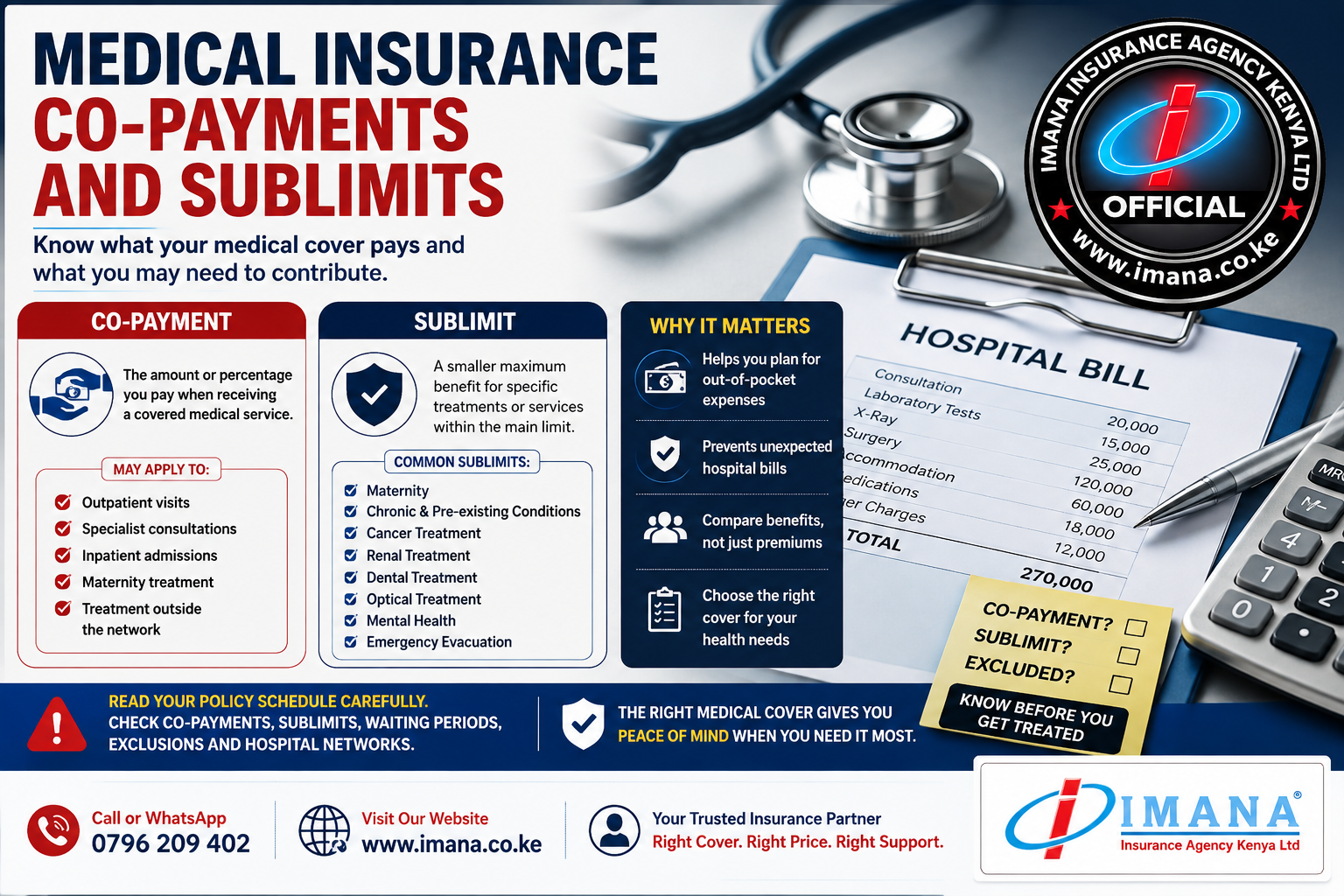
A co-payment, commonly called a co-pay, is the amount the insured member contributes when receiving a covered medical service.
The insurer pays the remaining eligible amount, subject to:
- Policy limits
- Provider network
- Pre-authorisation requirements
- Waiting periods
- Exclusions
- Medical necessity
- Applicable benefit conditions
A co-payment may be expressed as:
- A fixed amount
- A percentage of the medical bill
- A special charge at selected hospitals
- A contribution for certain procedures
- A contribution for treatment outside the preferred provider network
Fixed co-payment example
Suppose your policy requires a KSh 500 outpatient co-payment for every hospital visit.
If the eligible consultation and treatment cost is KSh 4,000:
- You pay: KSh 500
- Insurer considers: KSh 3,500
The insurer’s portion remains subject to the outpatient balance and policy terms.
Percentage co-payment example
Suppose a policy applies a 10% co-payment to treatment at a particular hospital.
If the eligible bill is KSh 100,000:
- Your contribution: KSh 10,000
- Insurer’s eligible contribution: KSh 90,000
A percentage co-payment can become expensive where the hospital bill is large.
Why Do Medical Insurers Apply Co-Payments?
Co-payments can be used to:
- Share treatment costs with the member
- Discourage unnecessary hospital visits
- Encourage use of preferred provider networks
- Control claims costs
- Offer more affordable premiums
- Manage treatment at high-cost hospitals
- Reduce misuse of medical benefits
A plan with a co-payment may have a lower premium than a similar plan offering full eligible payment at the same providers.
However, the lower premium should be compared with the likely number of hospital visits during the year.
Where Can a Co-Payment Apply?
A medical policy may apply co-payments to:
- Outpatient consultations
- Specialist consultations
- Inpatient admissions
- Maternity treatment
- Dental services
- Optical services
- Prescribed medicines
- Diagnostic tests
- Treatment at selected hospitals
- Treatment outside the approved network
- Chronic-condition management
- Emergency treatment outside the panel
Not every medical policy uses co-payments.
Some plans may provide:
- No co-payment within the approved network
- A co-payment only at selected premium hospitals
- A higher contribution for treatment outside the network
- A fixed outpatient co-payment
- A percentage contribution for specific conditions
The quotation and benefit schedule should identify where each co-payment applies.
What Is a Medical Insurance Sublimit?
A sublimit is a smaller maximum benefit placed within a larger medical-insurance limit.
For example, a policy may provide:
- Overall inpatient limit: KSh 1 million
- Maternity sublimit: KSh 100,000
- Chronic-condition sublimit: KSh 150,000
- Dental sublimit: KSh 20,000
- Optical sublimit: KSh 15,000
Although the policy has an overall limit of KSh 1 million, the insurer will not ordinarily pay KSh 1 million for maternity, dental or optical treatment.
Each listed service is restricted by its own sublimit.
CIC explains an annual medical limit as the maximum amount an insurer will pay for covered benefits during a year and separately identifies benefit-specific limits such as hospital accommodation limits. (CIC Kenya)
Overall Limit vs Sublimit
Overall limit
The overall limit is the maximum amount available under a major policy section during the insurance year.
Examples include:
- Inpatient limit
- Outpatient limit
- Annual family limit
- Per-person annual limit
Sublimit
A sublimit is the smaller amount available for a particular category within that larger section.
Example
A member has:
- Inpatient limit: KSh 500,000
- Chronic-condition sublimit: KSh 100,000
If eligible chronic-condition treatment costs KSh 160,000, the insurer may pay only up to KSh 100,000 under that sublimit.
The remaining KSh 60,000 may have to be paid by the member unless another applicable benefit responds.
The unused portion of the general inpatient limit does not automatically increase the chronic-condition sublimit.
Common Medical Insurance Sublimits in Kenya
Medical insurers may apply separate limits to the following benefits.
1. Maternity
Maternity sublimits may cover eligible:
- Normal delivery
- Caesarean section
- Pregnancy complications
- Antenatal care
- Postnatal care
- Other stated maternity services
Maternity benefits commonly have:
- Waiting periods
- Separate delivery limits
- Family eligibility conditions
- Age restrictions
- Provider requirements
A KSh 1 million inpatient limit does not mean KSh 1 million is available for maternity.
2. Chronic and Pre-Existing Conditions
A policy may place a separate limit on conditions such as:
- Diabetes
- Hypertension
- Asthma
- Long-term heart conditions
- Other declared chronic illnesses
The sublimit may apply to:
- Consultations
- Medication
- Tests
- Hospital admission
- Ongoing management
Pre-existing conditions may also be subject to:
- Medical underwriting
- Waiting periods
- Additional premium
- Exclusion
- Separate benefit limits
3. Cancer Treatment
Cancer treatment may have a separate limit covering eligible:
- Chemotherapy
- Radiotherapy
- Surgery
- Diagnostic procedures
- Specialist treatment
- Medication
A low cancer sublimit can be exhausted quickly even where the overall inpatient limit appears high.
4. Renal Treatment
Kidney-related treatment may be limited separately for:
- Dialysis
- Specialist reviews
- Medication
- Inpatient care
- Related procedures
Ask whether the stated limit applies:
- Per session
- Per year
- Per family
- Per member
5. Dental Treatment
Dental benefits may cover eligible:
- Consultation
- Extraction
- Filling
- Scaling
- Emergency dental treatment
The policy may exclude or limit:
- Cosmetic dentistry
- Braces
- Dental implants
- Teeth whitening
- Elective procedures
6. Optical Treatment
Optical benefits may include:
- Eye examination
- Prescription lenses
- Frames
- Treatment of specified eye conditions
The sublimit may apply annually or once within a specified period.
7. Mental-Health Treatment
Mental-health benefits may have a separate limit for:
- Psychiatric consultations
- Counselling
- Hospitalisation
- Medication
- Rehabilitation
The policy should identify whether treatment is covered under inpatient, outpatient or a separate benefit.
8. Congenital and Neonatal Conditions
Medical plans may impose separate limits or restrictions for:
- Congenital conditions
- Premature babies
- Neonatal intensive care
- Birth-related complications
Parents should review these benefits before planning pregnancy or adding a newborn.
9. Funeral or Last-Expense Benefits
Some medical policies include a fixed last-expense benefit.
This is usually separate from the inpatient limit and paid under specific conditions.
10. Emergency Evacuation
A policy may set a sublimit for:
- Ground ambulance
- Air evacuation
- Transfer between hospitals
- Emergency stabilisation
- Repatriation
What Is a Bed Limit?
A bed limit is the maximum amount the insurer will pay for hospital accommodation per day.
CIC describes the bed limit as the accommodation cost, including standard meals provided by the hospital. (CIC Kenya)
A policy may provide:
- General ward
- Shared room
- Private room
- Daily monetary limit
Example
Your policy has a daily bed limit of KSh 8,000.
You choose a room costing KSh 13,000 per day.
You may have to contribute:
- KSh 5,000 per day for the room difference
- Possible related cost differences where the hospital calculates other charges according to the selected room category
A more expensive room can sometimes increase the wider hospital bill, not only the accommodation charge.
What Is a Co-Insurance Percentage?
Co-insurance is similar to a percentage co-payment.
The insured person pays an agreed percentage of an eligible bill, while the insurer pays the remaining percentage.
For example:
- Insurer pays: 80%
- Member pays: 20%
For an eligible KSh 200,000 bill:
- Insurer portion: KSh 160,000
- Member portion: KSh 40,000
The terms co-payment and co-insurance may be used differently between insurers, so the policy schedule should be checked carefully.
What Is a Deductible?
A deductible is the amount the member must pay before the insurer begins paying eligible expenses.
Example
A policy has an annual deductible of KSh 20,000.
The member first meets KSh 20,000 of eligible medical costs. The insurer then considers covered expenses above that amount, subject to the remaining terms.
A deductible may apply:
- Per year
- Per claim
- Per admission
- Per family
- Per member
Do not confuse a deductible with:
- Co-payment
- Policy excess
- Benefit sublimit
- Excluded expense
How Co-Payments and Sublimits Can Apply Together
A member can be affected by both a sublimit and a co-payment during the same treatment.
Example
A policy has:
- Maternity sublimit: KSh 100,000
- Maternity co-payment: 10%
The eligible maternity bill is KSh 120,000.
The insurer first considers the maternity limit and co-payment according to the policy’s calculation method.
The member could be responsible for:
- The amount above the KSh 100,000 sublimit
- The applicable co-payment
- Any excluded hospital charges
- Any amount relating to an upgraded room
- Non-covered services
The exact calculation depends on the policy wording.
Request a written illustration before purchasing the plan.
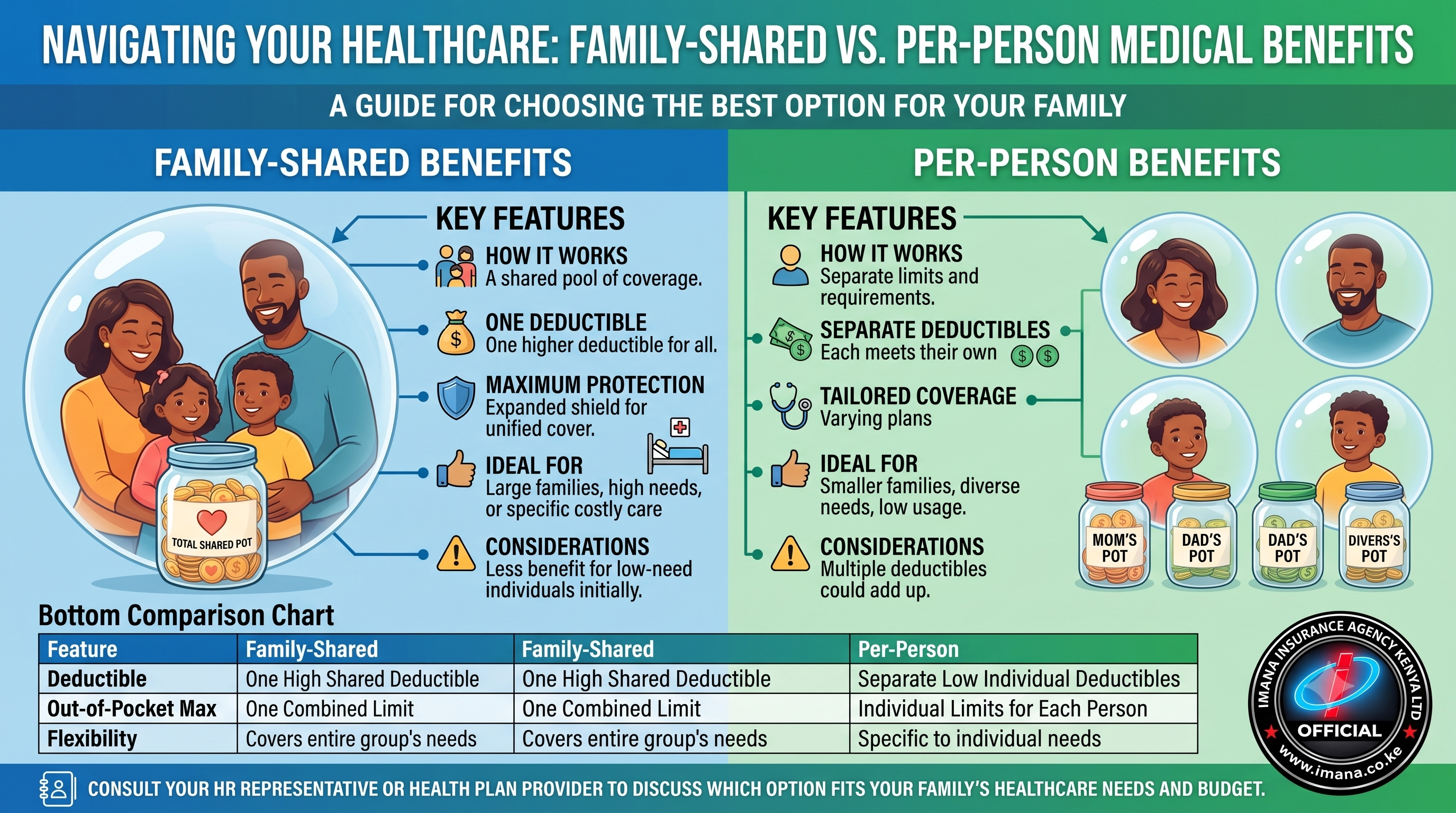
Per-Person vs Family-Shared Sublimits
Medical policies can structure limits differently.
Per-person limit
Each insured member receives their own benefit limit.
Example
A family of four has an outpatient limit of KSh 50,000 per person.
Each member may access up to their individual limit, subject to the policy.
Unused benefits may not be transferred to another family member.
Family-shared limit
All members use one combined benefit pool.
Example
A family has a shared outpatient limit of KSh 150,000.
One member may use KSh 100,000, leaving KSh 50,000 for the rest of the family.
Hybrid arrangement
A policy may have:
- Shared main limit
- Per-person maternity limit
- Shared dental limit
- Individual optical sublimits
- Separate chronic-condition limits
Customers should ask how every benefit is allocated.
Annual, Per-Visit and Per-Condition Limits
A sublimit can apply in several ways.
Annual limit
The maximum available during the policy year.
Per-visit limit
The maximum payable for each consultation or treatment visit.
Per-day limit
Commonly used for:
- Hospital accommodation
- Intensive-care benefits
- Cash benefits
Per-condition limit
The maximum available for one illness or diagnosis.
Per-procedure limit
The amount available for a specific medical procedure.
Lifetime limit
The maximum available over the member’s entire period of cover under the plan.
The policy should clearly state which type applies.
Network Hospitals and Co-Payments
Medical insurers usually maintain a network of approved hospitals and healthcare providers.
The cost-sharing arrangement may differ depending on the provider selected.
A policy may offer:
- No co-payment at preferred hospitals
- Fixed co-payment at premium hospitals
- Higher co-payment outside the preferred network
- Reimbursement-only treatment outside the network
- No cover at excluded hospitals
A hospital appearing on the insurer’s broad provider list may not necessarily be available under every medical plan.
Before purchasing cover, confirm:
- Your preferred hospital
- Nearest emergency hospital
- Children’s hospital
- Maternity hospital
- Specialist facilities
- Pharmacies
- Diagnostic centres
Why Some Hospitals Attract Higher Co-Payments
Insurers may place co-payments on particular facilities because of:
- Higher treatment costs
- Higher consultation charges
- Billing patterns
- Greater claims utilisation
- Premium service levels
- Provider-network negotiations
The hospital list and co-payment requirements can change.
Always request the current provider panel and written co-payment schedule before buying or renewing cover.
Can a Hospital Charge More Than the Insurer Approves?
Yes.
A difference can arise where:
- The hospital charges above the insurer’s agreed tariff
- The treatment was not pre-authorised
- A non-covered service was provided
- The member chose a higher room category
- The policy limit was exhausted
- The provider is outside the network
- A co-payment applies
- The insurer considers part of the treatment medically unnecessary
- The policy excludes certain consumables
The member should ask both the hospital and insurer for an itemised explanation.
What Happens When a Sublimit Is Exhausted?
Once a sublimit is exhausted, further treatment within that benefit may have to be paid by the member.
For example:
- Dental limit: KSh 20,000
- Amount already used: KSh 18,000
- New eligible dental bill: KSh 10,000
The policy may pay the remaining KSh 2,000.
The member may have to pay KSh 8,000.
The dental benefit does not normally reset until the next policy year, assuming continuous renewal.
Do Sublimits Reduce the Main Limit?
This depends on the policy structure.
A sublimit may be:
Part of the main limit
Every payment reduces both the sublimit and the main benefit balance.
Additional to the main limit
The benefit is provided separately and does not reduce the main limit.
Subject to both limits
The claim must fit within the sublimit and the overall annual maximum.
Request clarification in writing.
The phrase “within the inpatient limit” commonly means payments reduce the main inpatient benefit.
The phrase “in addition to the inpatient limit” may indicate separate protection, but the policy wording should still be checked.
How SHA and Private Medical Insurance May Interact
Kenya’s Social Health Insurance framework pays approved benefits according to the statutory benefit package, applicable tariffs, empanelled providers and digital claims procedures. Claims and pre-authorisations are processed through the Social Health Authority’s centralised platform. (Kenya Law)
Private medical insurance may supplement statutory health protection by offering benefits such as:
- Additional inpatient limits
- Outpatient cover
- Wider provider access
- Maternity
- Dental and optical
- International treatment
- Higher accommodation options
Policyholders should establish:
- Which scheme pays first
- Whether private insurance covers the balance
- Whether co-payments remain payable
- Whether the hospital coordinates both covers
- Whether pre-authorisation is required from each provider
Do not assume that holding both SHA and private medical insurance automatically removes every out-of-pocket expense.
How Co-Payments Affect Affordable Medical Plans
Co-payments can help reduce the initial premium, making a medical plan appear more affordable.
This may work well for a member who:
- Rarely visits hospitals
- Uses preferred providers
- Can comfortably meet small contributions
- Wants protection mainly against major expenses
It may be less suitable for a person who:
- Requires frequent outpatient care
- Has children who visit hospitals regularly
- Manages a chronic condition
- Uses hospitals with percentage co-payments
- Has limited emergency cash
The cheapest premium may produce higher total annual healthcare costs.
Questions to Ask Before Buying Medical Insurance
Before accepting a quotation, ask:
- What is the inpatient limit?
- What is the outpatient limit?
- Are benefits shared or per person?
- Which hospitals require a co-payment?
- Is the co-payment fixed or percentage-based?
- Does the co-payment apply per visit, admission or year?
- What are the maternity, dental and optical sublimits?
- Are chronic and pre-existing conditions separately limited?
- What is the room or bed limit?
- Are cancer and renal treatment limited separately?
- Do payments under sublimits reduce the main limit?
- What happens outside the hospital network?
- Which services require pre-authorisation?
- Are prescribed medicines limited separately?
- Can provider lists and co-payments change during the year?
Request answers in writing.
How to Compare Medical Insurance Quotations Properly
Two plans with the same inpatient limit can offer very different practical protection.
Suppose both plans provide a KSh 1 million inpatient limit.
Plan A
- No co-pay at preferred hospitals
- Maternity: KSh 150,000
- Chronic conditions: KSh 200,000
- Cancer: KSh 500,000
- Private-room limit included
Plan B
- 20% co-payment at preferred hospital
- Maternity: KSh 75,000
- Chronic conditions: KSh 100,000
- Cancer: KSh 200,000
- Lower daily bed limit
Although both advertise KSh 1 million inpatient protection, Plan A may provide significantly stronger benefits.
Compare:
- Main limits
- Sublimits
- Co-payments
- Provider network
- Waiting periods
- Exclusions
- Pre-authorisation
- Chronic-condition terms
- Renewal age
- Premium
Common Mistakes Medical Insurance Buyers Make
Looking only at the inpatient limit
The headline limit may hide restrictive sublimits.
Ignoring percentage co-payments
A 10% contribution may appear small until the member receives a large bill.
Assuming every panel hospital is co-pay free
Different hospitals may have different contribution requirements.
Failing to check room limits
Choosing a more expensive hospital room may create substantial additional costs.
Ignoring chronic-condition limits
Regular medication and tests can exhaust a small sublimit quickly.
Buying maternity cover too late
Maternity commonly has a waiting period.
Confusing shared and per-person limits
A family-shared benefit can be consumed by one member.
Failing to request the full benefit schedule
A marketing brochure may not show every restriction.
Assuming renewal terms never change
Premiums, provider networks, co-payments and benefits may be reviewed at renewal.
What to Do When You Disagree With a Co-Payment or Hospital Bill
1. Request an itemised bill
Check every service, medicine, test and procedure.
2. Ask the hospital to identify the uncovered amount
Establish whether it relates to:
- Co-payment
- Sublimit
- Exclusion
- Room upgrade
- Exhausted benefit
- Non-approved service
- Tariff difference
3. Contact the insurer or medical administrator
Request a written benefit calculation.
4. Review the policy documents
Check:
- Schedule
- Benefit table
- Provider list
- Co-payment schedule
- Pre-authorisation
- Exclusions
5. Escalate an unresolved complaint
Begin with the insurer’s formal complaints process.
The Insurance Regulatory Authority regulates Kenya’s insurance industry, maintains registers of licensed insurers and medical insurance providers, and operates a consumer complaint channel. (Insurance Regulatory Authority)
How Imana Helps Customers Compare Medical Cover
Imana Insurance Agency Kenya Ltd helps individuals, families, employers and organisations compare medical insurance quotations from suitable licensed insurers.
The comparison process may include:
- Reviewing the required inpatient and outpatient limits.
- Confirming preferred hospitals.
- Comparing fixed and percentage co-payments.
- Reviewing maternity, chronic, cancer, renal, dental and optical sublimits.
- Checking waiting periods and exclusions.
- Comparing per-person and family-shared benefits.
- Reviewing provider networks.
- Explaining pre-authorisation requirements.
- Coordinating policy issuance.
- Supporting renewal and claim enquiries.
Medical options may include:
- Individual medical cover
- Family medical cover
- Child-only medical insurance
- Senior medical insurance
- Group Medical Insurance
- SHA supplementary cover
- Inpatient-only plans
- Inpatient and outpatient plans
Medical Insurance Quotations in Westlands and Across Kenya
Imana Insurance Agency Kenya Ltd
4th Floor, Krishna Centre
Woodvale Grove, Westlands
Nairobi, Kenya
Medical insurance information:
https://www.imana.co.ke/insurance/imana-health
Website: www.imana.co.ke
Call or WhatsApp: +254 796 209 402
Compare the limits. Check the co-payments. Understand the sublimits. Let Imana help you choose suitable medical cover.
Frequently Asked Questions
What is a medical insurance co-payment?
It is the amount an insured member must contribute when receiving an eligible healthcare service. It may be fixed or percentage-based. (Insurance Regulatory Authority)
What is a medical insurance sublimit?
It is a smaller benefit limit applying to a particular treatment or service within the wider medical policy.
Is a co-payment the same as an excess?
They are similar cost-sharing mechanisms but may apply differently. A co-payment is commonly charged when receiving a medical service, while an excess or deductible may apply before or during claim settlement.
Can I buy medical insurance without a co-payment?
Yes, depending on the insurer, plan and selected hospital network.
Does the inpatient limit include maternity?
Often maternity is limited separately within the inpatient benefit. Check whether it is within or additional to the main limit.
What happens when a sublimit is exhausted?
The member normally pays further expenses within that benefit unless another policy section applies.
Does unused outpatient cover increase my inpatient limit?
Not ordinarily. Inpatient and outpatient benefits are usually separate.
Does every hospital charge the same co-payment?
No. Co-payments can vary by hospital, provider network and medical plan.
Can co-payments change at renewal?
Yes. Insurers may review provider networks, premiums and cost-sharing arrangements at renewal.
Are chronic conditions covered under the main inpatient limit?
They may be subject to a separate sublimit, waiting period or underwriting condition.
Does SHA remove private medical co-payments?
Not automatically. Coordination depends on the statutory benefits, private policy terms, hospital billing and claims procedures. (Kenya Law)
Can Imana compare medical sublimits?
Yes. Imana can compare co-payments, hospital networks, waiting periods, benefit limits and exclusions across available quotations.
The Bottom Line
Medical-insurance buyers should look beyond the headline inpatient limit.
Before paying, understand:
- Your co-payment at each hospital
- Whether the contribution is fixed or percentage-based
- The maternity sublimit
- Chronic and pre-existing-condition limits
- Cancer and renal benefits
- Dental and optical limits
- Daily hospital-room allowance
- Whether family benefits are shared
- What happens when a sublimit is exhausted
- Which services require pre-authorisation
A KSh 1 million medical policy is only as useful as the benefits, sublimits, provider network and cost-sharing terms behind that figure.
Imana Insurance Agency Kenya Ltd
Call or WhatsApp: +254 796 209 402
Website: www.imana.co.ke
Understand what the insurer pays. Know what you may contribute. Choose your medical cover with clarity.
Medical Insurance premiums, co-payments, sublimits, hospital networks, waiting periods, pre-authorisation rules and exclusions differ between insurers and may change at renewal. Obtain a current quotation, benefit schedule, provider list and complete policy wording before purchasing cover.