- Author: Raymond
- Category: Compare Insurance Quotations In Kenya
Insurance for Schools in Kenya | Students, Staff, Property and Buses
Learn which insurance covers schools in Kenya should consider, including Student Personal Accident, WIBA, property, public liability, school-bus, cyber and business interruption insurance.
Why Schools Need More Than One Insurance Policy
Schools are responsible for learners, teachers, support staff, buildings, vehicles, equipment and large amounts of personal information.
A normal school day may involve:
- Learners attending lessons
- Children playing sports
- School buses collecting and dropping students
- Kitchen staff preparing meals
- Teachers supervising trips
- Maintenance employees repairing facilities
- Visitors entering the premises
- Computers storing learner and parent records
- Boarding students remaining on campus overnight
An accident, fire, theft, cyber incident or serious illness can therefore affect many people and interrupt learning.
A suitable school insurance programme can help protect:
- Learners
- Teachers and support employees
- School buildings
- Furniture and equipment
- Laboratories
- School buses
- Rental or tuition income
- Visitors and third parties
- Electronic records
- The institution’s financial stability
Kenya’s Basic Education Regulations require school management to take reasonable measures concerning learners’ hygiene, security and safety. Ministry of Education guidance also emphasises fire-fighting equipment, first-aid arrangements, emergency contacts and regular drills. Insurance supports these measures but does not replace them.
A school insurance programme should protect the institution before an incident and support recovery after one.
What Is School Insurance?
School insurance is not usually one single policy.
It is a collection of insurance covers designed around the institution’s activities, property, employees and learners.
Depending on the school, the programme may include:
- Student Personal Accident Insurance
- WIBA Insurance
- Group Personal Accident Insurance
- Property Insurance
- Fire and Allied Perils
- Public Liability Insurance
- School Bus Insurance
- Business Interruption Insurance
- Burglary Insurance
- Electronic Equipment Insurance
- Cyber Insurance
- Money Insurance
- Fidelity Guarantee Insurance
- Group Medical Insurance
- Professional Indemnity
- Travel Insurance
- Political Violence and Terrorism
The correct combination depends on whether the institution is:
- A pre-primary school
- A primary school
- A junior school
- A secondary school
- A boarding school
- An international school
- A special-needs institution
- A college
- A vocational training centre
- A university
- A tuition or training centre
A small day school and a large boarding institution do not face the same risks.
Is Insurance Compulsory for Schools in Kenya?
Not every school insurance product is automatically compulsory.
However, some covers arise from legal duties or contractual requirements.
WIBA Insurance
Schools that employ teachers, administrators, drivers, cleaners, cooks, guards or maintenance workers should maintain Work Injury Benefits Act insurance.
Section 7 of the Work Injury Benefits Act requires every employer to obtain and maintain insurance against liabilities arising under the Act.
Motor Insurance
Every school vehicle used on public roads must carry the legally required motor insurance under the applicable motor-insurance framework.
The correct classification is important where the vehicle transports learners.
Contractual requirements
Additional policies may be required by:
- Banks and financiers
- Property owners
- School boards
- Parent agreements
- Tender documents
- International accreditation bodies
- Development partners
- Transport contracts
Student Personal Accident, Public Liability and property insurance are highly relevant, but their exact legal or contractual status should be confirmed for the institution concerned.
Essential Insurance Covers for Schools in Kenya
1. Student Personal Accident Insurance
Student Personal Accident Insurance protects learners against specified accidental injuries during the policy period.
Depending on the policy, cover may apply:
- While attending school
- During authorised sports
- On approved school trips
- During educational tours
- While travelling in a school vehicle
- At boarding facilities
- On a 24-hour basis
- During holidays, where expressly included
The policy may provide benefits for:
- Accidental medical expenses
- Accidental death
- Permanent disability
- Temporary disability
- Funeral expenses
- Emergency evacuation
- Artificial appliances
- Dental treatment following an accident
Example
A learner falls during a school sports activity and requires medical treatment.
The Student Personal Accident policy may reimburse eligible accident-related medical expenses up to the selected limit.
The policy will not necessarily cover ordinary illness, infections or routine treatment.
Questions schools should ask
- Is cover limited to school hours?
- Does it provide 24-hour protection?
- Are sports included?
- Are school trips covered?
- Are boarding students covered overnight?
- Does the policy cover travel between home and school?
- What is the medical-expense limit?
- Does it cover accidental dental treatment?
- What activities are excluded?
The benefit schedule should be given to parents so they understand what the policy does and does not cover.
2. WIBA Insurance for School Employees
WIBA Insurance protects the school against statutory liability where an employee suffers a qualifying work-related injury or occupational disease.
Employees may include:
- Teachers
- Administrators
- Drivers
- Conductors
- Cooks
- Cleaners
- Security guards
- Grounds staff
- Laboratory technicians
- Nurses
- Maintenance workers
- Casual employees
A workplace accident may involve:
- A teacher falling on school premises
- A cook suffering an injury in the kitchen
- A cleaner slipping while working
- A driver being injured during an authorised school journey
- A technician being injured by equipment
- A grounds employee being injured while maintaining the compound
WIBA premiums are commonly influenced by:
- Number of employees
- Occupations
- Annual gross payroll
- Work locations
- Claims history
- Level of workplace risk
Schools should separate employees into accurate occupational categories.
An office administrator presents a different risk from a school-bus driver, cook or maintenance worker.
3. Group Personal Accident Insurance for Employees
Group Personal Accident Insurance can provide benefits beyond work-related accidents.
A 24-hour GPA policy may cover employees for eligible accidents occurring:
- At work
- At home
- During private travel
- On weekends
- During leave
Potential benefits may include:
- Accidental death
- Permanent disability
- Temporary disability
- Medical expenses
- Funeral expenses
GPA should not be treated as a replacement for WIBA.
A school may arrange:
- WIBA for statutory workplace protection
- GPA for broader accident benefits
- Group Life for death from illness or accident
- Group Medical for healthcare expenses
4. Fire and Allied Perils Insurance
Fire can cause substantial loss to:
- Classrooms
- Dormitories
- Offices
- Laboratories
- Libraries
- Kitchens
- Dining halls
- Workshops
- Stores
- Furniture
- Learning materials
Property Insurance may protect against fire and selected additional risks such as:
- Lightning
- Explosion
- Storm
- Flood
- Earthquake
- Impact damage
- Burst pipes
- Malicious damage
- Other listed perils
Ministry of Education guidance for pre-primary institutions requires appropriate fire-fighting equipment, emergency contacts, first-aid arrangements and regular fire drills. These measures reflect the importance of active safety management alongside insurance.
Buildings and contents should be valued separately
Buildings may include:
- Classrooms
- Dormitories
- Offices
- Laboratories
- Libraries
- Kitchen blocks
- Workshops
- Boundary walls
- Fixed installations
Contents may include:
- Desks
- Chairs
- Textbooks
- Computers
- Laboratory equipment
- Kitchen equipment
- Beds and mattresses
- Sports equipment
- Office furniture
The sum insured should normally reflect rebuilding or replacement cost rather than the original purchase price.
5. Public Liability Insurance
Public Liability Insurance protects the institution against eligible legal claims where a learner, parent, visitor, contractor or other third party suffers accidental bodily injury or property damage connected to the school’s premises or activities.
Possible incidents include:
- A parent falling on a damaged walkway
- A visitor being injured by a faulty gate
- A learner being injured because of allegedly defective premises
- A school activity damaging neighbouring property
- A temporary structure collapsing during an event
- Water from the school damaging another property
The policy may pay eligible:
- Compensation
- Legal defence expenses
- Claimant’s approved legal costs
- Investigation expenses
Public Liability does not remove the school’s duty to provide reasonably safe facilities.
The Basic Education Regulations place responsibility on institutional management to implement reasonable measures relating to learner safety and security.
6. School Bus Insurance
Schools may operate:
- Buses
- Vans
- Minibuses
- Staff vehicles
- Utility vehicles
School vehicles should be insured under the correct class and declared use.
The policy may include:
- Comprehensive vehicle damage
- Third-party liability
- Passenger liability
- Fire
- Theft
- Windscreen
- Road rescue
- Political Violence and Terrorism
- Driver Personal Accident
Important underwriting information
The insurer may require:
- Vehicle registration
- Make and model
- Year of manufacture
- Seating capacity
- Vehicle value
- Route information
- Driver details
- Inspection or valuation
- Claims history
- Tracking information
A private-car policy should not be used for a vehicle regularly transporting students as part of school operations.
Schools should also maintain
- Valid driver licences
- Vehicle inspection records
- Service records
- Passenger registers
- Emergency contacts
- Pick-up and drop-off procedures
- Authorised-driver lists
Insurance does not compensate for unsafe transport practices.
7. Business Interruption Insurance
After a serious fire or insured property loss, the school may be unable to operate normally.
The institution may still have to pay:
- Salaries
- Rent
- Loan repayments
- Security expenses
- Utilities
- Temporary classroom expenses
- Transport costs
- Communication expenses
Business Interruption Insurance may cover eligible financial losses arising from an interruption caused by insured physical damage.
For a school, the cover may be structured around:
- Lost tuition or fee income
- Continuing expenses
- Temporary learning facilities
- Additional transport
- Increased cost of working
- Alternative accommodation for boarding students
The indemnity period should reflect how long it could take to:
- Repair buildings
- Obtain approvals
- Replace equipment
- Secure temporary premises
- Restore normal enrolment and operations
8. Burglary Insurance
Schools own items that may be attractive to thieves, including:
- Computers
- Projectors
- Laboratory equipment
- Televisions
- Sound systems
- Sports equipment
- Food stock
- Office equipment
Burglary Insurance may protect specified property where theft follows forcible or violent entry into or exit from the premises.
The policy may require:
- Security guards
- Functional locks
- CCTV
- Alarm systems
- Secure windows
- Police reporting
- Updated asset registers
Unexplained disappearance or inventory shortages may be excluded.
9. Electronic Equipment Insurance
Schools increasingly depend on:
- Computers
- Servers
- Smartboards
- Projectors
- CCTV
- Access-control systems
- Networking equipment
- Biometric devices
- Communication systems
Electronic Equipment Insurance may protect against sudden and accidental physical damage.
Possible extensions include:
- Data-restoration costs
- External storage media
- Increased cost of working
- Portable equipment
A school should maintain an asset register showing:
- Item description
- Serial number
- Location
- Purchase date
- Replacement value
- Responsible department
10. Cyber Insurance
Schools collect and store sensitive information about:
- Learners
- Parents
- Employees
- Medical conditions
- Fees and payments
- Examination results
- Identification details
- Contact information
A cyber incident may lead to:
- Exposure of personal information
- Ransomware
- Loss of learner records
- Email fraud
- Payment diversion
- System interruption
- Parent complaints
- Regulatory and legal expenses
Cyber Insurance may cover eligible:
- Incident investigation
- Data restoration
- Legal defence
- Privacy liability
- Notification expenses
- Crisis communication
- Cyber Business Interruption
Cyber cover should be supported by:
- Multi-factor authentication
- Regular backups
- Access restrictions
- Staff training
- Updated software
- Secure payment procedures
- Incident-response planning
11. Money Insurance
Schools may handle:
- Tuition fees
- Activity payments
- Transport charges
- Canteen collections
- Event proceeds
- Petty cash
Money Insurance may cover funds:
- On the premises
- In a locked safe
- In transit to the bank
- In the custody of authorised employees
Separate limits may apply for:
- Working hours
- Overnight storage
- Money in transit
- Approved safes
Digital payments can reduce cash exposure, but schools should still use strong reconciliation and authorisation controls.
12. Fidelity Guarantee Insurance
Employees may have access to:
- Fees
- Bank accounts
- Procurement systems
- Food stocks
- School supplies
- Payroll
- Mobile-money accounts
Fidelity Guarantee Insurance may protect the institution against specified direct financial losses caused by dishonest employees.
It should be supported by controls such as:
- Separation of duties
- Regular audits
- Daily reconciliation
- Dual payment authorisation
- Stock checks
- Restricted system access
- Employee screening
Insurance should not replace proper financial governance.
13. Machinery Breakdown Insurance
Some schools operate equipment such as:
- Generators
- Water pumps
- Lifts
- Boilers
- Laundry machines
- Kitchen machinery
- Workshop equipment
- Refrigeration systems
Machinery Breakdown Insurance may protect against sudden and unforeseen internal mechanical or electrical damage.
Common exclusions include:
- Wear and tear
- Corrosion
- Poor maintenance
- Gradual deterioration
- Consumable parts
Maintenance records may be required when a claim is filed.
14. Group Medical Insurance for Employees
Schools may provide medical insurance as an employee benefit.
A Group Medical plan may include:
- Inpatient treatment
- Outpatient treatment
- Maternity
- Dental
- Optical
- Chronic-condition benefits
- Emergency evacuation
- Last expense
The premium may depend on:
- Number of employees and dependants
- Ages
- Selected limits
- Hospital network
- Claims history
- Benefits
- Co-payments
Group Medical does not replace WIBA for work-related injuries.
15. Professional Indemnity Insurance
Educational institutions may face allegations involving professional services such as:
- Specialised assessments
- Counselling
- Educational consulting
- Professional training
- Examinations
- Certification
- Research services
Professional Indemnity Insurance may protect the institution against eligible claims alleging negligent professional advice, errors or omissions.
The school should disclose the exact educational and professional services provided.
16. Event Insurance
Schools organise:
- Sports days
- Prize-giving ceremonies
- Concerts
- Graduation events
- Parent meetings
- Fundraisers
- Exhibitions
Event-related insurance may include:
- Public Liability
- Temporary equipment cover
- Property damage
- Personal Accident
- Event cancellation
- Money Insurance
The venue or service provider may require proof of liability insurance before the event.
17. Travel Insurance for School Trips
Schools may organise travel for:
- Educational tours
- Sports competitions
- Exchange programmes
- International trips
- Music festivals
- Academic events
Travel Insurance may cover eligible:
- Emergency medical expenses
- Medical evacuation
- Trip cancellation
- Lost baggage
- Passport loss
- Personal Liability
- Accidental injury
The school should obtain:
- Parent consent
- Traveller information
- Medical details
- Emergency contacts
- Destination details
- Approved itinerary
International trips may require specific visa-compliant benefits.
18. Contractors All Risks Insurance
Schools may undertake:
- Construction of classrooms
- Dormitory expansion
- Laboratory installation
- Renovations
- Boundary-wall construction
- Roofing
- Electrical works
Contractors All Risks Insurance may protect the project against:
- Accidental physical damage
- Fire
- Theft
- Storm
- Construction-related third-party liability
- Other covered risks
The school should establish whether the contractor or project owner is responsible for arranging the cover.
Existing school buildings and learners should be protected from construction-site risks.
Insurance for Boarding Schools
Boarding schools have additional exposure because learners remain on campus day and night.
Risks may involve:
- Dormitory fires
- Illness at night
- Food safety
- Learner supervision
- Theft
- Water systems
- Electrical installations
- Emergency evacuation
- Boarding facilities
A boarding-school insurance programme may require:
- Student Personal Accident
- Buildings and Contents
- Fire and Allied Perils
- Public Liability
- Business Interruption
- WIBA
- Food-related Product Liability
- Burglary
- Machinery Breakdown
- School Bus Insurance
Ministry of Education assessments continue to examine compliance by boarding schools with prescribed safety standards, reinforcing the importance of active emergency planning and risk controls.
Insurance for School Kitchens and Meals
Schools providing meals may face risks involving:
- Food poisoning
- Kitchen fires
- Burns
- Refrigeration breakdown
- Gas systems
- Food contamination
- Employee injuries
Relevant covers may include:
- Product Liability
- Fire Insurance
- Machinery Breakdown
- Deterioration of Stock
- WIBA
- Public Liability
Food handling, hygiene and temperature controls remain essential.
Product Liability Insurance may address eligible claims where supplied food allegedly causes injury or illness.
Insurance for Laboratories and Workshops
Laboratories and technical workshops may contain:
- Chemicals
- Glass equipment
- Machinery
- Electrical systems
- Tools
- Specialist equipment
The insurer should be informed about:
- Type of laboratory
- Chemicals stored
- Equipment values
- Ventilation
- Fire protection
- Access controls
- Staff qualifications
- Disposal procedures
Possible insurance sections include:
- Property
- Fire
- Machinery Breakdown
- Electronic Equipment
- Public Liability
- WIBA
- Student Personal Accident
Insurance for Special-Needs Schools
Schools serving learners with disabilities should assess:
- Accessible evacuation
- Medical support
- Assistive devices
- Special transport
- Individual supervision
- Emergency communication
- Specialist equipment
Ministry of Education guidance calls for accessible safety measures, evacuation mechanisms and periodic disaster-preparedness drills for institutions serving learners with disabilities.
Assistive equipment should be declared separately where it has significant value.
How Much Does School Insurance Cost in Kenya?
There is no universal premium.
The cost may depend on:
- Number of learners
- Number of employees
- Payroll
- Building value
- Contents and equipment
- Boarding or day-school status
- Number of buses
- Claims history
- Student Accident limits
- Public Liability limit
- Location
- Fire and security controls
- Sports activities
- Laboratories and workshops
- Policy excesses
A small day school will not be priced the same as a large boarding school with buses, laboratories and several buildings.
A current written quotation is required.
Information Required for a School Insurance Quotation
Institution details
- Registered school name
- Physical address
- Type of institution
- Number of learners
- Day or boarding status
- Curriculum
- Claims history
Property details
- Building values
- Contents values
- Number of blocks
- Construction materials
- Laboratories
- Dormitories
- Kitchens
- Fire equipment
- Security arrangements
Employee details
- Number of staff
- Occupations
- Annual payroll
- Casual employees
- Work locations
Learner details
- Number of learners
- Age groups
- Boarding population
- Sports activities
- Trips
- Required Student Accident limits
Vehicle details
- Registration numbers
- Vehicle values
- Seating capacity
- Drivers
- Routes
- Claims history
Additional risks
- Swimming pools
- Workshops
- Laboratories
- Events
- International trips
- Special-needs facilities
- Construction projects
Accurate information enables insurers to provide comparable quotations.
What Schools Should Do After an Accident
1. Protect the learner or employee
Arrange first aid and appropriate medical treatment.
2. Notify the parent or guardian
Communication should be prompt and factual.
3. Record the incident
Document:
- Date and time
- Location
- Activity
- Witnesses
- Supervising employee
- Nature of injury
- Immediate action taken
4. Preserve evidence
Keep:
- Photographs
- CCTV
- Equipment
- Medical records
- Witness details
- Staff reports
5. Notify the insurer
Report the matter immediately, even where the final treatment cost is unknown.
6. Report to the relevant authority
Workplace injuries involving employees should follow the applicable WIBA and occupational-safety reporting procedures.
7. Avoid admitting liability
The school can assist the affected person without promising compensation before the facts and insurance position are assessed.
Common Claim Documents
Depending on the claim, the insurer may request:
- Claim form
- Policy schedule
- Learner or employee identification
- Incident report
- Parent statement
- Medical report
- Treatment invoices
- Receipts
- Police abstract
- Witness statements
- Photographs
- School register
- Employment and payroll documents
- Vehicle records
- Fire or inspection report
- Property valuation
- Repair quotations
Schools should maintain an organised claims file for each incident.
Common Insurance Mistakes Schools Make
Buying only Student Personal Accident
Student Accident does not protect buildings, employees, buses or public liability.
Assuming WIBA covers learners
WIBA protects employees under the work-injury framework. Learners generally require separate Student Personal Accident protection.
Using private motor cover for a school vehicle
School transport must be declared and insured under the correct use.
Underinsuring buildings
Outdated construction values can reduce property claim settlements.
Ignoring boarding risks
Dormitories, kitchens and overnight supervision increase the institution’s exposure.
Failing to disclose sports
Contact sports, swimming and other activities should be declared.
Ignoring cyber risks
Learner and parent information requires protection.
Choosing the cheapest policy
A lower premium may mean:
- Smaller medical limits
- No 24-hour Student Accident cover
- Lower liability limits
- Higher excesses
- Excluded activities
- Narrower property protection
How Schools Can Reduce Risk
Schools should maintain:
- Fire extinguishers
- First-aid kits
- Emergency contacts
- Evacuation plans
- Regular safety drills
- Safe water and sanitation
- Vehicle-maintenance records
- Trained drivers
- Secure laboratories
- Controlled visitor access
- CCTV where appropriate
- Accurate learner and staff registers
- Cybersecurity controls
- Incident-reporting procedures
The Ministry of Education’s safety framework emphasises emergency preparedness, fire safety, first aid and evacuation planning.
Insurance is most effective when combined with active risk prevention.
How to Compare School Insurance Quotations
Give each insurer identical information.
Then compare:
- Student Accident medical limit
- Accidental death and disability benefits
- Coverage period
- Sports and trip protection
- WIBA payroll basis
- Property values
- Fire and allied perils
- Public Liability limit
- School-bus passenger protection
- Business Interruption
- Burglary
- Cyber Insurance
- Policy excesses
- Exclusions
- Claims requirements
The school should receive a written comparison showing what is included and omitted.
How Imana Helps Schools Compare Insurance
Imana Insurance Agency Kenya Ltd helps schools, colleges and training institutions compare insurance quotations from suitable licensed insurers.
The process may include:
- Reviewing learner and staff numbers.
- Assessing school buildings and equipment.
- Reviewing boarding, sports and transport risks.
- Preparing WIBA payroll information.
- Selecting suitable Student Accident benefits.
- Reviewing Public Liability exposure.
- Comparing quotations and exclusions.
- Coordinating inspections and policy issuance.
- Managing policy changes and renewals.
- Supporting claims notification and follow-up.
Available solutions may include:
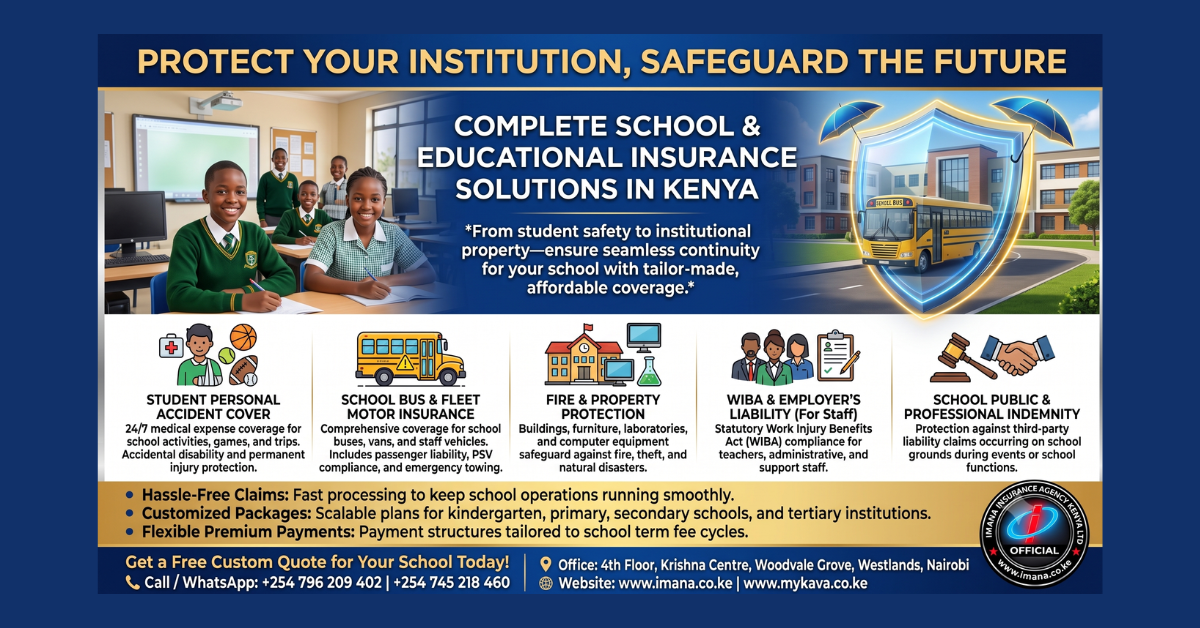
- Student Personal Accident
- WIBA and WIBA Plus
- Group Personal Accident
- School Bus Insurance
- Property Insurance
- Public Liability
- Business Interruption
- Cyber Insurance
- Electronic Equipment
- Money Insurance
- Fidelity Guarantee
- Group Medical
- Travel Insurance
- Contractors All Risks
Insurance should be placed through licensed insurers and intermediaries. The Insurance Regulatory Authority regulates and supervises Kenya’s insurance sector and publishes information on licensed entities and consumer protection.
School Insurance in Nairobi and Across Kenya
Imana Insurance Agency Kenya Ltd
4th Floor, Krishna Centre
Woodvale Grove, Westlands
Nairobi, Kenya
Imana supports:
- Pre-primary schools
- Primary schools
- Junior schools
- Secondary schools
- Boarding schools
- International schools
- Colleges
- Vocational institutions
- Universities
- Training centres
Website: www.imana.co.ke
Call or WhatsApp: +254 796 209 402
Protect the learners. Protect the employees. Protect the school. Let Imana help you compare suitable cover.
Frequently Asked Questions
What insurance does a school need in Kenya?
Common covers include Student Personal Accident, WIBA, Property Insurance, Public Liability, School Bus Insurance, Business Interruption and Cyber Insurance.
Is Student Personal Accident Insurance compulsory?
Its requirement can depend on the institution, contract or regulatory arrangement. Schools should confirm the applicable requirements and consider it because ordinary property or WIBA cover does not protect learners in the same way.
Is WIBA compulsory for schools?
Schools with employees should maintain WIBA Insurance. Section 7 of the Work Injury Benefits Act requires employers to insure their liabilities under the Act. (Kenya Law)
Does WIBA cover students?
No. WIBA is intended for employees. Learners generally require Student Personal Accident or another appropriate student policy.
Does Student Personal Accident cover illness?
Ordinary Personal Accident Insurance mainly covers accidental injury. Illness is normally excluded unless specifically included.
Are learners covered during school trips?
They may be, provided authorised trips are included in the policy.
Does a student policy cover sports?
Sports may be included, restricted or excluded depending on the activity and policy wording.
Can a school insure all learners under one policy?
Yes. A group Student Personal Accident policy can cover a declared number or schedule of learners.
Does the landlord’s insurance cover a rented school?
The landlord’s policy may protect the building, but the school may still need cover for contents, liability, employees, learners and business interruption.
Does school insurance cover fire?
Fire and Allied Perils Insurance can protect insured buildings and contents, subject to declared values, covered perils and exclusions.
Can one policy cover several school branches?
Possibly. Every location, learner population, property value and activity must be declared.
Does school-bus insurance cover learners?
Passenger-related protection must be included under the correct motor classification. The school should confirm the applicable passenger limits and policy terms.
Can Imana compare insurance quotations for a school?
Yes. Imana can compare learner, employee, property, vehicle, liability and other institutional covers from suitable insurers.
The Bottom Line
A school faces risks involving:
- Learners
- Employees
- Buildings
- Equipment
- Vehicles
- Visitors
- Fees and money
- Personal data
- Educational continuity
No single policy protects every exposure.
A suitable school insurance programme should combine the relevant covers based on the institution’s size, activities and facilities.
Before purchasing insurance:
- Count learners and employees accurately.
- Declare boarding and sports activities.
- Value buildings and equipment properly.
- Insure school vehicles under the correct class.
- Maintain WIBA protection for employees.
- Select appropriate Student Accident limits.
- Include Public Liability.
- Consider loss of income and temporary premises.
- Review cyber and electronic-equipment risks.
- Maintain fire, first-aid and emergency procedures.
The purpose of school insurance is not only to repair buildings after a loss. It is to protect learners, support employees and help education continue after an unexpected event.
Imana Insurance Agency Kenya Ltd
4th Floor, Krishna Centre, Woodvale Grove, Westlands, Nairobi
Call or WhatsApp: +254 796 209 402
Website: www.imana.co.ke
Safer learners. Protected employees. Stronger schools.
School insurance benefits, premiums, limits, coverage periods, excesses and exclusions vary between insurers. Legal and Ministry requirements may change. Obtain a current written quotation, benefit schedule, insurer confirmation and complete policy wording before purchasing cover.