- Author: Raymond
- Category: Corporate & SME Insurance in Kenya
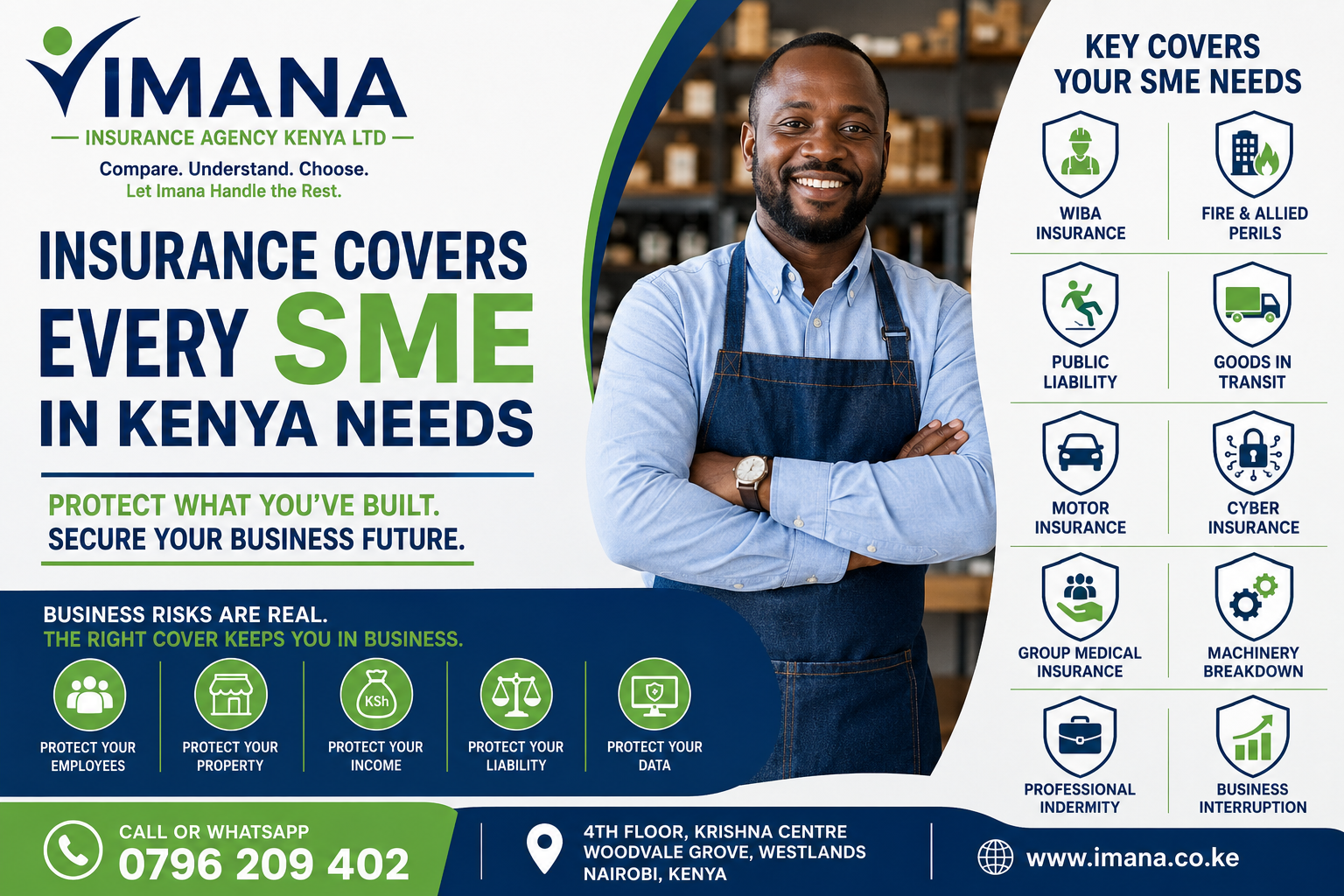
Insurance Covers Every SME in Kenya Needs | Business Insurance Guide
Discover the essential insurance covers every SME in Kenya should consider, including WIBA, property, public liability, motor, business interruption, cyber and professional indemnity insurance.
Why Every Kenyan SME Needs an Insurance Plan
Small and medium-sized enterprises are central to Kenya’s economy, but many operate with limited financial reserves.
A single fire, employee injury, burglary, road accident, cyberattack or liability claim can interrupt operations and consume money that took years to build.
Insurance does not prevent accidents or business losses. It transfers specified financial risks to an insurer, subject to the policy’s limits, exclusions and conditions.
The right insurance programme can help an SME protect:
- Employees
- Business premises
- Stock
- Equipment
- Vehicles
- Customer property
- Revenue
- Legal liabilities
- Digital systems
- Contracts
- Business continuity
However, no single policy protects every business against every risk.
A restaurant, construction company, online shop, consulting firm and transport business do not face identical exposures. Every SME should therefore begin with a basic risk assessment before requesting quotations.
Business insurance should match what the company owns, what it does, whom it employs and what it could legally owe another person.
Is Business Insurance Compulsory in Kenya?
Some classes of insurance are required by law, while others are voluntary but commercially important.
For example, the Work Injury Benefits Act requires every employer to obtain and maintain insurance covering liabilities that may arise from work-related injuries or occupational diseases affecting employees. (Kenya Law)
A business that owns or operates vehicles on public roads must also maintain the legally required motor third-party protection.
Certain professions, contracts, landlords, financiers, regulators and principal contractors may require additional insurance, such as:
- Professional indemnity
- Contractors All Risks
- Public liability
- Performance bonds
- Group Personal Accident
- Fire insurance
- Marine cargo insurance
The Insurance Regulatory Authority regulates Kenya’s insurance industry and maintains current registers of licensed insurers and intermediaries. SMEs should verify the insurer and agent or broker before purchasing cover. (Insurance Regulatory Authority)
Essential Insurance Covers for Kenyan SMEs
1. WIBA Insurance
Work Injury Benefits Act insurance, commonly called WIBA insurance, should be a priority for every business with employees.
It covers the employer’s statutory liability when an employee suffers a qualifying work-related injury, occupational illness, disability or death.
Section 7 of the Work Injury Benefits Act requires every employer to obtain and maintain an insurance policy covering liabilities incurred under the Act. (Kenya Law)
WIBA may respond to eligible claims involving:
- Medical expenses
- Temporary incapacity
- Permanent disability
- Occupational diseases
- Funeral expenses
- Compensation following work-related death
The employer must still maintain a safe workplace and follow statutory accident-reporting procedures. Insurance does not replace occupational safety obligations.
Kenyan employers and workplace occupiers have duties to provide safe work systems, appropriate training, adequate supervision and a working environment that does not expose employees to unnecessary health and safety risks. (Kenya Law)
Information required for a WIBA quotation
An insurer may request:
- Number of employees
- Employee occupations
- Annual gross payroll
- Work locations
- Nature of business
- Claims history
- Temporary or casual labour details
- Exposure to machinery, heights or hazardous work
The payroll and occupational classifications must be accurate. A cleaner, office administrator, driver, machine operator and construction worker do not present the same level of risk.
WIBA vs WIBA Plus
Ordinary WIBA focuses on the employer’s liability under the Work Injury Benefits Act.
WIBA Plus may combine statutory workplace-injury protection with additional benefits, such as Group Personal Accident protection for accidental injuries occurring outside working hours.
The additional benefits vary between insurers.
Before selecting WIBA Plus, confirm:
- Whether protection applies for 24 hours
- Death and disability limits
- Medical-expense benefits
- Funeral-expense limits
- Territorial scope
- Exclusions
- Whether employees are covered outside work
2. Fire and Allied Perils Insurance
Fire insurance protects business property against fire and specified related risks.
Depending on the policy and extensions, it may cover:
- Buildings
- Office contents
- Furniture
- Machinery
- Electronic equipment
- Stock
- Fixtures and fittings
- Tenant improvements
Allied perils may include:
- Explosion
- Lightning
- Storm
- Flood
- Earthquake
- Impact damage
- Malicious damage
- Burst pipes
Not every peril is automatically included. The policy schedule should clearly identify the insured events.
Why accurate property values matter
An SME should insure property using realistic replacement values.
Underinsurance may result in a reduced claim settlement because the business insured only part of the actual value at risk.
Consider:
- Current replacement cost of equipment
- Cost of rebuilding premises
- Value of stock at peak periods
- Imported machinery and exchange-rate changes
- Installation and transport costs
- Taxes and professional fees
Do not use outdated purchase prices without considering current replacement costs.
3. Burglary and Theft Insurance
Burglary insurance protects specified business property following forcible or violent entry into or exit from the insured premises, subject to the policy wording.
It may cover:
- Stock
- Computers
- Furniture
- Tools
- Machinery
- Office equipment
- Other declared property
A burglary policy may not cover every unexplained disappearance.
The insurer may require evidence of:
- Forcible entry
- Police reporting
- Security measures
- Inventory records
- Ownership
- Value of stolen property
Security requirements may include:
- Alarm systems
- CCTV
- Guarding
- Reinforced locks
- Secure windows
- Fireproof safes
- Approved overnight storage
Failure to maintain a declared security measure may affect a claim.
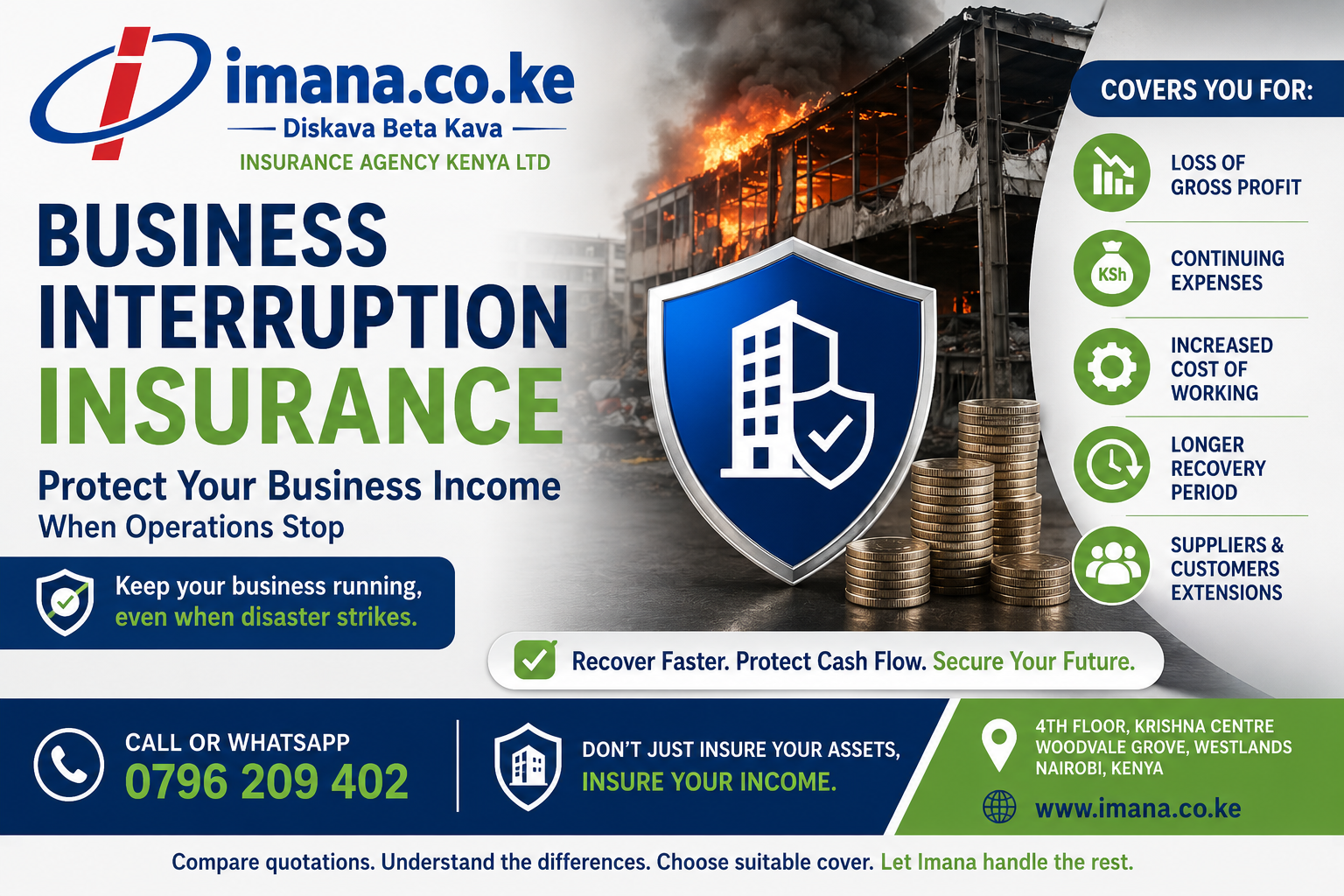
4. Business Interruption Insurance
Property insurance can repair damaged equipment and replace destroyed stock, but it does not automatically replace the income lost while the business is closed.
Business interruption insurance may cover eligible financial losses after operations are disrupted by an insured event, such as a fire.
Depending on the policy, it may address:
- Lost gross profit
- Continuing fixed expenses
- Employee wages
- Rent
- Loan commitments
- Temporary premises
- Additional operating costs
- Professional accounting fees
Example
A fire damages a bakery’s ovens and production area.
Fire insurance may pay for eligible physical repairs and equipment replacement. However, the bakery could remain closed for three months while:
- Rent continues
- Employees expect salaries
- Loan repayments fall due
- Customers move to competitors
- Sales stop
Business interruption insurance is designed to address this financial gap, subject to the selected indemnity period and policy limits.
The SME should select an indemnity period long enough to rebuild, replace equipment, obtain approvals and restore customers—not merely the time required to clean the premises.
5. Public Liability Insurance
Public liability insurance protects a business against eligible legal liabilities arising when a member of the public suffers accidental injury or property damage connected to the business’s operations.
Potential examples include:
- A customer slipping in a shop
- A visitor being injured at an office
- A contractor damaging neighbouring property
- A signboard falling onto a parked vehicle
- Water from business premises damaging another tenant’s stock
- An event attendee suffering an injury
The policy may cover:
- Compensation awarded to a third party
- Claimant’s legal costs
- Approved defence expenses
- Investigation costs
Public liability is especially relevant for businesses that receive customers, operate from shared buildings, organise events or carry out work at client premises.
Suitable businesses include:
- Shops
- Restaurants
- Hotels
- Clinics
- Salons
- Schools
- Gyms
- Contractors
- Event organisers
- Property managers
- Warehouses
- Professional offices
The SME should compare the liability limit per event and the annual aggregate—not only the premium.
6. Product Liability Insurance
Product liability insurance protects manufacturers, distributors, retailers and other suppliers against eligible claims arising from products that cause bodily injury or property damage.
It may be relevant to businesses dealing with:
- Food
- Cosmetics
- Electronics
- Furniture
- Machinery
- Building materials
- Household products
- Packaged consumer goods
A customer may allege that a product was:
- Defective
- Contaminated
- Incorrectly labelled
- Unsafe
- Supplied without adequate instructions
- Responsible for injury or property damage
Product liability does not replace quality control.
Businesses should still maintain:
- Supplier records
- Batch numbers
- Product testing
- Recall procedures
- Customer complaints records
- Safety warnings
- Distribution records
These records can be critical when investigating a claim.
7. Commercial Motor and Fleet Insurance
Any SME that owns or operates vehicles should arrange cover under the correct motor class.
Possible vehicle categories include:
- Private company cars
- Commercial own-goods vehicles
- General-cartage vehicles
- Delivery vans
- Pickups
- Trucks
- Prime movers
- PSV taxis
- Ride-hailing cars
- Motorcycles
- Tour vans
Available protection may include:
Third-Party Only
Covers specified liabilities involving other people but generally does not repair the SME’s own vehicle.
Third Party, Fire and Theft
Adds fire and theft protection to third-party liability but generally excludes accidental collision damage to the business’s vehicle.
Comprehensive
May cover accidental damage, fire, theft and third-party liabilities, subject to the policy.
An SME should also consider:
- Excess protector
- Political violence and terrorism
- Road rescue
- Windscreen cover
- Courtesy vehicle
- Driver Personal Accident
- Passenger liability
- COMESA Yellow Card
The declared vehicle use must match the actual business activity.
A delivery vehicle should not be insured as an ordinary private car.
8. Goods in Transit Insurance
Goods in Transit insurance protects specified goods while being transported between locations.
It may cover goods moved:
- From suppliers to the business
- From the warehouse to customers
- Between branches
- To exhibitions
- To construction sites
- By company vehicles
- Through contracted transporters
Depending on the policy, it may cover loss or damage arising from:
- Accidents
- Fire
- Theft following specified circumstances
- Loading or unloading risks
- Hijacking
- Overturning
A business should declare:
- Type of goods
- Maximum value per vehicle
- Annual value transported
- Routes
- Vehicle details
- Packaging
- Security arrangements
- Whether transport is owned or outsourced
Fragile, perishable, high-value or temperature-controlled goods may need specialised terms.
9. Money Insurance
Money insurance protects business funds against specified loss while:
- At the premises
- In a safe
- In transit to or from the bank
- In the custody of authorised employees
- At designated collection points
It may cover:
- Cash
- Cheques
- Postal orders
- Other defined monetary instruments
The policy normally applies stated limits for:
- Money in transit
- Money during business hours
- Money in locked safes
- Money outside normal working hours
Security procedures matter.
The SME may need:
- Dual control
- Cash-collection schedules
- Approved safes
- Security escorts
- Restricted employee access
- Banking frequency limits
Money insurance does not generally cover unexplained shortages or ordinary accounting errors.
10. Fidelity Guarantee Insurance
Fidelity Guarantee insurance protects a business against eligible direct financial loss caused by fraudulent or dishonest acts committed by employees.
Examples may include:
- Theft of cash
- Fraudulent transfers
- Stock theft
- Forged payments
- Misappropriation of customer funds
- Manipulation of financial records
The SME should maintain effective controls, including:
- Separation of financial duties
- Approval limits
- Bank reconciliations
- Stock audits
- Employee background checks
- Mandatory leave
- Access controls
- Transaction monitoring
Insurance should support internal controls—not replace them.
11. Electronic Equipment Insurance
Electronic Equipment insurance may protect computers and specialised electronic systems against sudden and accidental physical damage, subject to the policy.
It can be relevant for businesses using:
- Computers
- Servers
- Medical equipment
- Point-of-sale systems
- CCTV systems
- Communication equipment
- Laboratory devices
- Printing equipment
Possible extensions may cover:
- External data media
- Data-restoration costs
- Increased cost of working
- Portable equipment
- Breakdown from specified causes
Ordinary wear, gradual deterioration, software faults and cyber incidents may require different protection.
12. Machinery Breakdown Insurance
Machinery Breakdown insurance protects machinery against sudden and unforeseen physical damage from covered internal or operational causes.
It may be relevant for:
- Manufacturers
- Workshops
- Bakeries
- Laundries
- Printing businesses
- Factories
- Cold-storage facilities
- Processing plants
- Garages
It can cover machinery such as:
- Production equipment
- Generators
- Compressors
- Refrigeration systems
- Boilers
- Industrial motors
- Packaging machinery
Maintenance remains essential.
Policies may exclude:
- Wear and tear
- Corrosion
- Gradual deterioration
- Known defects
- Consumable parts
- Poor maintenance
13. Cyber Insurance
Many SMEs rely on:
- Cloud accounting
- Online banking
- M-Pesa
- Customer databases
- E-commerce
- Social media
- Digital payment systems
A cyber incident can expose confidential information, stop operations and create liability to customers.
Cyber insurance may cover eligible costs arising from:
- Data breaches
- Ransomware
- System interruption
- Cyber extortion
- Incident investigation
- Data restoration
- Customer notification
- Legal defence
- Public-relations support
- Third-party privacy claims
Cyber insurance does not excuse poor digital security.
Insurers may ask whether the business uses:
- Multi-factor authentication
- Regular backups
- Staff security training
- Updated antivirus systems
- Access restrictions
- Incident-response procedures
- Vendor controls
The business should declare its systems and cybersecurity arrangements accurately.
14. Professional Indemnity Insurance
Professional indemnity insurance protects businesses that provide advice, designs, consultancy or specialist services against eligible claims alleging professional negligence, errors or omissions.
It may be relevant for:
- Consultants
- Accountants
- Architects
- Engineers
- Lawyers
- Insurance intermediaries
- Medical practitioners
- IT professionals
- Project managers
- Surveyors
- Valuers
Certain professionals may have statutory, regulatory or contractual requirements to maintain professional indemnity insurance. For example, Kenya’s professional-indemnity regulations require advocates practising on their own behalf to maintain prescribed cover. (Kenya Law)
A professional indemnity policy may cover:
- Compensation
- Legal defence costs
- Investigation expenses
- Claims arising from negligent advice
- Errors in professional work
- Loss of client documents
Many policies operate on a claims-made basis. This means continuous cover and the retroactive date can be critical.
The SME should not cancel a professional indemnity policy without understanding how future claims relating to past work will be handled.
15. Group Medical Insurance
Group medical insurance helps an employer provide healthcare benefits to employees and eligible dependants.
It may include:
- Inpatient treatment
- Outpatient treatment
- Maternity
- Dental
- Optical
- Chronic-condition benefits
- Emergency evacuation
- Last expense
The employer’s statutory SHA responsibilities continue separately. Private group medical insurance can provide supplementary protection and wider provider options, depending on the plan.
When requesting quotations, provide consistent employee information:
- Dates of birth
- Gender
- Family composition
- Required limits
- Current insurer
- Claims experience
- Preferred hospitals
- Industry
- Number of employees
Inaccurate or incomplete employee data can produce misleading quotations.
The IRA publishes current registers of licensed medical insurance providers that customers can use when verifying providers. (Insurance Regulatory Authority)
16. Group Personal Accident Insurance
Group Personal Accident insurance provides defined benefits when an insured employee suffers accidental injury, disability or death.
Unlike ordinary WIBA, it may provide protection for accidents occurring both during and outside working hours, depending on the policy.
Benefits may include:
- Accidental death
- Permanent disability
- Temporary disability
- Medical expenses
- Funeral expenses
- Artificial appliances
- Emergency transport
WIBA and Group Personal Accident should not be treated as identical products.
WIBA addresses the employer’s statutory liability for work-related injuries, while GPA pays defined benefits under the selected accident policy.
17. Group Life and Key-Person Insurance
Group Life Insurance
Group Life provides a benefit to an employee’s nominated beneficiaries following death during the policy period, subject to the terms.
It can form part of an employee-benefits programme.
Key-Person Insurance
Key-person insurance protects the business against financial disruption following the death or specified incapacity of a founder, director, specialist or other essential person.
The benefit may help the SME:
- Recruit a replacement
- Stabilise cash flow
- Repay business debt
- Maintain operations
- Protect investor confidence
- Manage succession
This is particularly relevant where the business depends heavily on one founder’s relationships, skills or licences.
18. Marine Cargo Insurance
SMEs importing or exporting goods should consider marine cargo insurance.
It may cover goods moving by:
- Sea
- Air
- Road
- Rail
- Multimodal transport
Protection can begin from the supplier’s warehouse and continue to the final destination, depending on the agreed transit terms.
A business may arrange:
- A single-shipment policy
- Annual marine open cover
- Import insurance
- Export insurance
- Inland-transit extensions
The business should declare:
- Nature of goods
- Value
- Packaging
- Origin
- Destination
- Mode of transport
- Incoterms
- Claims history
Do not assume the transporter’s liability will fully compensate the cargo owner.
19. Contractors All Risks Insurance
Contractors All Risks insurance is designed for construction projects.
It may protect:
- Contract works
- Construction materials
- Temporary works
- Plant at the site
- Third-party liabilities
- Principal-supplied materials
It is relevant for:
- Building contractors
- Renovation companies
- Interior fit-out businesses
- Civil contractors
- Property developers
- Subcontractors
The quotation may depend on:
- Contract value
- Project period
- Defects-liability period
- Nature of work
- Location
- Existing structures
- Third-party exposure
- Project experience
- Safety controls
Construction equipment may require separate Contractors’ Plant and Machinery insurance.
20. Public, Performance and Contractual Bonds
SMEs bidding for government, corporate or development projects may be required to provide bonds.
Common bond types include:
- Bid bonds
- Performance bonds
- Advance-payment bonds
- Customs bonds
- Immigration bonds
- Retention bonds
A bond is not ordinary loss insurance for the contractor. It is a guarantee to the beneficiary that the SME will meet specified contractual obligations.
The insurer may require:
- Company financial statements
- Contract documents
- Tender information
- Past project experience
- Directors’ guarantees
- Counter-indemnity
- Security
Businesses should understand the conditions under which the beneficiary can call the bond.
Which Covers Does a Small Business Need First?
An SME should prioritise insurance according to its greatest exposures.
An office-based consultancy may prioritise:
- WIBA
- Professional indemnity
- Electronic equipment
- Cyber insurance
- Public liability
- Group medical
A retail shop may prioritise:
- WIBA
- Fire and allied perils
- Burglary
- Money insurance
- Public liability
- Business interruption
- Fidelity Guarantee
A restaurant may prioritise:
- WIBA
- Fire and property
- Public liability
- Product liability
- Business interruption
- Machinery breakdown
- Money insurance
A transport or delivery company may prioritise:
- WIBA
- Commercial motor
- Goods in Transit
- Public liability
- Group Personal Accident
- Fidelity Guarantee
A construction SME may prioritise:
- WIBA
- Contractors All Risks
- Contractors’ Plant and Machinery
- Public liability
- Professional indemnity
- Performance bonds
- Commercial motor
An online business may prioritise:
- Cyber insurance
- Electronic equipment
- Product liability
- Goods in Transit
- Fidelity Guarantee
- Business interruption
How Much Does SME Insurance Cost in Kenya?
There is no universal price for SME insurance.
Premiums depend on factors such as:
- Nature of business
- Annual turnover
- Number of employees
- Payroll
- Property values
- Stock values
- Location
- Claims history
- Security
- Fire-protection systems
- Vehicle fleet
- Liability limits
- Contract value
- Cybersecurity controls
- Selected excesses
Two businesses with the same turnover may receive different quotations because their risks are different.
For example, a consultancy operating from an office has a different risk profile from a welding workshop with machinery, flammable materials and employees performing manual work.
Information Needed for an SME Insurance Quotation
Prepare:
- Business registration documents
- KRA PIN
- Nature of business
- Physical locations
- Number of employees
- Annual payroll
- Annual turnover
- Property and equipment values
- Stock values
- Vehicle details
- Claims history
- Existing insurance schedules
- Lease or contract insurance requirements
- Security and fire-protection details
- Required liability limits
Accurate information improves quotation quality and reduces disputes during claims.
Common SME Insurance Mistakes
Buying only the legally compulsory covers
Legal compliance may still leave property, revenue and liabilities uninsured.
Insuring assets but not income
Replacing property does not meet rent, salaries and loan payments during closure.
Using outdated asset values
Inflation and exchange-rate movements can make old values inadequate.
Ignoring liability risks
A third-party injury or professional-negligence claim can be more expensive than replacing office equipment.
Mixing personal and business insurance
A private motor or domestic policy may not cover commercial use.
Under-declaring payroll or turnover
Incorrect declarations can affect premium calculations and claims.
Failing to report business changes
Notify the insurer when the SME:
- Moves premises
- Adds new activities
- Acquires machinery
- Expands stock
- Employs more workers
- Opens a branch
- Begins exporting
- Changes vehicle use
Choosing the cheapest quotation automatically
A lower premium may involve:
- Higher excesses
- Lower limits
- Narrower protection
- More exclusions
- Reduced extensions
Treating insurance as a substitute for risk management
Insurance works alongside—not instead of—safety, maintenance, cybersecurity and financial controls.
How to Conduct a Basic SME Insurance Audit
Step 1: List the assets
Identify buildings, contents, equipment, stock, vehicles and digital systems.
Step 2: Identify people risks
Consider employees, customers, contractors, directors and key personnel.
Step 3: Review business activities
Document what the company manufactures, sells, transports, advises or installs.
Step 4: Identify interruption risks
Ask what would happen if the business could not operate for three, six or twelve months.
Step 5: Review contractual requirements
Check leases, tenders, financing agreements and client contracts.
Step 6: Review existing insurance
Examine:
- Limits
- Excesses
- Exclusions
- Policy periods
- Declared values
- Named locations
- Insured activities
Step 7: Obtain comparable quotations
Ensure all insurers use the same information.
Step 8: Review annually
Update the programme before renewal as the business grows.
How to Compare SME Insurance Quotations
Do not compare premiums in isolation.
Review:
- Scope of cover
- Sums insured
- Liability limits
- Excesses
- Exclusions
- Warranties
- Business descriptions
- Locations
- Optional extensions
- Claims procedures
- Instalment terms
- Insurer requirements
The quotations must be prepared using the same:
- Payroll
- Turnover
- Asset values
- Employee numbers
- Liability limits
- Project values
- Business activities
Otherwise, the comparison will be misleading.
How Imana Helps SMEs Compare Business Insurance
Imana Insurance Agency Kenya Ltd helps SMEs identify their major risks and compare quotations from suitable licensed insurers.
Business-insurance services include:
- WIBA and WIBA Plus
- Fire and allied perils
- Burglary
- Business interruption
- Public liability
- Product liability
- Commercial motor and fleet insurance
- Goods in Transit
- Money insurance
- Fidelity Guarantee
- Electronic Equipment
- Machinery Breakdown
- Cyber insurance
- Professional indemnity
- Group medical
- Group Personal Accident
- Group Life
- Marine cargo
- Contractors All Risks
- Contractors’ Plant and Machinery
- Insurance bonds
The process includes:
- Understanding the SME’s operations.
- Identifying material exposures.
- Preparing accurate insurance information.
- Requesting comparable quotations.
- Reviewing premiums, benefits and exclusions.
- Coordinating policy issuance.
- Supporting endorsements, renewals and claims.
Compare quotations. Understand the differences. Choose suitable cover. Let Imana handle the rest.
SME Insurance in Westlands, Nairobi and Across Kenya
Imana Insurance Agency Kenya Ltd
4th Floor, Krishna Centre
Woodvale Grove, Westlands
Nairobi, Kenya
Imana serves SMEs in:
- Westlands
- Parklands
- Riverside
- Lavington
- Kitisuru
- Gigiri
- Runda
- Muthaiga
- Nairobi CBD
- Industrial Area
- Other parts of Kenya through digital channels
Website: www.imana.co.ke
Call or WhatsApp: +254 796 209 402
Frequently Asked Questions
What insurance is compulsory for an SME with employees?
Every employer must obtain and maintain insurance covering liabilities under the Work Injury Benefits Act. (Kenya Law)
Does WIBA cover employees outside working hours?
Ordinary WIBA focuses on qualifying work-related injury and occupational disease. A WIBA Plus or Group Personal Accident policy may extend protection beyond working hours, depending on its terms.
Does fire insurance cover lost business income?
Not automatically. Business interruption cover is normally required to protect eligible lost gross profit and continuing expenses following an insured property event.
Does an SME need public liability insurance?
It may not be compulsory for every SME, but it is important where customers, visitors or other third parties could suffer injury or property damage.
What is the difference between public and product liability?
Public liability concerns injury or damage arising from business activities or premises. Product liability concerns injury or damage caused by products supplied by the business.
Does commercial motor insurance cover goods being transported?
Not necessarily. The vehicle and the cargo are separate exposures. Goods in Transit insurance may be required for the cargo.
Can a small online business buy cyber insurance?
Yes, subject to insurer requirements. The insurer may review data handling, backups, access controls and cybersecurity practices.
Is professional indemnity necessary for consultants?
It is highly relevant where the SME provides professional advice or specialist services. Some professions and contracts make it compulsory.
Can one policy combine several SME risks?
Yes. Some insurers offer combined SME packages containing sections such as fire, burglary, money, liability, fidelity and business interruption. Each section still has separate limits and conditions.
How often should an SME review its insurance?
At least annually and whenever there is a major change in operations, assets, staff, locations, contracts or revenue.
Can Imana compare SME insurance quotations?
Yes. Imana can help prepare the risk information, request suitable quotations and compare premiums, limits, excesses and exclusions.
The Bottom Line
Every SME faces risks, but not every SME needs the same insurance programme.
Start with the compulsory covers. Then protect the risks capable of causing the greatest financial damage.
For many Kenyan businesses, the core programme may include:
- WIBA
- Property insurance
- Business interruption
- Public liability
- Commercial motor
- Goods in Transit
- Cyber or professional indemnity cover
The final selection should reflect the company’s employees, assets, activities, contracts and ability to absorb a loss.
Do not wait for a fire, injury, lawsuit or cyberattack to reveal the gaps in your business insurance. Identify the risks early and build protection around the business you are working hard to grow.
Imana Insurance Agency Kenya Ltd
Website: www.imana.co.ke
Call or WhatsApp: +254 796 209 402
Insurance premiums, benefits, limits, excesses, exclusions and acceptance are subject to the selected insurer’s underwriting requirements and policy wording. Legal and contractual insurance obligations depend on the nature of the business. Obtain professional advice and current written quotations before purchasing cover.