- Author: Raymond
- Category: Corporate & SME Insurance in Kenya
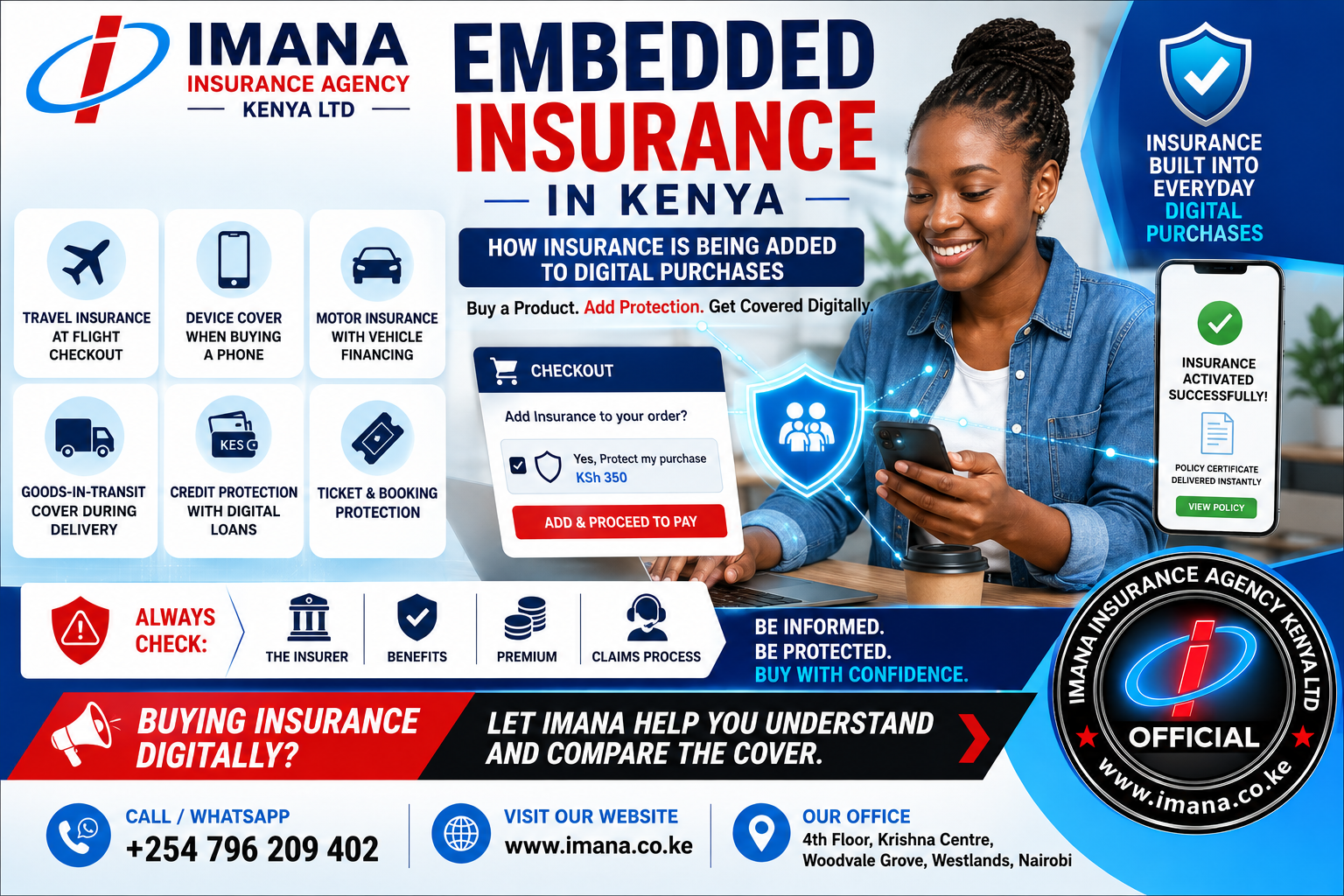
Embedded Insurance in Kenya: Insurance Added to Digital Purchases
Learn how embedded insurance in Kenya allows customers to obtain travel, device, motor, health and other covers while making digital purchases through apps, websites and online platforms.
What Is Embedded Insurance?
Embedded insurance is insurance offered within the purchase journey of another product or service.
Instead of leaving an online platform, searching for an insurer, completing a separate proposal form and making another payment, the customer may be offered suitable cover during the original transaction.
For example, a customer may encounter insurance while:
- Booking a flight
- Reserving accommodation
- Purchasing a mobile phone
- Financing a vehicle
- Applying for a digital loan
- Paying for a delivery
- Buying an event ticket
- Renting a vehicle
- Shopping through an e-commerce platform
- Registering for a digital service
The insurance may appear as:
- An optional checkout add-on
- A benefit included in the purchase price
- A subscription attached to another service
- A pay-as-you-use benefit
- Automatically generated cover after an eligible transaction
- A policy activated through an application programming interface
Kenya’s Insurance Regulatory Authority has publicly identified embedded insurance as an emerging distribution trend in which cover is incorporated into products or services such as travel-ticket purchases and digital transactions. During the first quarter of 2026, the Authority reported approving 28 new and repackaged insurance products across different insurance classes. (Facebook)
Embedded insurance places protection where the customer is already making a purchase instead of requiring the customer to begin a separate insurance-buying journey.
How Embedded Insurance Works
An embedded-insurance transaction usually involves several connected parties:
- The customer buys a non-insurance product or service.
- A digital platform presents a related insurance option.
- The customer reviews the benefit, premium and conditions.
- Required information is passed securely to the insurer or licensed intermediary.
- The customer accepts or declines the cover.
- The premium is paid independently or as part of the main transaction.
- The insurer issues a certificate, policy schedule or confirmation.
- Claims are reported through the insurer, platform or designated administrator.
The technology connecting the platform and insurer may include:
- Application programming interfaces
- Mobile applications
- Online checkout systems
- Payment gateways
- Cloud-based insurance platforms
- Automated underwriting systems
- Digital policy-generation tools
- Customer-verification systems
The customer may experience the process as one transaction even though several businesses operate behind the platform.
Examples of Embedded Insurance in Kenya
Embedded insurance can be incorporated into many digital purchasing environments.
The following are practical use cases rather than a claim that every Kenyan platform currently offers each product.
1. Travel Insurance During Flight Booking
A traveller purchasing an airline ticket may be offered travel insurance before completing payment.
The cover may include eligible:
- Emergency medical expenses
- Medical evacuation
- Trip cancellation
- Trip curtailment
- Lost baggage
- Delayed baggage
- Passport loss
- Personal Accident
- Personal Liability
The platform may request only the information already supplied during booking, such as:
- Traveller’s name
- Destination
- Departure date
- Return date
- Age or date of birth
The customer should still review:
- Medical-expense limit
- Territorial scope
- Waiting period
- Pre-existing-condition exclusions
- Excess
- Cancellation conditions
- Emergency contact information
A checkbox marked “travel protection” does not tell the customer everything contained in the policy.
2. Insurance Added to Bus or Train Tickets
A passenger booking a journey digitally may be offered Personal Accident protection for the travel period.
The benefit may provide specified compensation following:
- Accidental injury
- Accidental death
- Permanent disability
- Emergency medical expenses
The cover should clearly state:
- When protection begins
- When it ends
- Whether it applies only inside the vehicle
- Whether connecting journeys are included
- Maximum benefit per passenger
- Claim-reporting procedure
Passenger insurance should not be confused with the transport operator’s statutory motor or liability insurance.
3. Mobile-Phone and Device Insurance
A customer buying a phone, laptop or tablet may be offered device insurance during checkout.
Depending on the product, cover may include:
- Accidental screen damage
- Accidental physical damage
- Liquid damage
- Theft following stated circumstances
- Electrical damage
- Replacement or repair costs
Important conditions may include:
- Policy excess
- Waiting period
- Device age
- Proof of purchase
- Serial or IMEI number
- Approved repair centres
- Depreciation
- Theft-reporting requirements
Ordinary disappearance, carelessness or leaving a device unattended may not be covered.
4. Motor Insurance During Vehicle Purchase or Financing
A motor dealer, vehicle marketplace, leasing company or lender may include insurance within the acquisition process.
The customer may be offered:
- Comprehensive Motor Insurance
- Third-Party Only Insurance
- Excess Protector
- Political Violence and Terrorism
- Road rescue
- Personal Accident
- Windscreen cover
- Courtesy car
- Tracking services
The convenience can be valuable, but the customer should still confirm:
- Issuing insurer
- Vehicle value
- Policy class
- Intended vehicle use
- Excesses
- Optional benefits
- Repair-garage conditions
- Territorial limits
- Claims procedure
Financed vehicles may require comprehensive insurance, but the customer should establish whether they can compare quotations rather than automatically accepting one option.
5. Insurance Attached to Digital Loans
A borrower applying for credit may be offered or required to obtain credit-related insurance.
Possible benefits may include repayment of an eligible outstanding loan following:
- Death
- Permanent disability
- Critical illness
- Loss of employment, where specifically covered
- Another stated event
The customer should identify:
- Whether the insurance is compulsory
- The premium charged
- Who receives the claim payment
- Whether the benefit reduces as the loan reduces
- What happens after early repayment
- Whether any premium is refundable
- The applicable exclusions
The borrower should receive clear insurance information rather than discovering the charge only after the loan is issued.
6. E-Commerce Purchase Protection
An online retailer may offer insurance for goods bought through its platform.
Protection could relate to:
- Accidental damage
- Theft
- Delivery damage
- Extended warranty
- Product breakdown
- Return-shipping expenses
Insurance should be distinguished from:
- Manufacturer warranty
- Retailer return policy
- Delivery guarantee
- Maintenance agreement
A warranty usually addresses product defects under specified conditions. Insurance addresses defined accidental or uncertain risks.
7. Delivery and Goods-in-Transit Insurance
A seller or buyer arranging delivery may be offered insurance for the goods while they are being transported.
This may be relevant to:
- Electronics
- Furniture
- Machinery
- Retail stock
- Agricultural products
- Parcels
- Commercial goods
The policy should establish:
- Who owns the goods during transit
- Insured value
- Covered risks
- Packaging requirements
- Maximum value per consignment
- Territorial route
- Excluded goods
- Proof-of-loss requirements
The delivery vehicle’s Motor Insurance does not automatically insure the goods being carried.
8. Insurance Within Accommodation Bookings
A customer reserving a hotel, serviced apartment or holiday property may be offered:
- Booking-cancellation protection
- Personal Accident
- Travel Insurance
- Baggage protection
- Personal Liability
The host or property owner may separately require insurance for:
- Property damage
- Public Liability
- Contents
- Loss of income
- Guest-related risks
Guest insurance and property-owner insurance protect different interests.
9. Insurance for Event Tickets
A platform selling tickets for concerts, conferences or sporting events may offer ticket-protection insurance.
Possible benefits may apply where the customer cannot attend due to a stated event such as:
- Accidental injury
- Serious illness
- Travel disruption
- Bereavement involving an eligible relative
- Another listed circumstance
The cover does not ordinarily pay because the customer:
- Changed their mind
- Found another event
- Forgot the date
- Arrived late
- No longer wants to attend
The permitted cancellation reasons should be visible before payment.
10. Insurance Included in Memberships or Subscriptions
A digital membership, banking account, professional platform or service subscription may include:
- Personal Accident
- Funeral expenses
- Hospital cash
- Travel benefits
- Device protection
- Cyber protection
The customer should establish:
- Whether the cover is included or separately charged
- Who underwrites it
- Eligibility requirements
- Benefit limits
- Membership conditions
- What happens when the subscription ends
Insurance protection may stop when the underlying membership or service is cancelled.
Embedded Insurance vs Traditional Insurance
Traditional insurance journey
A customer ordinarily:
- Identifies an insurance need.
- Contacts an insurer or intermediary.
- Completes a proposal form.
- Receives quotations.
- Compares benefits.
- Pays the premium.
- Receives policy documents.
Embedded-insurance journey
The insurance appears during another purchase.
The customer may:
- Select a product or service.
- See an insurance offer at checkout.
- Accept the cover.
- Pay once.
- Receive instant digital confirmation.
The embedded process is often faster, but speed should not remove:
- Proper disclosure
- Customer choice
- Accurate underwriting information
- Clear policy wording
- Data-protection compliance
- Claims support
- Access to complaints procedures
Embedded Insurance vs Bundled Insurance
These terms may overlap, but they are not always identical.
Embedded insurance
Insurance is technologically integrated into the purchase journey of another product or service.
Bundled insurance
Insurance is packaged with other benefits, but the transaction may not necessarily involve a seamless digital integration.
For example:
- A travel package containing insurance may be bundled.
- A travel-booking app generating insurance instantly during checkout may be embedded.
- A bank account offering Personal Accident cover may be bundled or embedded, depending on how the benefit is arranged and activated.
The important issue for the customer is not the marketing label. It is whether the cover, premium, insurer, benefits and claim process are clearly explained.
Is Embedded Insurance Automatically Included?
Not always.
Embedded cover may be:
Optional
The customer actively chooses whether to purchase it.
Automatically included
The platform includes the cover within the product or membership price.
Mandatory
The underlying transaction may require specified insurance, such as comprehensive motor cover for a financed vehicle.
Opt-out
The insurance may be preselected, requiring the customer to remove it.
Where cover is optional, good consumer practice requires the choice to be clear and understandable. The customer should be able to identify the insurance premium and the effect of accepting or declining the cover.
Who Is the Actual Insurer?
The website, application, retailer, airline, lender or marketplace presenting the insurance may not be the insurer.
The parties may include:
- A licensed insurer underwriting the risk
- A licensed insurance agent or broker
- A technology provider
- The retailer or digital platform
- A claims administrator
- A payment provider
Kenya’s Insurance Regulatory Authority regulates and supervises insurance business under the Insurance Act and licenses insurers and insurance intermediaries. Customers should verify the insurer and intermediary rather than assuming that the digital platform itself carries the insurance risk. (Insurance Regulatory Authority)
Before accepting embedded insurance, confirm:
- Name of the insurer
- Policy or certificate number
- Name of the intermediary
- Premium
- Benefits
- Exclusions
- Claims contacts
- Complaints procedure
Are Embedded Insurance Products Approved in Kenya?
Insurance products offered in Kenya remain subject to the country’s insurance regulatory framework.
The IRA publishes product-approval procedures and guidelines requiring insurers to submit products for regulatory consideration. Its insurance-product guidelines apply to insurers and intermediaries authorised to conduct insurance business under the Insurance Act. (Insurance Regulatory Authority)
Embedding a policy into an application does not remove the need for:
- A licensed insurer
- An approved insurance product
- Proper distribution arrangements
- Appropriate customer disclosure
- Valid policy documentation
- Claims procedures
The technology changes how the product is distributed—not the insurer’s responsibility for the policy.
Benefits of Embedded Insurance for Customers
Convenience
The customer can buy protection without beginning a separate transaction.
Faster policy issuance
Customer and transaction information may be transferred directly to the insurer.
Relevant timing
Insurance is offered when the related risk arises.
For example:
- Travel Insurance when booking a trip
- Device Insurance when buying a phone
- Goods-in-Transit cover when arranging delivery
Smaller and more affordable products
Platforms may offer limited-duration or transaction-based protection rather than a full annual policy.
Digital documentation
Certificates and policy schedules may be delivered through:
- SMS
- Mobile application
- Online account
- Downloadable PDF
- WhatsApp, where supported
Increased insurance access
Embedded distribution may introduce insurance to customers who would not independently search for a traditional policy.
Benefits for Digital Platforms and Businesses
Businesses may use embedded insurance to:
- Improve the customer experience
- Protect customers against risks connected to the purchase
- Create an additional revenue stream
- Differentiate their services
- Increase customer loyalty
- Reduce transaction-related disputes
- Build a broader service ecosystem
However, the platform must avoid presenting insurance in a misleading way.
It should clearly explain:
- Whether the platform is an insurer or distributor
- Who underwrites the product
- What the customer pays
- What the policy covers
- How to cancel
- How to claim
- How customer data is used
Risks and Challenges of Embedded Insurance
1. Customers may accept cover without reading it
Fast checkout can encourage customers to tick a box without reviewing:
- Benefits
- Exclusions
- Excesses
- Policy period
- Claim conditions
2. The insurance may be too limited
A low-cost product may cover only a narrow risk.
For example, travel protection may provide Personal Accident benefits but exclude comprehensive medical expenses.
3. The premium may not be obvious
The insurance charge may be combined with:
- Ticket price
- Loan charges
- Subscription fee
- Device instalment
- Delivery cost
The customer should be able to identify the cost.
4. Customers may not know the insurer
The platform brand may be more visible than the insurance company underwriting the risk.
5. Claims responsibility may be unclear
Customers may not know whether to contact:
- The retailer
- Platform
- Insurer
- Intermediary
- Claims administrator
6. Duplicate insurance may arise
A traveller may buy embedded travel insurance despite already having suitable annual travel cover.
A financed vehicle may be insured twice if the owner already arranged a policy.
7. Data may be shared without sufficient understanding
Embedded insurance depends on the transfer of customer and transaction information between connected businesses.
Kenya’s Data Protection Act requires personal data to be processed lawfully, fairly, transparently and for specified purposes. Where consent is relied upon, the organisation must be able to demonstrate that consent, and individuals generally have a right to withdraw it. (Kenya Law)
Embedded Insurance and Personal Data
A digital insurance transaction may process:
- Name
- Telephone number
- Email address
- Identification number
- Date of birth
- Vehicle information
- Travel details
- Purchase history
- Payment details
- Health information
- Location data
The Data Protection (General) Regulations require organisations relying on consent to explain matters such as:
- Identity of the data controller or processor
- Purpose of processing
- Type of data collected
- Automated decision-making, where relevant
- Third-party data sharing
- Right to withdraw consent
- Consequences of withholding or withdrawing consent (Kenya Law)
A digital platform should not use an insurance checkbox as unrestricted permission to use customer information for unrelated purposes.
Customers should review:
- Privacy notice
- Data-sharing statement
- Marketing consent
- Retention policy
- Third-party disclosures
Insurance companies, mobile-money providers, retailers and other organisations processing personal data may also fall within registration and compliance requirements administered by the Office of the Data Protection Commissioner. (Data Protection Office)
What Customers Should Check Before Accepting Embedded Insurance
Before clicking “Add Insurance”, confirm:
- Who is the insurer?
- Is the intermediary licensed?
- What is the exact premium?
- Is the cover optional or compulsory?
- What risk is insured?
- When does protection begin and end?
- What is the maximum benefit?
- What excess or co-payment applies?
- Which events are excluded?
- How will the certificate be delivered?
- How is a claim reported?
- What documents will be required?
- Can the policy be cancelled?
- Is the premium refundable?
- How will personal data be shared?
Do not assume that insurance offered by a familiar retailer automatically provides suitable protection.
What Documents Should the Customer Receive?
After purchasing embedded insurance, the customer should ordinarily receive appropriate evidence of cover, such as:
- Policy schedule
- Insurance certificate
- Confirmation email or SMS
- Benefit summary
- Policy wording
- Claims contact
- Premium confirmation
- Terms and conditions
The documents should show:
- Customer’s name
- Insurer
- Policy number
- Insured item or transaction
- Start and expiry dates
- Benefit limit
- Premium
- Important exclusions
- Claims instructions
A payment receipt alone may not provide enough information to understand the insurance contract.
How Are Embedded Insurance Claims Made?
The claims journey should be as clear as the purchase journey.
A customer may report a claim through:
- Mobile application
- Online claim form
- Insurer’s website
- Telephone
- Retailer or platform
- Licensed intermediary
The customer may need:
- Policy or certificate number
- Proof of purchase
- Identification
- Incident report
- Police abstract
- Medical report
- Repair quotation
- Photographs
- Travel documents
- Delivery records
- Another document relevant to the loss
The platform should not advertise “instant insurance” while making claims contacts difficult to locate.
The insurer remains responsible for assessing claims according to the policy terms.
What Happens When a Customer Has a Complaint?
The customer should first contact:
- The digital platform
- The licensed intermediary
- The issuing insurer
The complaint should be made in writing and include:
- Customer details
- Policy number
- Transaction reference
- Description of the problem
- Supporting documents
- Requested resolution
Where the complaint remains unresolved, the Insurance Regulatory Authority receives and handles complaints involving entities registered under its regulatory mandate. (Insurance Regulatory Authority)
Data-use complaints may also fall within the mandate of the Office of the Data Protection Commissioner.
How Kenyan Businesses Can Introduce Embedded Insurance
A retailer, fintech, travel company, lender, transport platform or digital marketplace considering embedded insurance should begin with the customer’s actual risk.
Step 1: Identify the relevant risk
Examples include:
- Travel disruption
- Accidental device damage
- Goods lost in transit
- Credit repayment risk
- Personal Accident
- Motor liability
Step 2: Work with licensed insurance parties
The arrangement should involve:
- An appropriately licensed insurer
- A licensed intermediary where required
- Suitable technology providers
- Approved payment channels
Step 3: Design a suitable product
The product should have:
- Clear eligibility
- Relevant benefits
- Sustainable premium
- Defined exclusions
- Practical claims requirements
- Appropriate policy period
Step 4: Obtain regulatory approval
The insurer should follow the applicable product-approval and distribution requirements.
Step 5: Build clear customer consent
The customer should understand:
- That insurance is being purchased
- The amount charged
- The insurer involved
- What data will be shared
- Whether the cover is optional
Step 6: Test the claims process
A strong embedded-insurance solution should make it easy to:
- Find the policy
- Report a claim
- Upload documents
- Track progress
- Contact a human support team
Step 7: Monitor customer outcomes
The partners should review:
- Policy uptake
- Claims frequency
- Claim acceptance
- Complaints
- Cancellation rates
- Customer understanding
- Data-security incidents
High sales with poor claims outcomes do not create sustainable insurance value.
The Role of Insurance Agents and Brokers
Embedded insurance does not eliminate the need for professional insurance advice.
Simple transactional policies may work effectively through digital platforms. However, customers and businesses still require support when:
- Comparing several insurers
- Insuring complex risks
- Reviewing exclusions
- Choosing adequate limits
- Declaring unusual circumstances
- Coordinating several policies
- Filing a difficult claim
- Renewing or amending cover
A licensed insurance intermediary can help connect digital convenience with professional risk advice.
For example, a business may use embedded insurance for each delivery while still requiring an annual programme covering:
- Property
- WIBA
- Public Liability
- Cyber Insurance
- Fidelity Guarantee
- Business Interruption
- Commercial Motor
- Goods in Transit
Will Embedded Insurance Replace Traditional Insurance?
Embedded insurance is more likely to complement traditional insurance than eliminate it.
It is particularly suited to:
- Simple products
- Short periods
- Defined transactions
- Standard benefit limits
- High-volume digital purchases
- Immediate policy issuance
Traditional advisory channels remain important for:
- Corporate insurance
- High-value property
- Complex medical needs
- Large motor fleets
- Professional Indemnity
- Construction projects
- Marine risks
- Tailored liability programmes
The future of insurance distribution is likely to combine:
- Digital purchasing
- Automated processing
- Human advice
- Licensed intermediation
- Claims support
- Regulatory oversight
How Imana Supports Digital Insurance Customers and Businesses
Imana Insurance Agency Kenya Ltd helps individuals, families, SMEs and organisations compare suitable insurance quotations and understand the protection behind digital insurance products.
Support may include:
- Reviewing embedded-insurance offers.
- Identifying the issuing insurer.
- Comparing the embedded option with alternative quotations.
- Explaining benefits, limits and exclusions.
- Checking whether duplicate cover already exists.
- Arranging complementary insurance.
- Coordinating policy issuance.
- Supporting claim notification and follow-up.
- Helping businesses structure insurance around digital services.
- Connecting customers with licensed insurers.
Relevant insurance solutions may include:
- Motor Insurance
- Medical Insurance
- Travel Insurance
- Personal Accident
- Goods in Transit
- Marine Cargo
- Cyber Insurance
- Device and Electronic Equipment Insurance
- Credit-related insurance
- Business Insurance
- WIBA
- Public Liability
Digital Insurance Quotations in Westlands and Across Kenya
Imana Insurance Agency Kenya Ltd
4th Floor, Krishna Centre
Woodvale Grove, Westlands
Nairobi, Kenya
Website: www.imana.co.ke
Call or WhatsApp: +254 796 209 402
Digital convenience should come with clear benefits, licensed providers and dependable claims support.
Frequently Asked Questions
What is embedded insurance?
Embedded insurance is cover integrated into the purchase of another product or service, often through an application, website or digital checkout.
Is embedded insurance available in Kenya?
Yes. Kenya’s regulator has recognised embedded insurance as an emerging product-distribution approach, including insurance offered within travel and other service transactions.
Is embedded insurance compulsory?
Not always. It may be optional, included in the product price or required as part of a financing or contractual arrangement.
Who provides the insurance?
A licensed insurer underwrites the policy. The digital platform may act through an insurer, intermediary or technology partnership.
Is the retailer the insurer?
Usually not. The customer should identify the licensed insurer shown on the certificate or policy schedule.
Is embedded insurance cheaper?
It may be affordable because it can cover a limited transaction or period. However, a lower premium may also mean narrower benefits.
Can I decline embedded insurance?
Optional cover should ordinarily allow the customer to accept or decline it. Where it is mandatory, the reason should be clearly explained.
Can I receive a policy document?
Yes. Customers should receive appropriate evidence of cover and access to the applicable policy terms.
Does embedded insurance automatically cover every loss?
No. Claims remain subject to insured events, benefit limits, exclusions and documentation requirements.
How is my data protected?
Businesses processing customer information must comply with Kenya’s data-protection requirements, including lawful and transparent processing and appropriate consent where relied upon. (Kenya Law)
Can I complain about an embedded-insurance product?
Yes. Begin with the platform, intermediary and insurer. Unresolved insurance complaints may be submitted to the Insurance Regulatory Authority. (Insurance Regulatory Authority)
Can Imana help compare the cover?
Yes. Imana can review the embedded offer and compare it with suitable alternatives from licensed insurers.
The Bottom Line
Embedded insurance is changing how customers encounter and purchase protection.
Instead of searching for insurance separately, a customer may obtain it while:
- Booking travel
- Buying a device
- Financing a vehicle
- Applying for credit
- Arranging delivery
- Reserving accommodation
- Purchasing an event ticket
The model can make insurance:
- Faster
- More convenient
- More relevant
- Easier to distribute
- Accessible through familiar digital platforms
However, customers should still confirm:
- The issuing insurer
- The premium
- Benefit limits
- Policy duration
- Exclusions
- Excesses
- Claims procedure
- Cancellation terms
- Data-sharing arrangements
Insurance should not become invisible simply because it is embedded. The customer must still understand what was purchased, who provides it and how it will respond when a claim occurs.
Imana Insurance Agency Kenya Ltd
Call or WhatsApp: +254 796 209 402
Website: www.imana.co.ke
Buy digitally. Understand the cover. Protect the transaction.
Embedded-insurance products, digital-platform arrangements, premiums, benefits, exclusions and claims procedures vary between providers. Insurance and data-protection requirements may change. Obtain current product documents, regulatory confirmation and complete policy wording before purchasing or distributing embedded insurance.